This report examines the investment profile of Coca-Cola, highlighting its performance primarily driven by consistent dividend payouts rather than significant stock growth, a characteristic that differentiates it from broader market trends and aligns with the strategy of prominent long-term investors.
Unveiling the True Value: Coca-Cola's Dividend Dominance in a Volatile Market
Beyond the Fizz: Understanding Coca-Cola's Investment Dynamics
Coca-Cola, a global beverage giant, might not appear as an exhilarating stock to many. With its long history dating back to 1919 and a portfolio boasting over 200 brands, it embodies the essence of a well-established corporation.
Warren Buffett's Enduring Connection to Coca-Cola
The company's investment story gained considerable attention when Warren Buffett's Berkshire Hathaway began accumulating its shares in the late 1980s, eventually holding 400 million units. Despite no further purchases or sales since 1994, this substantial stake remains a focal point for market observers, shedding light on the company's long-term investment viability.
Historical Performance: A Look Back at Coca-Cola Since 1995
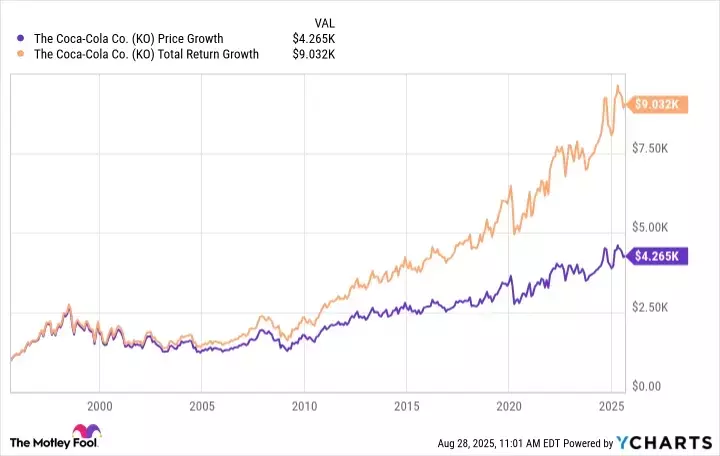
An initial capital of $1,000 invested in Coca-Cola three decades ago would have swelled to approximately $9,030 today. However, a significant portion of this increase, around $4,760, stems from accumulated dividend payments, showcasing Coca-Cola's impressive record of 63 consecutive years of dividend increases, earning it the prestigious 'Dividend King' title. In contrast, the stock's value itself contributed about $4,270 to this growth.
A Comparative Analysis: Coca-Cola vs. the S&P 500
Interestingly, over the same 30-year span, a $1,000 investment in the S&P 500 index would have yielded roughly $20,000, more than double Coca-Cola's total return. It is important to note that Berkshire Hathaway's acquisition of Coca-Cola shares predates this specific period, suggesting Buffett's returns likely surpassed the S&P 500. Furthermore, Buffett's decision not to reinvest dividends back into Coca-Cola since at least 1994, coupled with the stock's current price-to-earnings ratio of 24, implies that Berkshire may not perceive it as an undervalued asset at present.
The Allure of Dividends: Why Coca-Cola Appeals to Income Investors
Nevertheless, Coca-Cola remains a compelling option for income-seeking investors. Its strong history of dividend hikes and a current dividend yield of 2.9%, significantly higher than the S&P 500's average of 1.2%, make it particularly appealing. However, for investors prioritizing overall capital appreciation rather than solely dividend income, Coca-Cola's underperformance relative to the S&P 500 over the past three decades suggests it might not be the ideal choice for deploying new capital.
