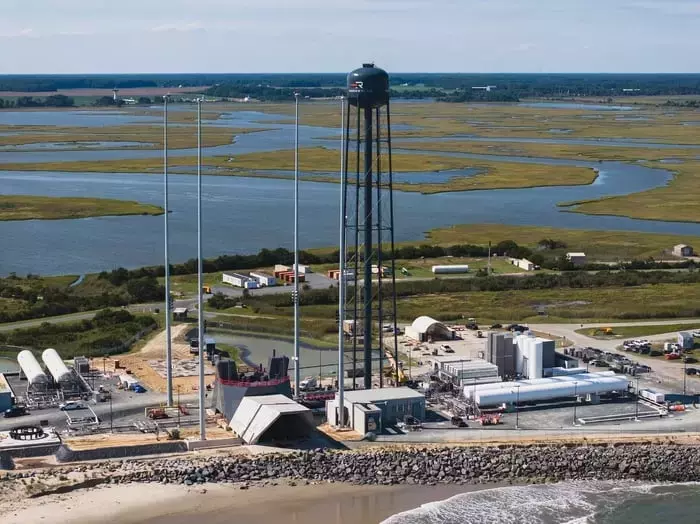
Rocket Lab is making substantial strides in the aerospace sector, marked by the recent inauguration of its third launch complex, LC-3, in Virginia. This new facility is critical for the development and deployment of its next-generation Neutron rocket, signaling a bold expansion of the company's capabilities and aspirations in space exploration and commercial services.
Propelling Humanity Forward: Rocket Lab's Vision for the Cosmos
A New Era Dawns: The Launch of LC-3 in Virginia
Last week, Rocket Lab officially unveiled its new launch complex, LC-3, situated on Wallops Island, Virginia, at the Mid-Atlantic Regional Spaceport. This event, attended by state officials and company executives, signaled a pivotal moment for the company, laying the groundwork for its more powerful rocket, Neutron, and its future missions.
Neutron: A Game Changer in Space Launch Capabilities
The newly established LC-3 is set to become the primary launch site for Rocket Lab's colossal Neutron rocket. Standing at 141 feet, Neutron will possess an impressive lift capacity of 13 metric tons to low Earth orbit, making it 43 times more potent than its predecessor, the Electron. This significant upgrade is expected to dramatically enhance Rocket Lab's ability to undertake more demanding missions, with Neutron's maiden flight anticipated later this year.
From Earth's Orbit to the Red Planet: Expanding Horizons
One of Neutron's most exciting prospects is its potential to facilitate missions to Mars. Rocket Lab already has two satellites prepared for the ESCAPADE science mission, destined for Mars. Historically, the absence of a sufficiently powerful rocket has hindered these deep-space endeavors. Neutron's increased capacity aims to rectify this, enabling Rocket Lab to independently execute complex interplanetary missions, reducing reliance on other space agencies or private companies.
Challenging the Giants: Rocket Lab's Competitive Strategy
Beyond planetary exploration, Neutron is designed to position Rocket Lab as a formidable competitor in the satellite constellation deployment and cargo resupply markets. With its enhanced payload capabilities, Neutron could vie with industry leaders such as SpaceX and Northrop Grumman for contracts, including those for resupplying the International Space Station. This strategic move could open up lucrative opportunities for Rocket Lab in vital commercial and governmental space operations.
Venturing into Human Spaceflight: The Ultimate Frontier
Perhaps the most significant revelation from the LC-3 opening was Rocket Lab's subtle yet clear indication of its ambition to engage in human spaceflight. While details remain scarce, the company hinted at eventually using Neutron to transport astronauts into space. This ambitious goal suggests a future where Rocket Lab could provide a third option for crewed missions, potentially joining the ranks of SpaceX's Crew Dragon and Boeing's Starliner, and fundamentally reshaping the landscape of space tourism and crewed exploration to destinations like the Moon or Mars.
