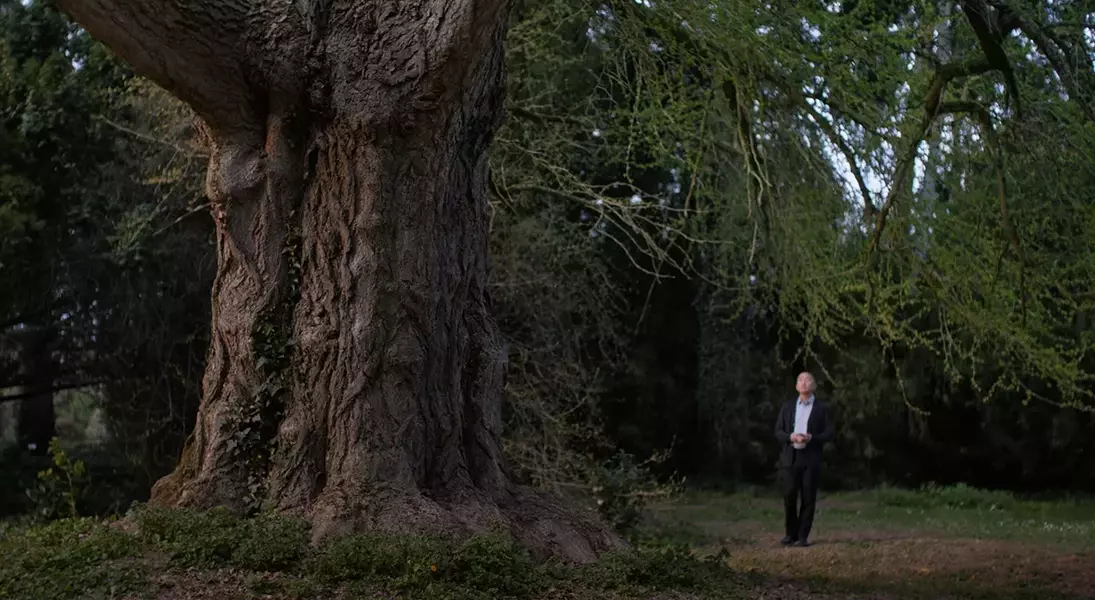
Ildikó Enyedi's latest cinematic offering, 'Silent Friend,' embarks on an enigmatic and deeply immersive exploration of the subtle yet profound connections between humans and the botanical world. Unlike many contemporary dramas, this film cultivates a sense of hope and a unique perspective on our future, suggesting that a deeper understanding of nature's subtle cues could guide us forward. It's a journey that challenges conventional storytelling, inviting audiences to surrender to its unfolding narrative and absorb its rich thematic layers.
Unveiling Nature's Whispers: A Multi-Generational Scientific Quest
At the prestigious Venice Film Festival, amidst a selection of more somber and challenging narratives, 'Silent Friend' emerged as a beacon of positive introspection. Set within the venerable halls of a German university, the film gracefully weaves together three distinct timelines across two centuries, all centered on groundbreaking botanical research. Each period features a dedicated scientist striving to unravel the mysteries of nature's communicative abilities.
The contemporary thread, commencing during the challenging global events of 2020, introduces us to Tony, a distinguished neuroscientist from Hong Kong, portrayed with captivating depth by the legendary Tony Leung Chiu-wai. Confined to an eerily quiet campus during the lockdown, Tony redirects his research from infant brainwaves to the subtle electrical impulses of a magnificent, ancient ginkgo tree residing just outside his laboratory window. This venerable tree, planted in 1832, serves as a profound biological and possibly metaphysical link to two of his predecessors at the same institution.
Moving back in time, we encounter Grete, brought to life by the luminous Luna Wedler. Grete, a brilliant and determined student, breaks barriers as the first woman to join the university's traditionally male-dominated science department in the late 19th century. Her story illuminates the historical challenges faced by pioneering women in academia. Parallel to this, in the vibrant 1970s, we meet Hannes, played by Enzo Brumm, a student whose academic pursuits often take a backseat to his more personal scientific endeavors. He assists his housemate, Gundula (Marlene Burow), in her meticulous experiments on a geranium perched on her windowsill, highlighting a more intimate and domestic form of scientific curiosity.
Enyedi masterfully navigates between these interwoven narratives, sometimes lingering on one for an extended period, then seamlessly transitioning to another for a fleeting moment, only to shift again. This non-linear approach, while initially disorienting for those seeking a straightforward plot, ultimately enhances the film's immersive quality. It encourages viewers to embrace the journey of discovery rather than anticipate a singular destination, much like the winding paths of scientific inquiry itself. The film's exquisite cinematography, oscillating between crisp high-definition, nostalgic 16mm color, and pristine 35mm black-and-white, combined with a meticulously layered sound design, creates an aesthetically rich and subtly crafted experience. These artistic choices underscore the film's central theme: the interconnectedness of seemingly disparate elements—human voices and silent plants, historical advancements and modern dilemmas, and even the unexpected online collaboration between Tony Leung and Léa Seydoux during a global health crisis.
Beyond its intellectual depth, 'Silent Friend' is imbued with a delightful, understated humor. A particularly memorable scene sees Seydoux's botanist playfully offer to send "sperm" to Tony for his ginkgo tree project, a moment that subtly hints at the film's exploration of communication and connection across species, even in the most solitary of worlds. This film champions the idea that true understanding often lies in listening more intently, particularly to an environment that communicates in ways beyond conventional language. It subtly asserts that while humanity may experience profound moments of isolation, the channels of communication remain perpetually open for those willing to perceive them. It’s a compelling argument that stars aren't just found on red carpets, but often in the deepest, most unexpected corners of our shared natural world.
