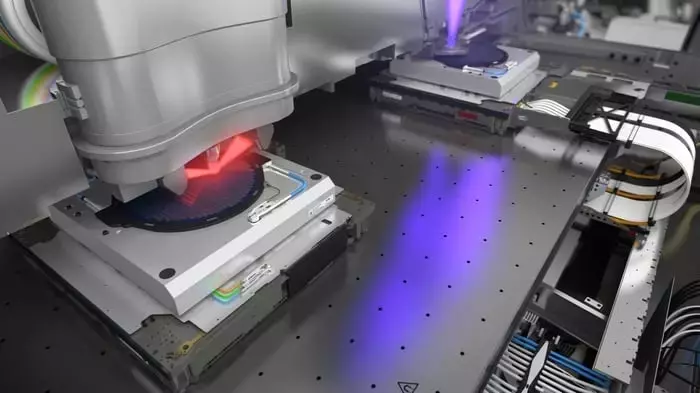
ASML, a critical innovator in the semiconductor industry, has demonstrated remarkable resilience and growth, particularly with its latest financial results. The company's cutting-edge extreme ultraviolet (EUV) lithography technology is not only reshaping the landscape of chip manufacturing but also solidifying ASML's position as a long-term investment opportunity, despite potential headwinds in certain markets.
ASML's Strong Q3 2025 Performance and Future Trajectory
In the third quarter of 2025, ASML, a dominant force in semiconductor equipment, announced impressive net sales totaling 7.5 billion euros. Looking ahead, the company forecasts fourth-quarter sales to range between 9.2 billion and 9.8 billion euros, aligning its annual revenue guidance with earlier projections. This performance is particularly noteworthy given its recovery from an earlier market dip, with shares surging by 45.7% year-to-date, significantly outpacing the S&P 500's 13.4% rise. ASML's gross margin for the full year is expected to slightly exceed 52%, reinforcing its commitment to profitability. Moreover, the company has reiterated its ambitious 2030 targets, aiming for revenues between 44 billion and 60 billion euros and gross margins of 56% to 60%.
A key driver behind ASML's expanding margins and pivotal role in the industry is its advanced EUV technology. The third quarter saw the sale of nine EUV machines, including one high-numerical aperture (high-NA) system. These sophisticated machines, each valued at approximately 400 million euros, constituted a substantial portion of ASML's quarterly sales. EUV lithography is indispensable for producing the most advanced artificial intelligence (AI) chips, particularly those with node sizes below 3 nanometers. By utilizing shorter wavelengths of light, EUV technology enables the creation of more transistors per chip, leading to enhanced computing power and efficiency—a crucial factor for leading chip designers like Nvidia, Broadcom, and Advanced Micro Devices.
While ASML's long-term prospects remain bright, the company anticipates a potential deceleration in near-term growth due to macroeconomic uncertainties and trade restrictions, especially concerning sales to China. Chinese customers accounted for a significant 42% of system sales volume in the recent quarter, and ASML projects a notable decrease in demand from this region in 2026. This forecast, primarily influenced by the Netherlands' alignment with U.S. trade policies, poses a challenge but does not deter ASML's overall positive outlook.
Considering its critical role in the semiconductor value chain, its reasonable valuation, dividend payments, and vast growth potential over the coming decades, ASML continues to represent a compelling investment. For investors seeking exposure to the escalating demand for AI chip manufacturing, ASML offers a robust and comprehensive pathway.
ASML's journey underscores the intricate balance between technological innovation, market dynamics, and geopolitical influences. The company's ability to consistently deliver on its financial commitments while pioneering advancements in chip manufacturing highlights its strategic importance. As the world continues its rapid embrace of AI, the demand for ASML's highly specialized equipment will only intensify, solidifying its status as an indispensable leader in the global technology arena. This trajectory suggests a future where ASML not only benefits from but actively shapes the evolution of digital intelligence.
