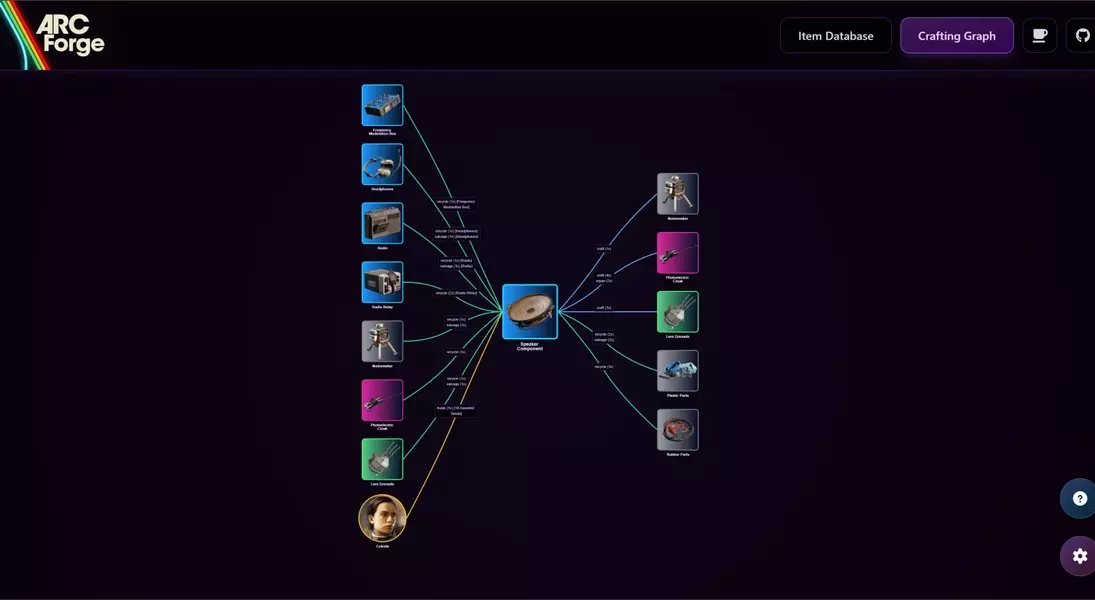

In the expansive world of Arc Raiders, the sheer volume of in-game items presents a significant challenge for players. While weapons, shields, and other primary gear are straightforward, the utility of numerous crafting components, quest items, and trinkets often remains obscure. Navigating this intricate item landscape necessitates a comprehensive understanding of each item's role in upgrades and the recycling process. Fortunately, a community-driven database, known as 'Arc Forge,' has emerged as a vital resource, revolutionizing how players interact with the game's economy. This innovative platform, often utilized on a secondary monitor, acts as an essential companion, akin to interactive maps such as Meta Forge's, by demystifying the complex web of item functionalities and resource management.
The 'Arc Forge' tool stands out due to its unique 'crafting glyph' chart, which vividly illustrates the relationships between crafting, recycling, salvaging, and repair values for all items. This feature allows players to trace an item's lineage, delving deeper into its constituent parts or potential uses until no further connections are found. Furthermore, the database offers practical solutions to common in-game dilemmas, such as locating elusive components or identifying the most lucrative items for sale. By integrating Arc Forge into their gameplay, players can optimize their inventory, make informed decisions about resource allocation, and ultimately enhance their overall gaming experience, transforming what was once a confusing chore into a streamlined and strategic advantage.
Streamlining In-Game Resource Management with Arc Forge
Effectively managing the diverse array of items in Arc Raiders can be a complex endeavor for players. Beyond the obvious utility of firearms and protective gear, a myriad of crafting ingredients, mission-critical artifacts, and collectible trinkets often leave players puzzled about their true purpose. The 'Arc Forge' database, a testament to community ingenuity, serves as an invaluable digital companion, clarifying the roles and interdependencies within the game's intricate item system. This tool provides detailed insights into which items are essential for specific enhancements and how the recycling hierarchy operates, significantly simplifying resource allocation.
The most compelling aspect of Arc Forge lies in its visually intuitive 'crafting glyph' chart. This feature comprehensively details the crafting prerequisites, recycling yields, salvage potential, and repair values for every item. Players can seamlessly navigate through interconnected item chains, uncovering the origins and destinations of various components, thereby eliminating guesswork. For instance, if a player is searching for 'Speaker Components,' the database immediately reveals that items like 'Headphones,' 'Frequency Modulation Boxes,' and 'Radio Relays' can all be broken down to yield these crucial parts. This level of detail empowers players to make strategic decisions about what to keep, what to craft, and what to discard, directly impacting their progress and efficiency in the game.
Optimizing Gameplay and Economic Decisions through Item Knowledge
The ability to efficiently manage resources and understand their economic value is a cornerstone of success in Arc Raiders, especially when aiming for high-tier equipment. Crafting legendary weapons, such as the Hullcracker or Aphelion, often requires large quantities of specialized components like 'Magnetic Accelerators.' Arc Forge provides a clear pathway to acquiring these, detailing not only which items can be crafted with them but also which components (like Magnetrons) can be recycled to produce them in bulk. This eliminates the tedious trial-and-error process, allowing players to focus on strategic acquisition and synthesis.
Moreover, Arc Forge addresses common player frustrations, such as accumulating seemingly useless items. For example, many players find themselves with an abundance of 'Rope,' a rare blue item whose purpose remains unclear without external guidance. The database quickly reveals that Rope is primarily used for crafting 'Ziplines' and 'Snap Hooks,' allowing players to adjust their collection priorities accordingly. Beyond crafting, the platform offers a powerful search function that enables players to cross-reference items in real-time, preventing the accidental disposal of valuable resources during intense gameplay sessions. The database also supports economic optimization by allowing players to filter items by their sell value, often debunking the misconception that higher rarity always equates to greater monetary worth, thereby guiding players toward more profitable selling strategies.
