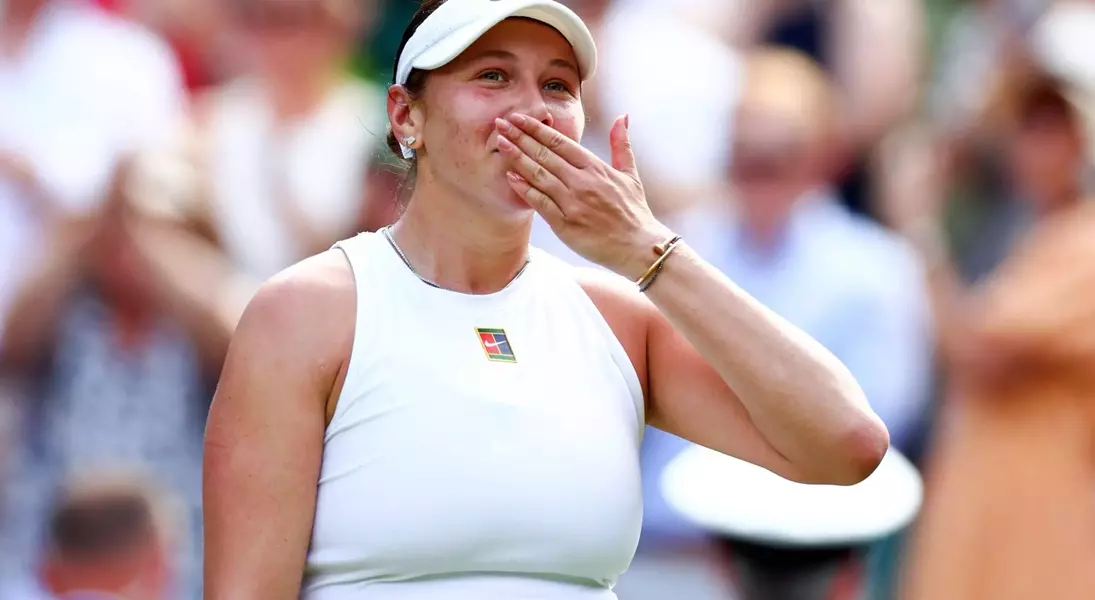
This article delves into Amanda Anisimova's candid post-match reflections following her Wimbledon final defeat, exploring the multifaceted factors that contributed to her performance. It provides a deeper understanding of the demands of elite tennis, not just physically but also mentally, and her aspirations for growth inspired by her peers.
Lessons from the Court: Anisimova's Path to Resilience
Reflecting on a Challenging Final: A Comprehensive Breakdown of Performance
Amanda Anisimova openly discussed the elements that led to her significant loss against Iga Swiatek in the Wimbledon final. This match saw Anisimova become only the second player in the Open Era to not secure a single game in a Grand Slam final, a rare occurrence previously seen in the 1988 Roland Garros final where Steffi Graf dominated Natalia Zvereva with an identical scoreline.
The Grueling Road to the Final: Physical Tolls and Triumphs
Anisimova’s journey to the final was marked by a series of high-intensity matches, including a career-best victory over World No. 1 Aryna Sabalenka in the semifinals. Her path included six consecutive wins, with three of her last four matches extending to a decisive third set, resulting in over ten hours of court time leading up to the final. This extensive play, particularly a semifinal lasting nearly two hours and forty minutes, inevitably led to considerable physical strain.
Navigating Nerves and Exhaustion: Anisimova's Post-Match Honesty
During her post-match press conference, Anisimova addressed inquiries regarding whether her performance was more influenced by physical exhaustion or the pressure of the grand stage. She admitted to feeling nervous but clarified that it was not an overwhelming sensation; rather, she was initially eager to compete. However, she pinpointed severe fatigue as a major contributing factor, noting its presence even during her morning warm-up, which prevented her from practicing the day before the final.
Insights from Elite Peers: Learning from Sinner and Alcaraz
Anisimova highlighted tennis stars Carlos Alcaraz and Jannik Sinner, who were set to contend for the men's Wimbledon title, as benchmarks for her own game. She admires their ability to perform with minimal errors, stating, “When I look at certain players like Jannik or Carlos, who I look up to a lot, they don’t make easy mistakes and don’t give almost anything to their opponents.” This observation underscores her desire to refine her precision and consistency. She acknowledged her own approach to accepting mistakes, realizing that while it fosters a fighting spirit, it may not always be the optimal strategy for victory.
Beyond Perfection: The Unseen Force of Fighting Spirit
Despite the challenging final, Anisimova recognized that her fighting spirit and mental fortitude were crucial to reaching the championship match. She confessed that she hadn't always played her best tennis throughout the tournament, but her ability to maintain focus, battle through tough moments, and remain positive, rather than dwelling on negativity, was what ultimately propelled her forward. This inner strength, she believes, was key to her unexpected success in reaching her first Grand Slam final.
