
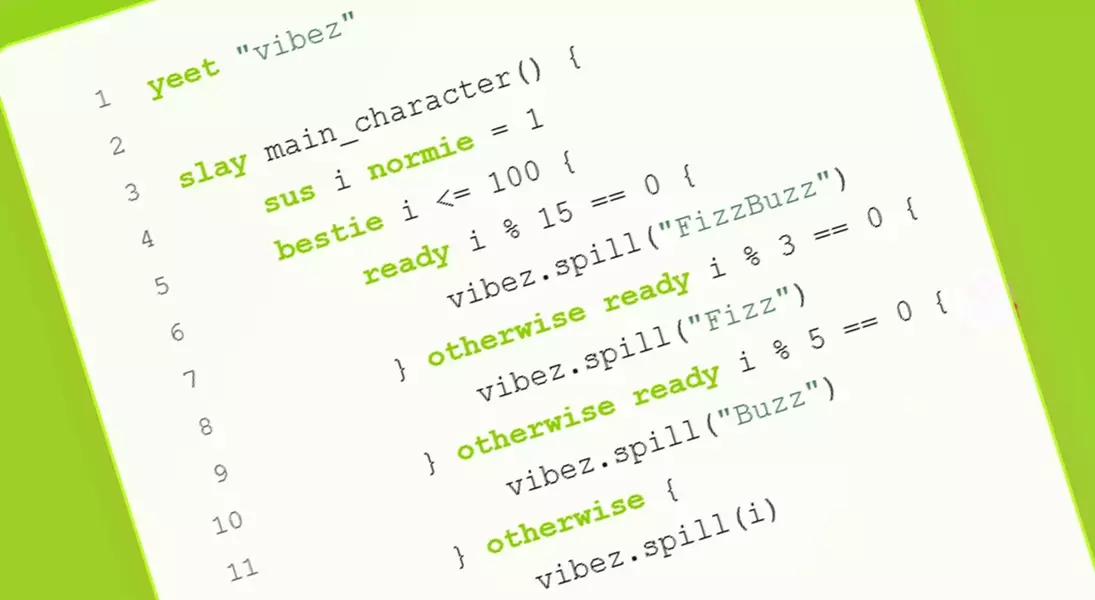
A recent development in artificial intelligence has led to the creation of a unique programming language that incorporates Generation Z slang. This intriguing project, developed by Anthropic's AI, Claude, under the guidance of Geoffrey Huntley, has sparked conversations about the evolving intersection of technology, culture, and language. The initiative, named 'cursed,' aims to blend the informal, dynamic lexicon of contemporary youth with the precise structure of programming, offering a fresh perspective on how AI can generate creative and unconventional solutions in the tech world.
Furthermore, this project highlights a new methodology in AI development, exemplified by Huntley's 'Ralph Wiggum loop.' This iterative process allows AI to continuously refine its output by feeding errors and results back into itself, mimicking a trial-and-error learning approach. This method not only facilitated the creation of the 'cursed' language but also demonstrated the potential for AI to autonomously develop complex systems with minimal human intervention. The implications of such powerful AI tools extend beyond linguistic experimentation, potentially revolutionizing how software is developed and how businesses approach outsourcing and project creation.
The Birth of 'Cursed': AI Meets Gen Z Vernacular
The programming language 'cursed,' a brainchild of Geoffrey Huntley and Anthropic's AI, Claude, represents a fascinating experiment in linguistic and technological convergence. Huntley, utilizing a continuous feedback mechanism he dubbed the 'Ralph Wiggum loop,' tasked Claude with transforming a Golang-like structure into a system where keywords were replaced with Gen Z slang. This innovative approach allowed the AI to autonomously generate a functional programming language using terms such as 'sus' for variables, 'slay' for functions, and 'bestie' for loops. The project, which took several months to materialize, challenges traditional notions of programming syntax by infusing it with modern, informal language, reflecting a playful yet significant exploration of AI's capabilities in creative text generation and code development.
This endeavor goes beyond mere novelty; it serves as a testament to the advanced generative power of AI. By instructing Claude to create a language that maintains near-C performance while embracing a distinct cultural lexicon, Huntley pushed the boundaries of what AI can achieve in software engineering. The 'cursed' language, born from a singular prompt, showcases how AI can not only understand and process complex instructions but also interpret and integrate nuanced cultural elements into functional code. This development has initiated discussions within the tech community about the potential for AI to democratize programming by making it more accessible and relatable to diverse demographics, as well as raising questions about the efficiency and long-term viability of such unconventional coding paradigms.
The 'Ralph Wiggum Loop': A New Frontier in AI Development
Geoffrey Huntley's innovative 'Ralph Wiggum loop' signifies a significant advancement in agentic coding, transforming the way AI interacts with and refines its own outputs. This method involves feeding an AI's results, including any encountered errors, back into its system repeatedly until a desired outcome or a near-perfect solution is achieved. In the context of the 'cursed' programming language, this iterative process enabled Claude to systematically refine the language's structure and functionality, moving from initial conceptualization to a robust, albeit unconventional, coding system. This continuous feedback mechanism simulates a learning cycle, allowing the AI to adapt and improve its performance without constant human oversight, highlighting a future where AI systems can independently iterate on complex tasks.
The effectiveness of the 'Ralph Wiggum loop' extends beyond experimental language creation, demonstrating profound implications for software development and economic efficiency. Huntley has observed that this agentic coding approach can significantly reduce the costs and time associated with various greenfield projects, such as cloning open-source software. By leveraging the loop, AI can handle tasks that traditionally require extensive human labor, performing them at a fraction of the cost. This newfound efficiency raises critical questions about the future of human roles in software development and the ethical considerations surrounding AI's growing autonomy and its potential impact on established industries. The 'Ralph Wiggum loop' not only showcases AI's capacity for self-improvement but also underscores its potential to disrupt conventional business models and accelerate technological innovation.
