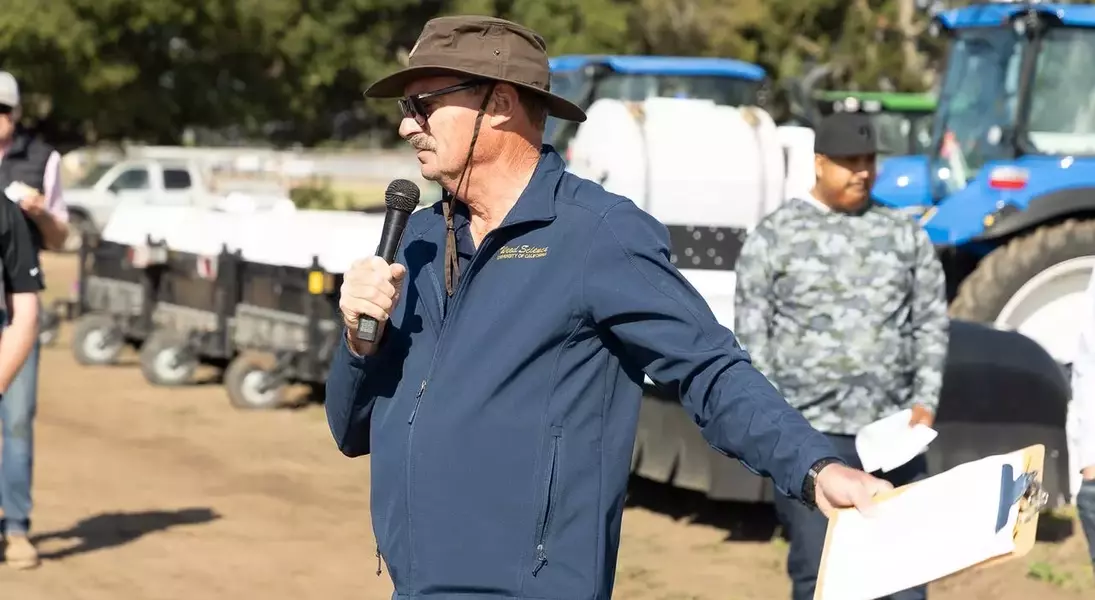
Renowned weed scientist Steve Fennimore, after a distinguished career spanning nearly three decades at the University of California, Davis, is venturing into a new phase that marries agricultural expertise with engineering ingenuity. His pioneering efforts, particularly in developing chemical-free soil preparation techniques for specialty crops, mark a significant step towards sustainable farming. This transition highlights a growing need for interdisciplinary approaches to tackle modern agricultural challenges.
Pioneering Sustainable Agriculture Through Ingenious Solutions
In the vibrant agricultural heartland of Salinas, California, a transformative journey is underway, led by the recently retired University of California, Davis weed scientist, Steve Fennimore. Having dedicated 28 impactful years to the Department of Plant Sciences, Fennimore is now channeling his profound knowledge into a groundbreaking endeavor: the seamless integration of agricultural practices with advanced engineering solutions. This visionary path is focused on developing chemical-free methods for soil preparation, particularly for delicate crops like strawberries.
Fennimore's extensive contributions to the field have been widely lauded, notably by the California Leafy Greens Research Board. Jennifer Clarke, the board's research program director, recently acknowledged his unwavering commitment to addressing weed challenges and pioneering non-chemical alternatives. Among his notable achievements is the development of a soil-steaming machine, an innovative device designed to eradicate weed seeds and harmful fungi without the need for traditional chemicals. This invention is recognized not only as a promising solution for weed management but also as a potent tool against soil-borne diseases.
Reflecting on his career, Fennimore noted the dramatic shifts in agricultural practices. Growing up on a family farm in Oregon's picturesque Willamette Valley, where farming techniques were far more rudimentary, he witnessed firsthand the arduous task of manual weeding, especially for crops like strawberries. This early exposure ignited a lifelong passion for finding more efficient and sustainable solutions. His academic journey led him to secure a master's degree from UC Davis in 1983, followed by a doctorate from Purdue University, before he returned to Davis in 1997.
A significant shift in the agricultural landscape has been the rise of mechanization. Fennimore observed that while herbicides remain effective, they only control about half of the weeds in crops such as lettuce. The burgeoning trend of automated weed control, which he helped initiate following a visit to Germany in 2007 to observe an “intelligent cultivator,” has revolutionized the industry. This evolution has led to the development of sophisticated tools like laser weeders, capable of precisely eliminating weeds with minimal intervention, dramatically reducing labor costs that can escalate to $5,000 per acre or more for organic strawberries.
Fennimore also takes immense pride in his work during the 1990s to establish a safe herbicide program for strawberries. Faced with growing environmental concerns over methyl bromide, a highly effective but ozone-depleting fumigant, he collaborated with herbicide manufacturers. This led to the development and registration of alternative products like GoalTender, Chateau, and Prowl H2O. He emphasized that effective pest management relies on a multifaceted approach, rather than a single treatment, to prevent the development of pest resistance. His team's meticulous research from 2001 to 2004 validated this system, which was then disseminated to growers through comprehensive extension courses offered in both English and Spanish across major strawberry-growing regions. This initiative proved timely, as California banned methyl bromide for most agricultural applications in 2005.
Currently, Fennimore's passion project involves scaling up his steam technology for soil treatment. Dating back to the 1880s, steam application is a proven method for eliminating soil pests. With private funding secured in 2023, he began developing a machine for vegetables and is now designing a version specifically for strawberries. He sees engineering as a dynamic, hands-on field that presents daily challenges and requires constant decision-making. His ultimate goal is to widely implement this technology, effectively transitioning from academic extension to direct, practical application.
Looking ahead, Fennimore identifies key challenges facing the agricultural sector: escalating labor and operational costs, water quality concerns, and complex regulations. While investing in automated technology can be substantial, often exceeding a million dollars, the long-term return on investment is undeniable for many operations. For newcomers to the field, Fennimore offers a compelling piece of advice: embrace risk and do not fear failure. He emphasizes that innovation often springs from uncharted territory, encouraging individuals to pursue ambitious projects even if they lack specialized engineering backgrounds. He himself, a weed scientist, is actively engaged in engineering, driven by clear goals and an understanding of machinery's potential. He also challenges academic and governmental leaders to significantly increase funding for non-pesticide, engineering-based solutions in agriculture, highlighting the critical need for interdisciplinary collaboration between weed scientists and engineers to foster a new generation of agricultural advancements.
Cultivating Tomorrow: The Imperative of Interdisciplinary Collaboration in Agriculture
Steve Fennimore's journey from a seasoned weed scientist to an agricultural engineering pioneer offers a profound lesson for the future of farming. His unwavering commitment to sustainable practices, particularly his advocacy for chemical-free soil preparation and automated technologies, underscores a vital paradigm shift. It’s clear that the complex challenges facing agriculture today—from labor shortages and rising costs to environmental concerns—cannot be solved through traditional, siloed approaches. Instead, they demand an interdisciplinary synthesis, a collaborative convergence of diverse expertise.
Fennimore’s transition from research to practical engineering, fueled by a passion to scale up his steam technology, serves as an inspiring blueprint. It demonstrates that innovation often emerges at the intersection of fields, pushing boundaries and redefining what's possible. His call for increased federal and university investment in agricultural engineering solutions is not merely an academic plea; it's a strategic imperative. By fostering environments where weed scientists can collaborate with engineers, and where researchers are empowered to take calculated risks, we can unlock transformative solutions that benefit both farmers and the planet. Ultimately, the future of agriculture hinges on our collective willingness to invest in bold, integrated approaches that cultivate both crops and cutting-edge ideas.
