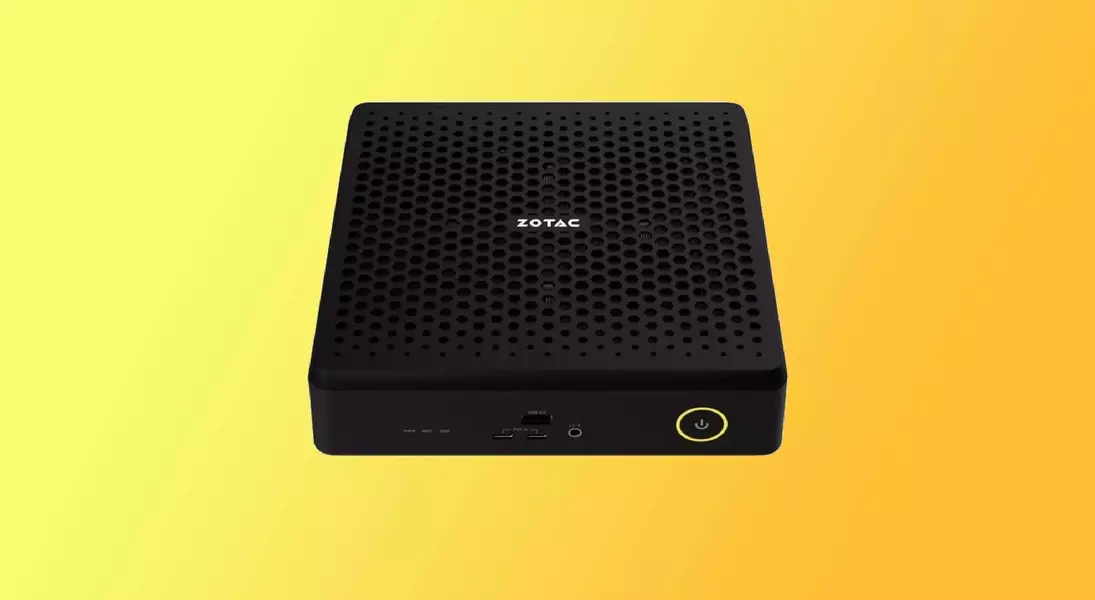
Zotac's latest Magnus EN mini workstation showcases an ingenious approach to integrating a powerful graphics processing unit within a compact chassis. This system manages to house an RTX 5060 Ti, a discrete desktop GPU, without requiring a separate power connector, a feat achieved through a clever modification of the standard PCIe interface.
Miniature PC designs consistently push the boundaries of hardware integration, and Zotac's Magnus EN workstation stands out with its innovative solution for powering the RTX 5060 Ti. Rather than employing an external power cable or a secondary set of power pins as seen in some alternative designs, Zotac reconfigures the standard PCIe x16 connector. This design choice was highlighted following a detailed examination of the device, which revealed the absence of conventional GPU power inputs.
The GPU-Z utility provides insights into this novel configuration, displaying the bus interface as 'PCIe x8 5.0 @ x8 5.0'. This indicates that the usual x16 PCIe lanes are effectively divided into two groups of x8. A closer look at the graphics card itself confirms this split, with one half dedicated to data communication and the other specially adapted to receive a 19-volt power input. This electrical division allows the card to draw sufficient power directly through the PCIe slot, circumventing the need for an additional power cable.
This method differs significantly from technologies like Asus' BTF (Back-to-the-Future) cards, which typically utilize supplementary pins alongside the main PCIe connector for power delivery. Zotac's strategy, by contrast, ingeniously repurposes portions of the existing PCIe connector. The RTX 5060 Ti, with its relatively modest 180W TDP, is well-suited for this approach. The 19V input, while high, ensures that the current flowing through each pin remains manageable, thus mitigating concerns about connector overheating and enabling Zotac to maintain a compact form factor for the workstation.
While undeniably inventive and space-saving, this bespoke engineering solution likely contributes to the device's overall complexity and cost. Industry observers note that a custom-designed PCB might have achieved similar integration with less complexity. Priced around $2,000 at its initial launch in China, and configurable with up to 96GB of DDR5-6400 RAM amidst current memory supply challenges, the Magnus EN reflects the premium nature often associated with specialized mini workstation builds.
This innovative design by Zotac underscores the continuous evolution in mini PC engineering, where manufacturers are constantly seeking novel ways to integrate high-performance components into ever smaller enclosures. The Magnus EN workstation serves as a testament to the creative problem-solving employed to achieve both power and compactness in modern computing hardware.
