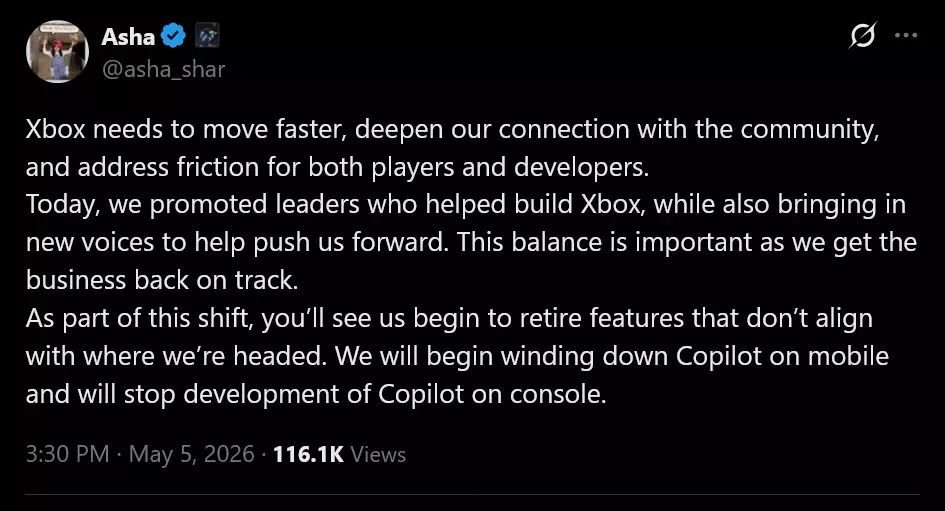


Microsoft's Xbox division is undergoing a significant strategic and leadership transformation. CEO Asha Sharma, who previously led Microsoft's CoreAI Product division, has appointed several former AI colleagues to pivotal positions within Xbox. This organizational restructuring aims to streamline operations and enhance product development. Concurrently, Xbox is recalibrating its approach to artificial intelligence, with plans to cease the development of Copilot AI on both mobile and console platforms. This dual strategy reflects a drive to improve business performance, foster stronger community connections, and eliminate inefficiencies in development, signaling a clear departure from past directions under previous leadership.
New Leadership Brings AI Expertise to Xbox Core Operations
Xbox has seen a substantial overhaul in its executive team, with new CEO Asha Sharma, who transitioned from leading Microsoft's CoreAI Product division, bringing in several key personnel from her former team. This strategic move aims to infuse the Xbox division with AI-centric leadership and methodologies. Jared Palmer, previously Vice President of CoreAI, now serves as Xbox's Vice President of Engineering and technical advisor to Sharma, focusing on advanced developer tools and infrastructure. Tim Allen, former Senior Vice President of CoreAI Design, now heads Xbox's design efforts, integrating product design, engineering, research, and creative initiatives with a strong emphasis on user experience. Additionally, Jonathan McKay, former CoreAI Head of Growth, assumes a similar role within Xbox, while Evan Chaki, former CoreAI General Manager, leads a new forward-deployed engineering group dedicated to automating routine tasks and improving operational efficiency.
These appointments signify a deliberate effort by Sharma to leverage her AI background to address long-standing challenges within Xbox. The integration of these leaders from a dedicated AI division suggests a foundational shift towards data-driven decision-making and advanced technological solutions in gaming. Sharma emphasized the need for Xbox to "evolve how we work and how we are organized across our platform," pointing to difficulties in delivering rapid impact and excessive internal focus. The goal is to move faster, engage more deeply with the gaming community, and resolve friction points for both players and developers. This new leadership is tasked with not only refining existing processes but also spearheading innovative approaches to game development and player engagement, utilizing their extensive experience in artificial intelligence to drive growth and efficiency.
Strategic Pivot: Halting Copilot AI Development for Focused Growth
Despite the influx of AI talent into Xbox's leadership, CEO Asha Sharma has announced a significant shift in the division's AI product strategy: the discontinuation of Copilot AI development for both mobile and console platforms. This decision, conveyed through an internal memo and confirmed on social media, indicates a re-evaluation of how AI technologies are integrated into the Xbox ecosystem. Sharma explained that this move is part of a broader initiative to "retire features that don’t align with where we’re headed," suggesting a strategic pivot towards more impactful and community-focused endeavors. This paradox—bringing in AI experts while scaling back a visible AI product—highlights a nuanced approach to technology integration, prioritizing core business improvements and player satisfaction over blanket AI deployment.
This strategic re-alignment underscores a commitment to accelerating Xbox's growth and strengthening its connection with the community. Sharma has acknowledged past shortcomings, stating that "player and revenue growth has not yet met our ambition," and this recent overhaul, including changes to Game Pass pricing and the abandonment of the "This is an Xbox" marketing campaign, reflects a clear intent to course-correct. The move away from Copilot AI on platforms like mobile and console, while bringing in leadership with deep AI expertise, suggests that the new strategy involves leveraging AI for foundational improvements in development and operations, rather than as a direct user-facing feature in its current form. This targeted application of AI is aimed at removing repetitive work, simplifying development processes, and ultimately enhancing the overall experience for developers and players, signaling a renewed focus on core gaming experiences and community engagement.
