World of Warcraft: Midnight's innovative player housing system, initially praised for its extensive creative possibilities, has become a point of contention due to the introduction of a new premium currency, Hearthsteel. While the core housing mechanics offer remarkable freedom for players to design and customize their spaces, the monetization strategy surrounding decorative items has drawn significant criticism from the community. Players are finding themselves in a familiar, yet frustrating, microtransaction loop that Blizzard had previously pledged to avoid.
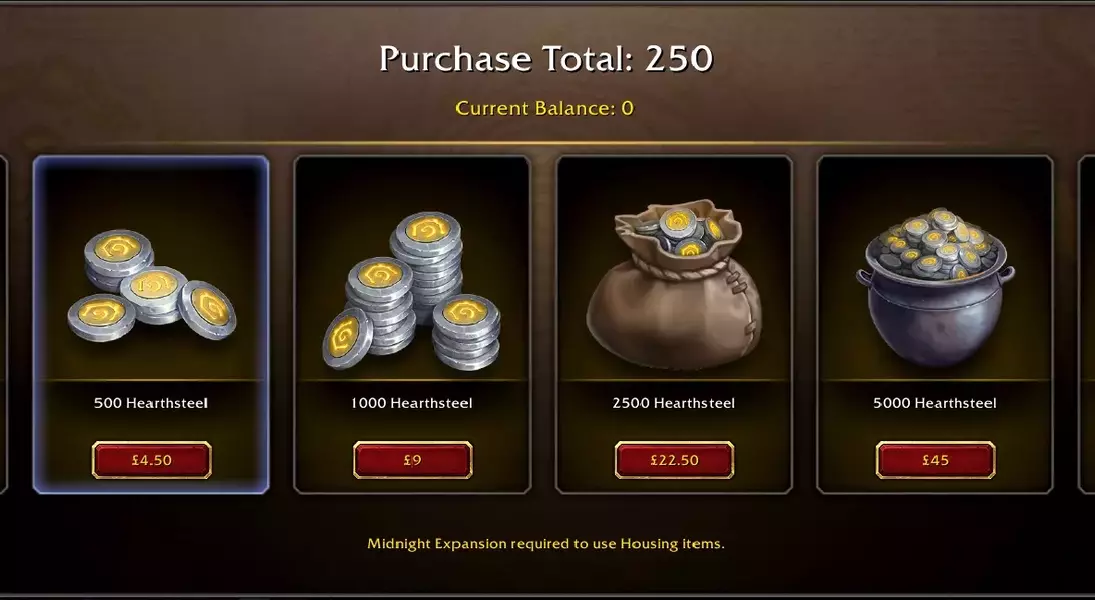
The issue primarily stems from how Hearthsteel is packaged and sold. Instead of offering exact amounts of the currency needed for specific items, Blizzard sells Hearthsteel in fixed, uneven increments. This often results in players having leftover currency after a purchase, effectively compelling them to spend more real money than intended to acquire desired decorations. For example, if an item costs 200 Hearthsteel, and the closest purchase options are 100 or 500, players are forced to buy the larger pack, leaving them with unused currency. This tactic is widely perceived as a deliberate ploy to encourage additional spending, directly contradicting a previous statement from Blizzard in November of last year, where they assured players that Hearthsteel purchases would align with item costs to minimize unused currency.
Furthermore, the pricing structure for individual decorative items within the housing system has fueled player dissatisfaction. Items such as Alliance/Horde doormats, Spring Blossom Chairs, and Spring Blossom Trees are priced at amounts that intentionally create these leftover currency scenarios. For instance, a Spring Blossom Gazebo costs 800 Hearthsteel, meaning players purchasing the 1,000 Hearthsteel pack will have 200 left over, not enough for another significant purchase, but too much to discard. While a few items, like plushies, manage to align with available currency packs, the majority of standalone decorations appear designed to maximize residual currency. Despite some price adjustments made by Blizzard in response to early player feedback, such as reducing the cost of a single blossom tree from 750 to 250 Hearthsteel, the fundamental problem of forced overspending persists.
Beyond the currency mechanics, the nature of the premium items themselves adds another layer of concern. Purchasing a decorative item with Hearthsteel provides only one copy, rather than unlocking it for repeated use or vendor acquisition. This means that to decorate a larger space with multiple instances of an item, players must make multiple premium purchases. Considering that World of Warcraft is a subscription-based game, this additional monetization for single-use cosmetic items is seen by many as excessive. Even for players who utilize in-game gold to purchase WoW Tokens, which can be converted into battle.net balance for Hearthsteel, the cost remains substantial, requiring immense amounts of in-game effort to acquire even a few decorative pieces. This approach raises questions about the overall value proposition for players, who are already invested financially in the game.
Ultimately, while World of Warcraft: Midnight's player housing system offers an exciting new dimension of creative expression, its current monetization model for the Hearthsteel premium currency is undermining the player experience. The discrepancy between Blizzard's stated principles and its actual implementation of staggered currency packs, combined with the pricing of single-use decorative elements, has left many players feeling frustrated and exploited. For a game with an existing subscription model, this aggressive monetization strategy for cosmetic items poses a significant challenge to player goodwill and long-term engagement.
