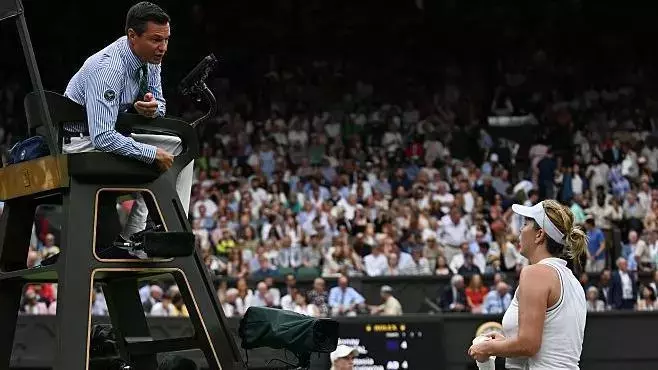
The All England Lawn Tennis Club has announced significant upgrades to its electronic line-calling system at Wimbledon, aiming to eradicate the possibility of human error after a recent incident caused debate and frustration during a high-profile match. This pivotal development underscores the tournament's commitment to fair play and technological advancement in sports officiating.
Precision on Court: Wimbledon's Commitment to Flawless Electronic Officiating
Wimbledon Implements Systemic Fixes Following Line-Call Controversy
Wimbledon officials have confirmed that they have made critical adjustments to the electronic line-calling system, specifically to prevent any recurrence of 'human error' that led to a contentious decision last Sunday. The incident, which occurred during a fourth-round match between Britain's Sonay Kartal and Russia's Anastasia Pavlyuchenkova on Centre Court, saw the ball-tracking technology inadvertently switched off due to an 'operator error.' The All England Lawn Tennis Club (AELTC) stated, 'Following our review, we have now removed the ability for Hawk-Eye operators to manually deactivate the ball tracking.' They emphasized that while the initial problem was human-induced, the system is now fortified against such future mistakes.
The Crucial Point That Sparked System Overhaul
The controversy unfolded when Sonay Kartal hit a backhand long while facing game point at 4-4, but the electronic line-call system failed to register the out call, instead emitting two 'stop' signals. Umpire Nico Helwerth subsequently decided to replay the point, which Kartal ultimately won. This decision drew sharp criticism from Pavlyuchenkova and various tennis commentators, who argued that the umpire should have overruled and called the ball out, given that television replays clearly showed the ball was significantly long. Pavlyuchenkova vocalized the need for a video review system, similar to those used in football, to empower umpires to make more informed decisions in such critical moments.
Umpire's Actions and AELTC's Stance on Officiating Protocols
Despite the backlash, the AELTC defended Umpire Helwerth's actions, asserting that he 'followed the established process' in place at the time. Sally Bolton, the Club's chief executive, further clarified that Helwerth was taking a scheduled 'rest day' and that his handling of the situation was entirely correct according to protocol. This incident, however, has reignited discussions about the potential integration of video review systems into Wimbledon's officiating framework. The AELTC confirmed that the issue of video reviews would be 'among the matters considered' during their comprehensive review of the Championships' operations at the conclusion of the event.
The Debate Over Video Review in Tennis Officiating
The debate surrounding video review systems in tennis has intensified. While many top-tier tournaments, including the US Open and Australian Open, utilize electronic line-calling, some also incorporate video review. Historically, Wimbledon relied on line judges, allowing players to challenge their calls with electronic reviews. However, under the current system, which replaced human line judges this year after 147 years, direct player challenges are no longer permitted, and video replays are not used for officiating purposes. Although replays of points are shown on big screens, these are primarily for entertainment and illustrate the technology's assessment of 'close calls' rather than serving as definitive evidence for rulings.
The Evolution of Line-Calling Technology at Wimbledon
The electronic line-calling system introduced at this year's Wimbledon is an 'enhanced' iteration of the previous Hawk-Eye technology, which was used for player challenges when line judges were still present. The system operates from a dedicated line-calling hub within the Wimbledon grounds, where 50 operators meticulously monitor ball-tracking footage from 12 cameras on each court, displayed across 144 screens. Despite the recent malfunction, the AELTC maintains 'full confidence in the accuracy of the ball-tracking technology,' emphasizing that the recent system changes are aimed at bolstering its reliability by mitigating human interface risks.
