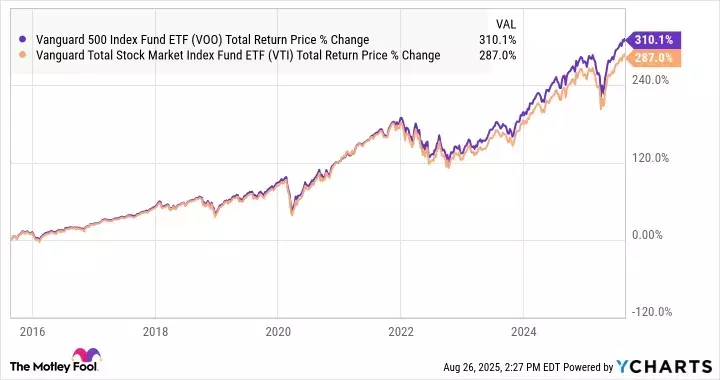

When examining investment performance over the last decade, it becomes clear that different index funds, while both providing excellent returns, have distinct characteristics that influence their outcomes. The Vanguard Total Stock Market ETF (VTI), which aims to capture the performance of the entire U.S. stock market, has demonstrated impressive growth, yet its broader diversification slightly tempered its returns compared to a more concentrated index like the S&P 500.
Specifically, an initial investment of $1,000 in VTI ten years ago would have appreciated to approximately $3,870, assuming all dividends were reinvested. This represents a robust annualized return of 14.5%, a commendable achievement for a passively managed fund. However, a similar investment in an S&P 500 tracking fund, such as the Vanguard S&P 500 ETF (VOO), would have yielded an even higher return, growing to about $4,100, which translates to a 15.1% annualized gain. This marginal difference in performance is largely attributed to the S&P 500's composition, which heavily weights large-capitalization companies, particularly in the technology sector, that have experienced exceptional growth during this period. While VTI includes these large-cap stalwarts, its inclusion of mid-cap and small-cap companies, which collectively did not perform as strongly, diluted its overall returns relative to the S&P 500's tech-driven surge. For example, Nvidia, a significant contributor to the S&P 500's performance, constitutes a smaller percentage of VTI's portfolio due to the latter's wider market coverage.
This comparison highlights an important principle in investing: while diversification is generally beneficial, the specific market segments included in an index can significantly impact its performance during different economic cycles. The past decade favored large-cap growth, particularly in technology, illustrating how a focused index can sometimes outpace a more broadly diversified one. Nonetheless, both ETFs underscore the power of long-term, passive investing, offering substantial wealth creation opportunities for diligent investors.
Investing in broad market index funds offers a compelling path to financial growth, demonstrating that consistent, disciplined participation in the stock market can lead to significant accumulation of wealth over time. Even subtle differences in fund composition, as seen between a total market fund and an S&P 500 fund, can lead to varying returns, yet both exemplify the positive impact of long-term investment strategies. This reinforces the idea that thoughtful financial planning and patience are virtues that ultimately empower individuals to build a more secure and prosperous future.
