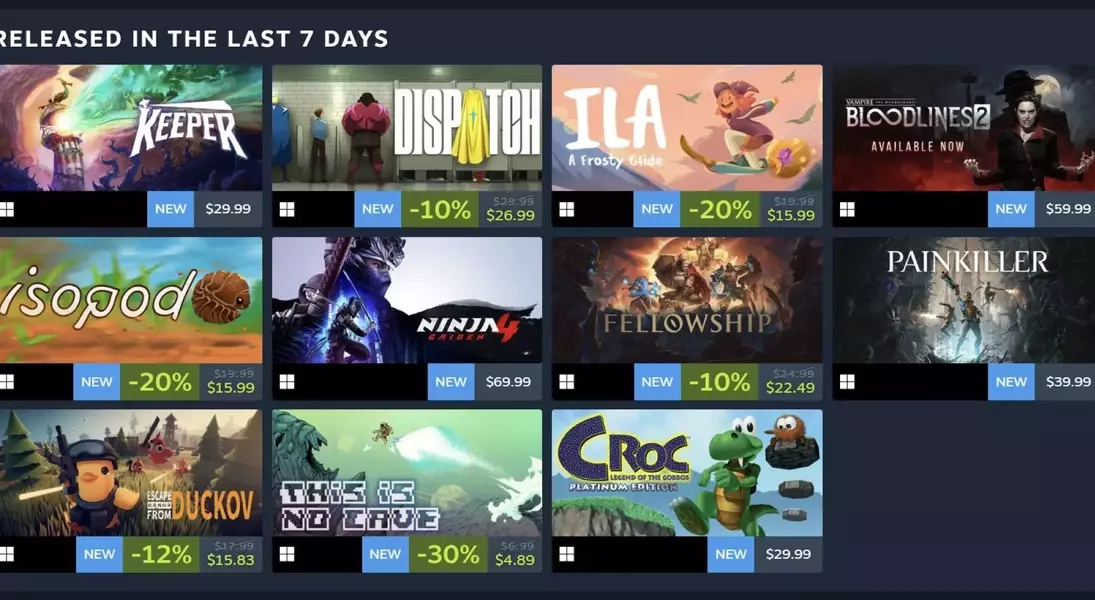
Despite Valve's continuous efforts to enhance game discoverability on its ubiquitous Steam platform, an industry insider contends that the system remains largely ineffective. Ichiro Lambe, a veteran with direct experience in this area at Valve, highlights that while Steam incorporates various features designed to showcase new releases and deals, the core issue of users finding previously unknown games persists. He suggests that the platform's primary role is transaction facilitation, with organic game discovery often being a fortuitous outcome rather than a deliberate success.
Understanding Steam's Discovery Conundrum: An Expert's Insight
In a revealing analysis, industry expert Ichiro Lambe, who previously contributed to Valve's initiatives for improving game visibility on Steam, sheds light on the inherent challenges within the platform's discovery mechanisms. Lambe posits that despite an array of features such as 'Top Sellers,' 'New and Trending,' and themed festivals like 'Real-Time Strategy Fest,' many players still struggle to unearth new titles directly through Steam. He elaborates that while Valve has a vested interest in maximizing game sales, the current approach to discovery often falls short, leading to a reliance on external channels for player engagement.
Lambe, in his candid observations, draws a compelling analogy, stating that Steam's discovery efforts, while perhaps superior to other media platforms, are akin to being the 'tallest hobbit' – a relative achievement within a fundamentally flawed system. He argues that users rarely engage in prolonged, idle scrolling on Steam, instead often being prompted to explore by specific events or direct notifications, such as promotional emails. This behavior, he believes, deviates significantly from the 'Rule of Seven' in consumer psychology, where multiple, light exposures to a product are typically required for it to register with a potential customer. The detailed, 'checkout aisle' presentation of Steam's store pages, according to Lambe, often overwhelms users who are encountering a game for the first time, potentially leading to disengagement rather than further interest, even for titles that would be ideal matches.
The veteran further asserts that platforms like YouTube and Twitch, alongside personal recommendations from trusted sources, serve as the predominant avenues through which gamers truly discover new titles. This phenomenon, widely acknowledged within the gaming community, underscores a significant gap in Steam's internal discovery capabilities. Lambe concludes that while Steam may inadvertently aid in discovery, its fundamental purpose remains the sale of games, with genuine new title revelation often a happy, but secondary, consequence. He acknowledges the complexity of this ongoing challenge, citing that simple solutions remain elusive, as evidenced by the varied success rates of games transitioning from early access, where only a minority see improved performance post-launch.
Reflections on Digital Discovery in the Gaming Sphere
This critical perspective on Steam's game discovery system offers valuable insights into the evolving landscape of digital media consumption. It challenges the conventional wisdom that a platform designed for commerce automatically excels at content discovery. For developers, this analysis reinforces the necessity of multi-platform marketing strategies, extending beyond a simple storefront listing to embrace community engagement and content creation on external channels. For players, it highlights the increasing importance of curated recommendations and the role of influencers in navigating the vast ocean of new releases. Ultimately, Lambe's argument serves as a potent reminder that in the crowded digital marketplace, true discovery often originates from authentic connections and external validation, rather than solely from algorithmic curation within a commercial ecosystem.
