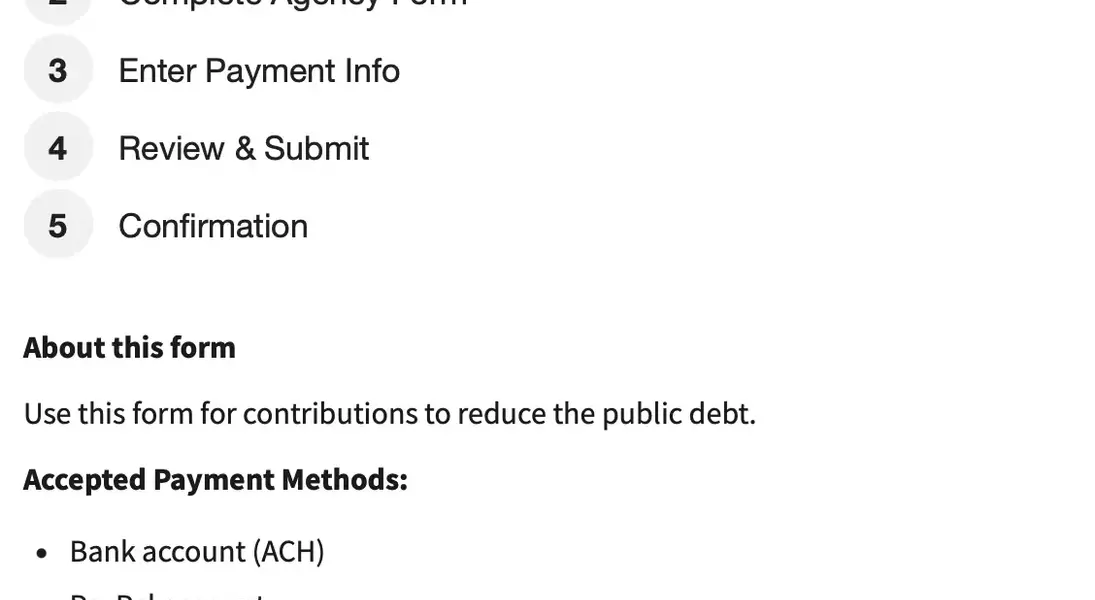

The US Treasury Department has expanded its methods for public contributions to the national debt, now embracing modern digital payment platforms. In a significant update, individuals can utilize Venmo, a popular mobile payment service, to donate towards the country's staggering $36 trillion debt. This progressive step by the Treasury indicates an adaptation to contemporary financial transaction trends, aiming to make civic contributions more accessible. The integration of Venmo complements existing payment avenues such as direct bank transfers, PayPal, and traditional credit or debit card transactions.
While this new payment channel simplifies the donation process, the colossal scale of the national debt presents a formidable challenge. With the debt escalating at an alarming rate of approximately $55,000 per second, the collective impact of individual digital donations, though symbolically significant, will likely be a modest dent in the overall figure. Nevertheless, this initiative underscores a governmental effort to leverage widely used technology to engage citizens in addressing a critical national fiscal issue.
Modernizing Public Contributions: The Venmo Integration
In a forward-thinking move to modernize financial interactions with the public, the United States Treasury Department has introduced Venmo as an official payment method for contributions aimed at reducing the national debt. This development was recently noted on the Treasury's 'Gifts to Reduce the Public Debt' online platform, marking a notable shift towards incorporating popular digital payment solutions. The adoption of Venmo signifies a recognition of evolving consumer payment habits and an effort to make the process of donating to the national cause more convenient and accessible to a broader demographic, particularly younger generations who frequently use such platforms.
The Treasury's decision to accept Venmo payments broadens the spectrum of options available to citizens, which already includes direct transfers from bank accounts, transactions via PayPal, and payments through conventional credit or debit cards. This enhancement in payment flexibility aims to streamline the donation experience, removing potential barriers for those who prefer or exclusively use digital wallets. Although the total amount collected through such voluntary contributions has reached over $67 million since September 1998, the immense scale of the national debt, which currently surpasses $36 trillion and continues to grow at a rapid pace of nearly $55,000 every second, suggests that these individual donations, while meaningful gestures of civic participation, represent a very small fraction of the overall financial challenge. The effectiveness of this new avenue will be measured not just in monetary terms, but also in its capacity to foster greater public engagement and awareness regarding national fiscal responsibilities.
Addressing the Debt: A Digital Approach
The implementation of Venmo as a payment gateway for national debt contributions is a strategic step by the US Treasury to embrace digital finance, reflecting a broader trend in government services to adopt more user-friendly and technologically advanced methods. This initiative, which appears to have been rolled out sometime after February 22nd, represents the latest effort to facilitate public participation in fiscal responsibility. By integrating a widely used peer-to-peer payment application, the Treasury aims to tap into a demographic accustomed to seamless digital transactions, thereby potentially encouraging more regular and smaller-scale contributions towards the national debt.
While the ease of use offered by Venmo is undeniable, the fundamental challenge of the national debt's magnitude remains. Historical data from the Treasury Department indicates that donations to this program have collectively amounted to just over $67 million since its inception in 1998. When juxtaposed with the rapid expansion of the national debt, which sees an increase of tens of thousands of dollars every second, it becomes evident that voluntary public contributions, even through accessible platforms like Venmo, are more symbolic than economically impactful. This highlights the reality that significant alleviation of the national debt will necessitate comprehensive and large-scale fiscal policies rather than relying primarily on individual donations, regardless of how digitally convenient they become. The move towards digital payments like Venmo is therefore more about fostering civic engagement and transparency than directly solving the debt crisis.
