
Upstart, a financial technology firm, is gaining recognition as a potential high-growth investment, leveraging artificial intelligence in a manner distinct from traditional credit agencies. Despite a recent dip in stock performance, the company's innovative AI platform is proving its efficacy, attracting a growing number of banking partners and accelerating its revenue and profitability. This advanced approach to credit assessment distinguishes Upstart in the lending landscape, offering a more inclusive and efficient system for borrowers and lenders alike.
Upstart's core innovation lies in its credit assessment model. Unlike conventional credit bureaus such as Equifax, TransUnion, and Experian, or even Fair Isaac's FICO model, Upstart employs a sophisticated AI algorithm. This algorithm, developed by co-founder Paul Gu, a computer science and economics expert, analyzes over 2,500 unique variables to determine a borrower's creditworthiness. This goes far beyond standard metrics like income and repayment history, incorporating diverse data points often overlooked by traditional systems.
The benefits of Upstart's AI-driven approach are significant. It facilitates 43% more loan approvals without an increase in default rates, demonstrating a superior risk assessment capability. Moreover, more than 90% of its loan approvals are automated, enabling rapid processing within seconds. This efficiency is accessible to lenders through a simple Application Programming Interface (API), seamlessly integrating Upstart's system into their operations.
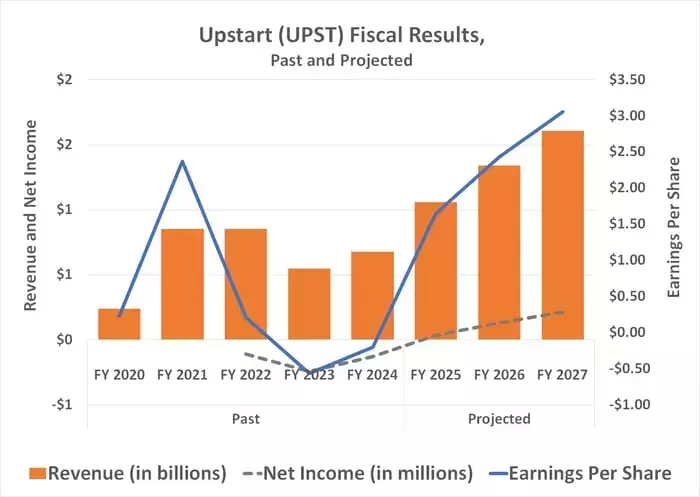
Initially, Upstart faced challenges establishing itself in a market dominated by long-standing players since its inception in 2012. However, the recent surge in artificial intelligence adoption, particularly following the launch of ChatGPT in late 2022, has provided a crucial inflection point. The number of banks utilizing Upstart's technology has soared from fewer than 20 in early 2021 to over 100 currently. This expanded adoption has led to consistent quarterly revenue growth and a return to profitability in the second quarter of this year, with analysts projecting continued earnings increases.
Despite originating 697,092 loans totaling $5.9 billion last year, Upstart's market penetration remains a small fraction of the vast U.S. loan market. The digital lending sector in the U.S. is projected to grow by over 13% annually through 2030, presenting a substantial opportunity for companies like Upstart. While the company currently focuses on personal and auto loans, this market segment alone offers immense potential for expansion, positioning Upstart to capture a significant share of this evolving industry.
Investing in Upstart stock today presents a compelling long-term opportunity, particularly given its recent market performance which, according to analysts, does not fully reflect its growth trajectory. The company's resilience in the face of economic uncertainties and its consistent top-line growth, with forecasts of 66% growth this year and 27% next year, underscore its strong fundamentals. Although some investors remain cautious about potential economic slowdowns affecting lending, the widespread adoption of Upstart's solution by both lenders and borrowers signals a robust future. While short-term volatility is expected, analysts maintain an optimistic one-year price target, suggesting substantial upside for committed long-term investors.
