
United Parcel Service (UPS) finds itself at a pivotal juncture, grappling with a complex array of near-term challenges while striving to realize its ambitious long-term strategic vision. The global logistics giant is confronting earnings pressures and scrutinizing its dividend policy, largely due to ongoing international trade disputes that have dampened key market segments. Despite these headwinds, the company's foresight in re-engineering its operational framework and pursuing higher-value deliveries offers a compelling narrative of resilience and potential future growth. The interplay between current market adversities and proactive strategic adjustments defines UPS's trajectory in the coming years.
The company's management is diligently working to steer the ship through these turbulent waters, recognizing the imperative to adapt to a changing economic landscape. While the path ahead may involve difficult decisions, the underlying strength of UPS's network and its commitment to innovation remain central to its strategy. This period of transition will undoubtedly test the company's resolve, but it also presents an opportunity to emerge leaner, more efficient, and better positioned for sustained profitability in a dynamically evolving global economy.
Navigating Market Headwinds and Strategic Imperatives
UPS is currently facing considerable pressure on its financial performance, primarily due to the ongoing repercussions of global trade conflicts. These disputes have had a particularly adverse effect on highly profitable trade lanes, such as those between China and the U.S., which are crucial revenue streams for the company's international operations. Additionally, the uncertainty introduced by these trade tensions has significantly impacted UPS's small and medium-sized business (SMB) segment, a vital customer base that often relies heavily on international supply chains. This downturn in SMB volumes complicates the company's plans to rebalance supply and demand in the U.S. small-package market, a strategy that anticipated a natural correction in capacity after the boom years of the pandemic. Consequently, management has refrained from providing updated full-year guidance, reflecting the unpredictable nature of the current economic environment.
In response to these challenges, UPS has been meticulously implementing a comprehensive strategic plan designed to enhance its operational efficiency and optimize its service offerings through 2026. This blueprint involves significant investments in advanced, productivity-boosting technologies like smart facilities and automation, aiming to establish what the company terms the \"network of the future.\" These investments are not merely about reducing per-package costs; they also enable the consolidation of less efficient facilities, centralizing delivery volumes into modernized hubs. Furthermore, UPS initiated a strategic shift away from lower-profit Amazon deliveries, planning to cut them by half by mid-2026, and is reclaiming last-mile delivery for its SurePost service from the Postal Service starting in January 2025. These measures collectively represent a deliberate pivot towards higher-margin, more productive delivery services, reinforcing the company's commitment to long-term profitability despite the prevailing market volatility.
Dividend Outlook and Future Trajectory
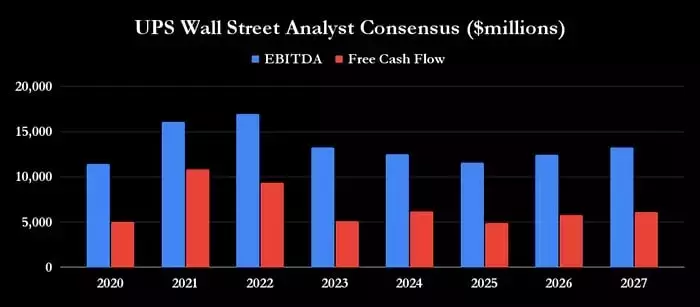
The current financial landscape has prompted considerable speculation among Wall Street analysts regarding UPS's ability to sustain its dividend payments. With projections indicating that a substantial portion—over 90%—of the company's free cash flow (FCF) in 2027 would be allocated to dividends, the pressure to maintain this payout is immense, especially if unforeseen market disruptions persist. This scenario is particularly concerning given that UPS currently distributes a hefty $5.5 billion annually in dividends. The question of a potential dividend reduction looms, as such a move could free up significant capital for reinvestment, allowing the company to accelerate its strategic initiatives and fortify its operational resilience. However, any decision to cut dividends would undoubtedly be met with dissatisfaction by investors, potentially leading to further downward pressure on the stock price in the near term.
Looking ahead, the most probable outcome for UPS appears to be a blend of optimistic and pessimistic scenarios. While the company's long-term vision of a more efficient, higher-margin operation is sound, the immediate future is clouded by the persistent impact of trade disputes and a challenging economic environment. A realistic outlook suggests that UPS may need to recalibrate investor expectations, possibly even considering a dividend adjustment, to fund necessary investments and adapt more swiftly to evolving market dynamics. Such a proactive measure, while potentially unpopular in the short run, could ultimately position the company for a stronger recovery and sustained growth in the long term. The current period represents a critical inflection point, where strategic foresight and decisive action will determine UPS's ability to overcome present hurdles and emerge as a more robust and profitable entity in the coming years.
