

Professional football players in the Premier League demonstrate a level of physical conditioning far beyond that of the general public. Their fitness is a complex interplay of various factors, including power, speed, agility, and stamina. Unlike typical gym routines, their training and assessment protocols are meticulously tailored to replicate the dynamic movements and physiological demands of competitive football. This specialized approach ensures that every aspect of their physical readiness is optimized for peak performance on the field. The commitment to such rigorous evaluation and development underscores the elite athleticism inherent in top-tier football.
To truly comprehend the exceptional physical attributes of Premier League athletes, a detailed examination of their comprehensive fitness evaluations is necessary. The Athletic collaborated with 292 Performance, a leading organization in elite athlete support, to conduct a series of specialized tests on Eduardo Tansley. Tansley, a 24-year-old former academy player and current journalist, volunteered for these assessments, which mirrored the evaluations typically administered to new professional club signings. The setting for these trials was Pennyhill Park, a luxurious facility renowned for its elite sports amenities, often utilized by the England rugby union team.
The assessment began with a thorough movement analysis overseen by Mathew Banks, 292 Performance’s lead physical-performance coach. Eduardo performed a sequence of progressively challenging lunges, including rotations and arabesques, followed by overhead pole marches. Banks meticulously observed his stability, mobility, and lower body control. These initial drills served not only as a diagnostic tool but also as an effective warm-up, visibly inducing perspiration and preparing Eduardo for more intensive evaluations.
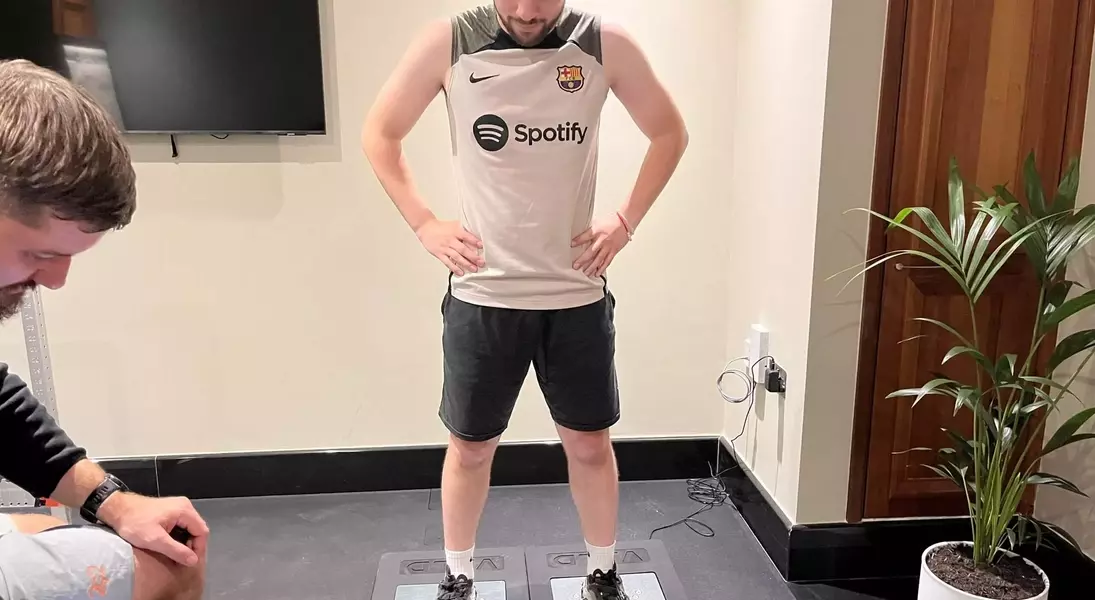
Subsequently, the testing moved to a room equipped with VALD (Vertical Assessment of Landing Dynamics) force plates. These advanced devices provided detailed insights into Eduardo’s leg power, ground contact time, and muscular symmetry. He underwent four distinct jump variations: counter-movement jumps for explosive strength, pogos for minimal ground contact, and single-leg versions of both. The data revealed significant differences between Eduardo’s performance and the average Premier League player. For instance, his best vertical jump was 33.70cm, notably below the Premier League average of 39cm. Elite players often exceed 48cm, placing them in the top five percent.
Banks also analyzed reactive strength, measuring how quickly Eduardo applied force to the platform and the resulting output. His reactive strength index was 0.51, compared to a Premier League average of 0.70. This metric is crucial for rapid changes in direction and acceleration, characteristics commonly observed in exceptionally fast players. Furthermore, the eccentric braking force, which measures the force applied during the descent of a jump, highlighted an imbalance in Eduardo’s left versus right side, signaling a potential injury risk. Such asymmetries are proactively addressed in a professional footballer’s training regimen.
The next phase involved a hopping test, where Eduardo completed ten jumps, aiming for maximum height with minimal ground contact. His mean contact time was commendable at 179 milliseconds, aligning with the Premier League average of 0.17 seconds. However, his jump height of 15.40cm resulted in a reactive strength index (RSI) of 1.98, falling short of the 3.0 to 3.5 range expected from elite athletes. Improving this score would necessitate enhancing his ability to generate greater force for increased jump height.
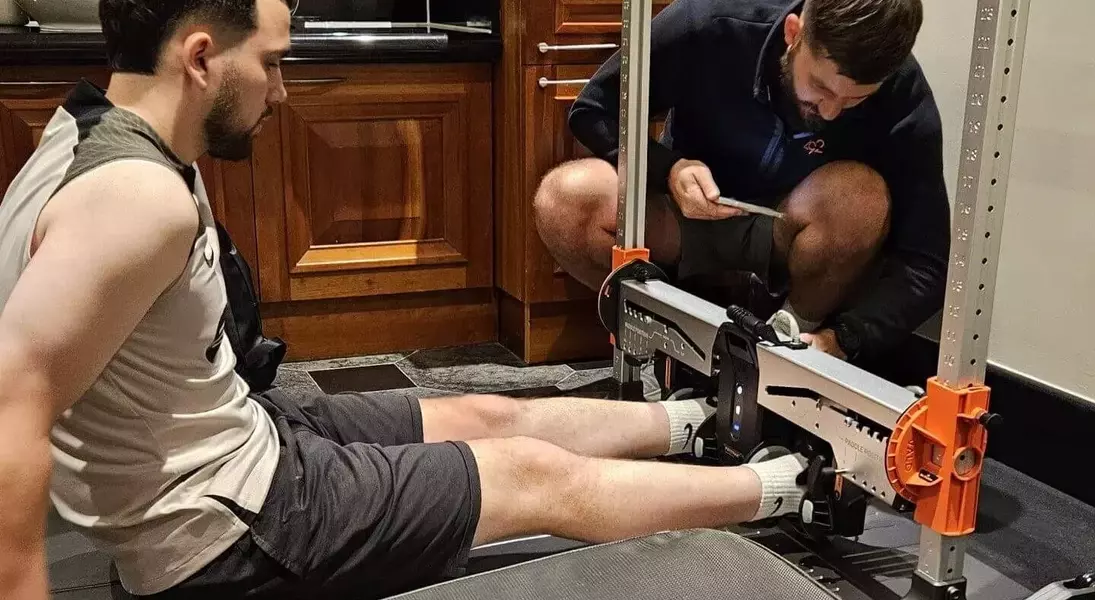
The indoor testing concluded with the VALD force frame, focusing on isometric strength. This method involves contracting muscles without movement, allowing for precise identification of individual muscle strengths and weaknesses, unlike compound exercises that can mask imbalances. This test is less strenuous and can be performed frequently to monitor training efficacy. Eduardo’s hamstring, calf, hip, and groin strength were assessed, along with the symmetry between his left and right lower body, and the ratio of hip to groin strength. Interestingly, Eduardo exhibited stronger hips than groin muscles, an inverse of a common pattern found in footballers. However, a notable 37 percent asymmetry was detected between his left and right calf muscles, and a smaller imbalance in his hips, with his right side showing a deficiency. These findings indicated areas for targeted intervention to prevent injury and optimize performance, as such deficits often correlate with reduced stability and inefficient force production.
The final segment of Eduardo’s evaluation concentrated on speed, an increasingly vital component in modern football. Using AI-driven movement analysis tools, Banks recorded Eduardo’s 10-meter accelerations on a hard-surface tennis court. While not ideal for simulating on-grass performance, this allowed for precise measurement of his speed and running economy. Eduardo achieved an overall speed score of 50 out of 100, positioning him in the middle range of individuals tested by 292 Performance. His raw scores, including a 10m time of 1.93 seconds and a peak velocity of 4.1m/s, contributed to this assessment. The analysis further delved into biomechanical details such as hip displacement, step frequency, thigh angular velocity, and step velocity, providing a granular understanding of his running mechanics and limb symmetry.
This comprehensive testing framework, integrating acceleration, strength, and symmetry, offers a holistic understanding of an athlete’s physical capabilities and areas for improvement. Banks emphasized that these evaluations are not isolated events but rather integral parts of a continuous monitoring process for professional players, typically performed weekly or bi-monthly. By constantly assessing and adapting training programs, clubs and performance specialists ensure players maintain peak physical condition, minimizing injury risks in an increasingly demanding sport. The continuous escalation in the physical intensity of the game means that maintaining optimal fitness is paramount, as injuries sustained at higher speeds and volumes lead to more severe consequences. Ultimately, the question of a Premier League footballer's fitness is not simple; it is a complex, ever-evolving metric defined by meticulous science and unwavering dedication.
