This article chronicles the inspiring journey of Junior Peña, a physicist whose early life in South Central Los Angeles instilled a drive for knowledge that ultimately led him to the forefront of experimental particle physics. It highlights his significant contributions to the Project 8 collaboration, an international effort focused on unraveling the mysteries of neutrinos, particularly their elusive mass. The narrative emphasizes the profound implications of this research for our understanding of the universe's fundamental composition and evolution, while also showcasing Peña's dedication to inspiring future generations in STEM.
Illuminating the Invisible: One Scientist's Pursuit of Cosmic Truths
From the Streets of South Central to the Gates of Academia: A Young Scientist's Formative Years
Growing up in a challenging environment within South Central Los Angeles, Junior Peña learned the crucial skill of strategic avoidance and the value of keeping his time occupied. In a neighborhood where missteps could easily lead to negative influences, he sought a different path. While his parents dedicated long hours to work, Peña immersed himself in after-school programs, digital games, and martial arts training. Unknown to his peers, he also spent countless hours independently studying advanced mathematics and philosophy online, demonstrating an early thirst for knowledge that defied expectations. His perception within his community did not align with his academic prowess, keeping his intellectual pursuits private.
A Glimpse into the Quantum Realm: The Revelation of the Higgs Boson
During his high school years, Peña encountered a captivating online video explaining the Higgs boson, often referred to as the \"God particle,\" believed to impart mass to nearly all matter in the cosmos. This revelation sparked a torrent of profound inquiries about existence, the universe, and our place within it. Although he had previously explored these philosophical questions, the concrete explanations offered by physics captivated him more deeply, steering his intellectual curiosity in a new direction.
Pioneering the Detection of Ghostly Particles: Neutrinos and Their Enigma
Peña's self-directed academic journey, which enabled him to ace AP calculus as a junior, propelled him towards a physics major at the University of Southern California, a summer research program at MIT in 2019, and ultimately, graduate studies at MIT. His current research focuses on neutrinos, subatomic particles that possess no charge and can effortlessly traverse through vast amounts of matter, requiring a lead shield equivalent to five light-years in thickness to impede them. These particles, emitted by celestial bodies like the sun and supernovas, and also generated by particle accelerators and nuclear reactors, signal their presence through an observed energy deficit.
The Mass Paradox: Challenging the Standard Model of Physics
The physicist Wolfgang Pauli first hypothesized the existence of neutrinos in the 1930s, noticing an energy discrepancy during radioactive beta decay. This led him to propose an undetectable particle carried away the missing energy, aligning with the principle of energy conservation. Einstein's famous equation, E=mc², implies that missing energy corresponds to missing mass. Yet, according to the standard model of physics, neutrinos should be massless because they do not interact with the Higgs field, a cosmic medium that bestows mass upon other particles. However, discoveries in the early 2000s revealed that neutrinos can oscillate between three distinct types, a phenomenon only possible if they possess mass. This groundbreaking finding ignited a critical question: what precisely is the mass of these enigmatic particles?
Unlocking Cosmic Secrets: The Significance of Neutrino Mass Measurement
Pinpointing the exact mass of neutrinos holds the key to answering some of the universe's most perplexing questions. It could elucidate why matter prevailed over antimatter in the early universe, refine models of cosmic evolution, and clarify the role of neutrinos in the composition of dark matter and dark energy. The Formaggio Lab, where Peña conducts his research, is a vital part of Project 8, an international collaboration involving 71 scientists from 17 institutions dedicated to precisely measuring neutrino mass. This ambitious endeavor utilizes tritium, an unstable hydrogen isotope that decays into helium, releasing an electron and an antineutrino. By meticulously analyzing the energy spectrum of these emitted electrons, scientists can deduce the extent of the missing energy, thereby inferring the neutrino's mass.
Revolutionizing Particle Detection: The Cyclotron Radiation Emission Spectroscopy (CRES) Method
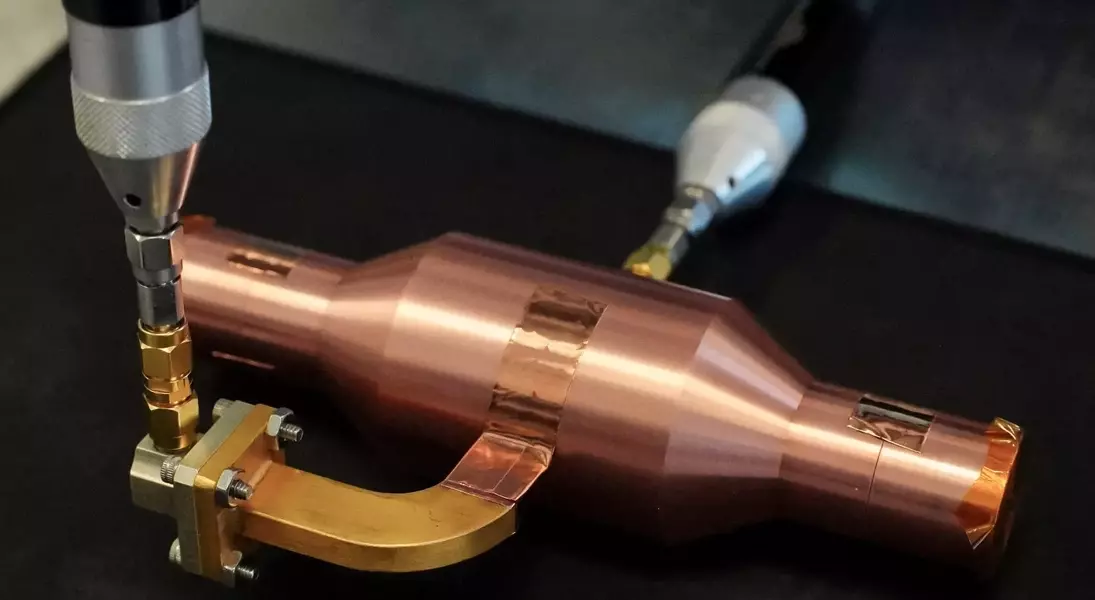
At the core of this innovative experiment lies Cyclotron Radiation Emission Spectroscopy (CRES), a novel detection method first proposed in 2008 by Joseph Formaggio and Benjamin Monreal. CRES "listens" to the faint radio signals produced as electrons spiral through a magnetic field. Peña played a crucial role in developing a critical component for this technology: a meticulously designed copper cavity. He likens this cavity to a guitar, where the electrons released during beta decay act as plucked strings. This resonator is engineered to amplify these delicate signals, enabling researchers to measure them with exceptional accuracy. Peña dedicated over a year to developing and refining a flashlight-sized prototype of this device, collaborating closely with machinists and fellow physicists.
The Iterative Design Process: From Concept to Functional Prototype
Joseph Formaggio, Peña's advisor, praised his dedication, noting how Peña mastered design and simulation software, interpreted complex signals, and meticulously tested numerous iterations. The design of Peña's cavity demanded a delicate balance: it needed to efficiently extract electron signals while remaining compatible with the researchers' calibration methods, including the use of an electron gun to inject electrons of known energy. Furthermore, the cavity had to maintain the integrity of its internal electromagnetic fields. In May, Peña's final prototype was shipped to the University of Washington, where it was successfully installed in July. Researchers are optimistic about commencing calibration this autumn, after which Peña's cavity and the entire experimental setup will be scaled up to begin collecting CRES data using tritium within a few years.
The Horizon of Discovery: Project 8 and Beyond
Jeremy Gaison, a Project 8 physicist at the Pacific Northwest National Lab, expressed excitement about the impending activation of the experiment, eager to validate their simulations with real-world data. Wouter Van De Pontseele, another Project 8 collaborator and former Formaggio Lab postdoc, lauded Peña's pivotal contribution, stating, \"Junior took an idea and turned it into reality.\" Project 8 remains in its nascent stages, with future phases involving larger and more complex versions of the technology Peña helped develop, culminating in a vast facility designed to precisely measure the neutrino's mass. Successful findings could profoundly impact our comprehension of the universe's fundamental structure, the evolution of galaxies, and the very nature of matter.
Inspiring the Next Generation: A Legacy Beyond Research
Peña's passion extends beyond scientific discovery; he is committed to pursuing postdoc work in fundamental physics, exploring promising areas like levitated nanosensors for gravitational experiments and dark matter detection. While acknowledging the long-term nature of experimental particle physics, Van De Pontseele affirms Peña's lasting impact. Beyond his research, Peña aspires to become a professor, creating opportunities for students who, like him, may not initially envision themselves in academia. He recognizes the transformative power of summer programs, crediting one for his own journey, and feels a deep responsibility to empower the next generation, showing them that they too belong in the realm of scientific exploration.
