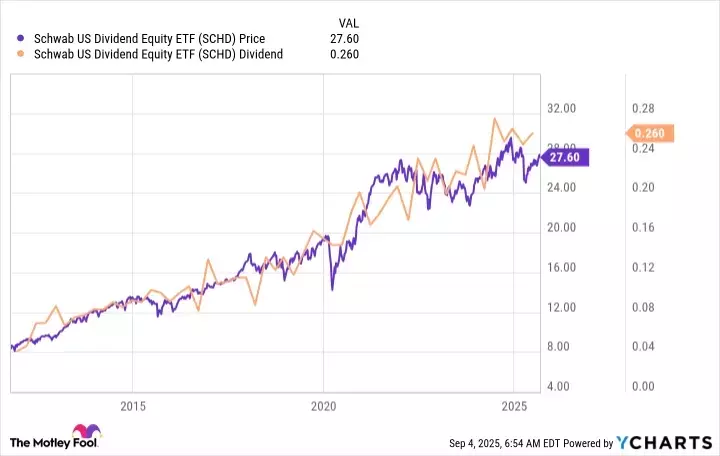

This article explores the Schwab U.S. Dividend Equity ETF (SCHD), a leading exchange-traded fund for dividend-oriented investors. It delves into the fund's underlying index, the Dow Jones Dividend 100, and explains the rigorous selection process that integrates both growth and value considerations. The analysis aims to provide a clear understanding of why SCHD appeals to a broad range of investors seeking consistent income and potential capital appreciation.
Navigating the Investment Landscape: Understanding Your Options
The Schwab U.S. Dividend Equity ETF: A Premier Choice for Income Seekers
The Schwab U.S. Dividend Equity ETF, known by its ticker symbol SCHD, stands out as a highly sought-after exchange-traded fund for those interested in dividend investments. With assets under management reaching an impressive $69 billion, its widespread adoption is evident. The core of its appeal lies in its sophisticated portfolio construction.
Decoding SCHD's Methodology: The Index-Driven Approach
As an index-tracking ETF, SCHD's performance directly mirrors the index it follows: the Dow Jones Dividend 100. This crucial detail means that understanding the ETF necessitates a deep dive into the index's rules and criteria. The journey of stock selection for this index begins with a fundamental requirement: companies must have a history of increasing their dividends for at least a decade, excluding real estate investment trusts. This initial filter serves a dual purpose, acting as both a quality control and a growth indicator. A company's consistent dividend increases signify not only financial stability but also a pattern of expansion. It would be challenging for a struggling entity to maintain such a record.
Comparing Investment Strategies: A Look at Competitors
In contrast, a rival fund, the Vanguard Dividend Appreciation ETF, tracks the S&P U.S. Dividend Growers Index. However, its subsequent steps differ; it eliminates the top 25% of qualifying stocks based on yield, which inherently leans the fund towards growth-oriented investments. The Dow Jones Dividend 100 index, utilized by SCHD, employs a more layered approach.
The Multi-Faceted Selection Process: Balancing Growth and Value
The Dow Jones Dividend 100 index extends its screening beyond a single criterion. It proceeds to develop a composite score for all companies that clear the initial dividend growth hurdle. This score incorporates several key metrics: the ratio of cash flow to total debt, return on equity, dividend yield, and the five-year dividend growth rate of the company. Each of these elements contributes to a nuanced evaluation. Cash flow to total debt gauges financial resilience, often associated with value investing. Return on equity reflects a company's operational efficiency and quality, which aligns more with growth prospects. Dividend yield, while a measure of income generation, can be viewed neutrally, though higher yields often suggest a tilt towards value. Lastly, the five-year dividend growth rate emphasizes growth, as higher rates typically demand more robust company expansion. Essentially, the selection process for the Schwab U.S. Dividend Equity ETF meticulously considers both growth and value attributes. The top 100 companies, based on their composite scores, are then included in the index and the ETF, weighted by market capitalization. This comprehensive due diligence is offered at an exceptionally low expense ratio of merely 0.06%.
Defining SCHD's Investment Stance: A Middle Ground
The resultant portfolio from this intricate selection process defies easy categorization. Its primary objective is to identify robust companies that offer attractive and expanding dividends, a goal that resonates with the majority of dividend investors. Regarding the perennial debate between growth and value, this ETF intentionally occupies a middle ground. This balanced approach means that both growth and value investors could comfortably integrate SCHD into their portfolios, asserting that it caters to their preferred investment style. Conversely, some may perceive this lack of a distinct bias as a drawback, finding the ETF insufficiently 'pure' for their specific investment philosophy. Ultimately, an investor's decision will hinge on their individual perspective and willingness to embrace a blended strategy. What remains unequivocally clear is that the Schwab U.S. Dividend Equity ETF is tailored for individuals who prioritize dividends. However, even here, a slight concession is made. The current dividend yield is approximately 3.8%, which, while significantly higher than the broader market average, is not the highest available among ETFs. This represents another compromise for those aiming to maximize portfolio income.
SCHD: A Well-Rounded Investment for Diverse Portfolios
Perfection in investment is an elusive concept, necessitating compromises along the way. In the case of SCHD, these compromises are entirely rational and contribute to a favorable outcome. Over time, the Schwab U.S. Dividend Equity ETF has consistently demonstrated a general upward trend in both its share price and dividend payouts. Given its appealing yield and the intricate, multi-layered screening process, this high-yield ETF can comfortably be added to the portfolios of growth, value, and income investors alike, without requiring them to feel they have sacrificed too much of their core investment principles.
