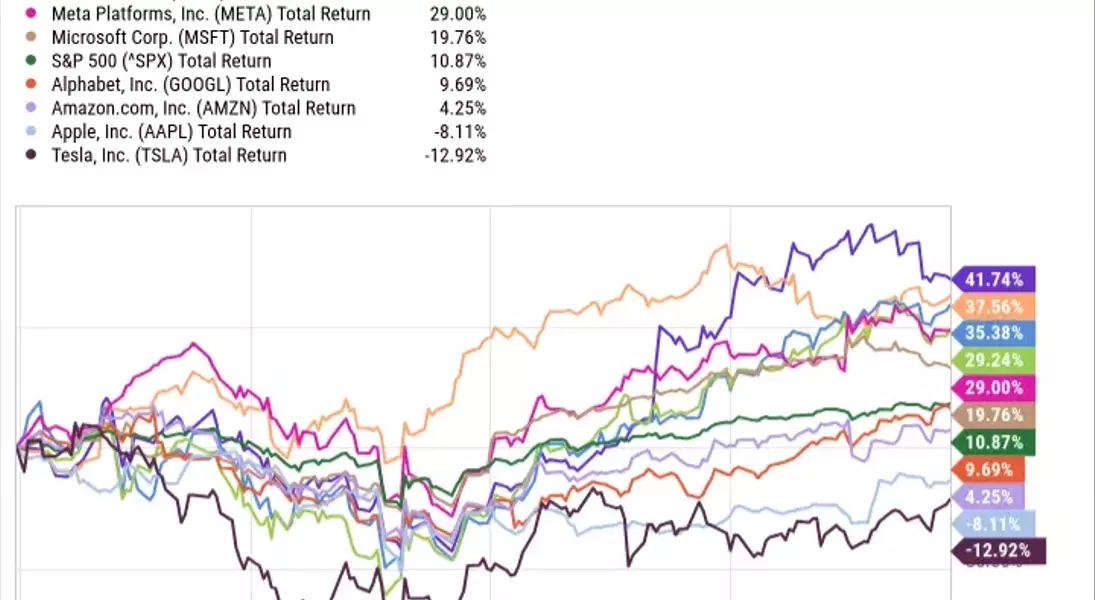

In the dynamic landscape of the stock market, a select group of ten companies, affectionately termed the \"Ten Titans,\" have recently asserted their dominance, collectively constituting a substantial 38% of the S&P 500. This elite cohort, which includes industry giants like Oracle, Netflix, and Nvidia, alongside Microsoft, Apple, Amazon, Alphabet, Meta Platforms, Broadcom, and Tesla, has captured significant attention with their exceptional year-to-date gains. The performance of Oracle, Netflix, and Nvidia, in particular, has been nothing short of extraordinary, each recording over 35% growth. This remarkable surge raises pertinent questions about the underlying strategies driving their success and whether these companies can sustain such momentum in the coming fiscal periods, especially as investors closely scrutinize their valuations.
Oracle's journey from a traditional database company to a cloud computing powerhouse is a testament to its strategic foresight. After a period of modest returns between 2015 and 2019, where its growth lagged behind the S&P 500, Oracle's stock has soared by an astounding 345% since early 2020. This impressive turnaround is largely attributable to the aggressive development and adoption of Oracle Cloud Infrastructure (OCI). OCI has distinguished itself by offering cost-effective and secure solutions for data-intensive operations, proving particularly appealing to highly regulated sectors such as financial services and healthcare, which prioritize stringent security and compliance. Oracle's ability to integrate its enterprise software solutions with a robust cloud ecosystem has positioned it as a formidable competitor against established cloud providers like Amazon Web Services, Microsoft Azure, and Google Cloud. However, this aggressive expansion comes at a cost, with substantial investments that make Oracle a high-risk, high-reward proposition. The future trajectory of its stock will heavily depend on how effectively these investments translate into tangible bottom-line growth, justifying its current high valuation.
Netflix, a perennial leader in entertainment, has navigated market fluctuations with a renewed sense of purpose, particularly after a challenging 2022. While its core business model remains consistent, the company has refined its content strategy, focusing on global successes and expanding its marketing reach. A pivotal move in its recent resurgence has been the successful crackdown on password sharing, which has surprisingly led to a significant increase in new subscriber accounts. This indicates a strong consumer willingness to pay for Netflix's valued service, even amidst stiff competition. Furthermore, the introduction of an ad-supported tier has spurred new sign-ups, further accelerating revenue growth. Netflix has evolved into a highly profitable entity, characterized by robust cash flow and healthy margins. However, its current valuation, trading at 52 times its trailing 12-month earnings, suggests that much of its future success is already priced in. While Netflix remains a compelling long-term investment, its ability to deliver outsized returns in the immediate future might be tempered by its stretched valuation, potentially necessitating a period of sustained earnings growth to catch up with its stock price.
Nvidia continues to set benchmarks for exponential growth, particularly in the realm of artificial intelligence. Its exceptional second-quarter fiscal 2026 results underscored its market leadership, with a remarkable 56% increase in revenue and 54% growth in adjusted earnings per share, despite export restrictions impacting its China operations. Nvidia's ability to maintain gross margins above 70% is a testament to its technological superiority and strong competitive moat. The data center segment remains the primary driver of its revenue, accounting for 88% of the recent quarter's sales. Beyond data centers, Nvidia's other business segments, including gaming, AI PC professional visualization, automotive, and robotics, are also experiencing substantial growth, collectively contributing $5.49 billion, a 48% increase year over year. The company's ambitious outlook for the third quarter of fiscal 2026, projecting $54 billion in revenue even without H20 chip shipments to China, further solidifies its position as a growth leader. While Nvidia's valuation is not inexpensive, its consistent delivery of strong results makes its price-to-earnings ratio of 58.4 appear justifiable. Should its earnings continue to grow at a projected 50% rate, its P/E ratio would become even more attractive, positioning Nvidia as a top AI stock. Its continued leadership is expected to propel the Ten Titans forward, though any unforeseen slowdown in AI spending could impact its trajectory and, by extension, the broader market.
Ultimately, the continued outperformance of Oracle, Netflix, and Nvidia hinges on their ability to innovate, adapt, and expand their market reach. While each company faces unique challenges—Oracle with its aggressive investment strategy, Netflix with its high valuation, and Nvidia with geopolitical trade complexities—their foundational strengths and proven track records suggest a continued, albeit possibly more measured, period of growth. The market will closely watch how these titans navigate future economic shifts and competitive pressures, determining whether their current valuations are sustainable and if they can indeed continue to lead the pack among the S&P 500's most influential companies.
