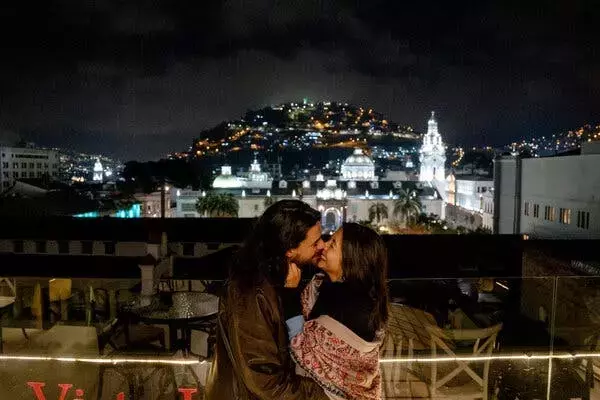
At a cozy cafe in Quito, the capital of Ecuador, a young woman delicately stirred her beverage, her eyes betraying recent tears. Opposite her, a man wept softly. From a nearby table, their intimate conversation was impossible to ignore.
She gently held his hands and, speaking in Spanish, inquired, “What is it you wish to do?”
He met her gaze and responded, “My dear, let us simply embrace with our legs.” This phrase, while seemingly straightforward, carries a depth of meaning not easily grasped by most Spanish speakers, even many Ecuadorians, and presents a formidable challenge for linguists and translators alike.
This particular idiom is a hallmark of the distinctive Spanish spoken in Ecuador's Andean region, a dialect rich with influences from Kichwa, an indigenous language that has thrived since the Inca established their presence on the slopes of the Pichincha volcano, long before the Spanish conquest in 1534.
Having relocated to Quito from Guayaquil on Ecuador's Pacific coast some years ago, the author embarked on a personal quest to document these linguistic nuances, meticulously collecting overheard conversations in various social settings—parties, dinners, and workplaces—captivated by the unique evolution of this form of Spanish.
The fusion of Kichwa and Spanish in the Ecuadorian Andes is a living testament to the rich cultural tapestry of the region. This linguistic blend not only highlights the resilience of indigenous languages but also underscores the dynamic nature of communication, where diverse cultures converge to create new and expressive forms of speech. It is a vibrant example of how history, geography, and human interaction shape the very words we speak, reflecting a profound sense of identity and heritage.
