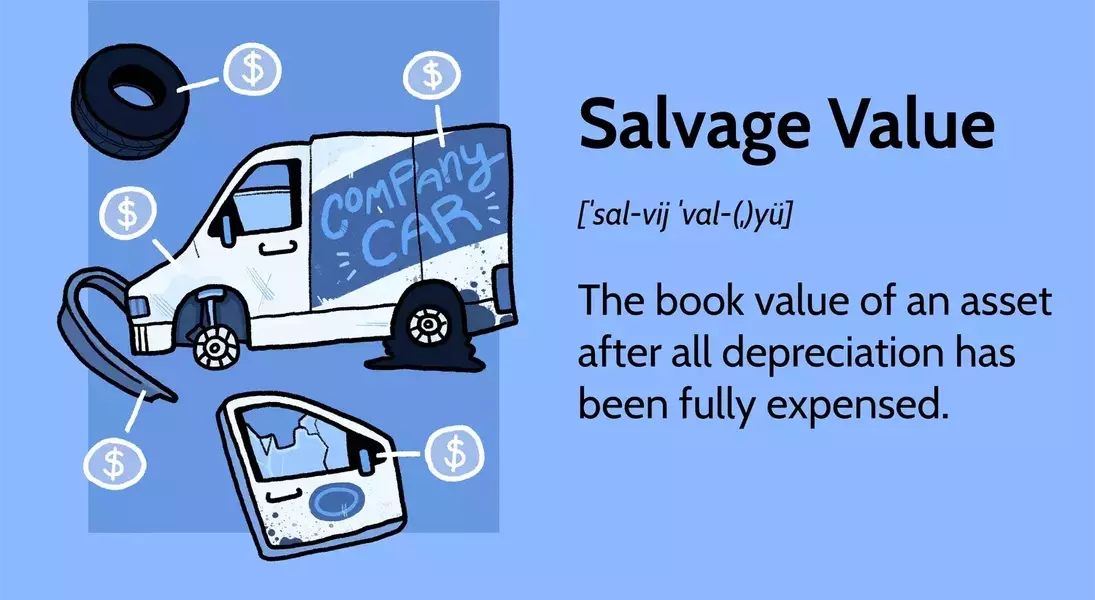
Salvage value represents the projected residual worth of an asset at the conclusion of its operational lifespan. This fundamental concept is pivotal in financial accounting, particularly for determining depreciation schedules and influencing how companies assess the book value of their assets. Accurately estimating this value involves various approaches, including professional appraisals, calculating a percentage of the original cost, or analyzing historical data.
The estimated salvage value can be applied to any asset a company depreciates over time. While some companies may set the salvage value to zero if an asset's residual worth is deemed negligible, many establish specific standards for its estimation. This value is critical as it defines an asset's worth on a company's financial records once it has been fully depreciated. It is based on the amount a company anticipates receiving from the sale of the asset after its useful life, which might include selling an inoperable asset for its constituent parts.
When estimating asset depreciation and salvage value, companies adhere to the matching principle, an accrual accounting concept. This principle dictates that expenses should be recognized in the same accounting period as the revenues they help generate. If an asset is expected to contribute to revenue over an extended period, it is assigned a long useful life. Conversely, if an asset's life is uncertain, a shorter estimated life with a higher salvage value might be used. Companies might also opt for accelerated depreciation methods to front-load expenses, though many simply assign a zero salvage value, assuming the asset's utility is fully consumed alongside its revenue generation.
Several methods are employed to compute depreciation, all of which consider salvage value. These include straight-line, declining balance, double-declining balance, sum-of-years digits, and units of production. Accelerated methods, such as declining balance, double-declining balance, and sum-of-years digits, apply higher depreciation expenses in the initial years. The depreciable amount of an asset, defined as its historical cost minus salvage value, represents the total amount that will be expensed over its useful life. The asset's carrying value at any point is its historical cost less accumulated depreciation to date.
The straight-line method, being the most straightforward, distributes equal depreciation expenses annually until the asset reaches its salvage value. For instance, an asset costing $5,000 with a $1,000 salvage value and a five-year life would incur $800 in annual depreciation. Accelerated methods like the declining balance apply a fixed percentage to the remaining book value, leading to larger deductions initially. The double-declining balance method doubles this rate, while the sum-of-years digits method uses a fractional approach to accelerate depreciation. The units of production method ties depreciation to the actual output of the asset, reflecting its usage rather than just time.
Salvage value is estimated through various techniques. One common method involves setting it as a percentage of the original cost. Alternatively, companies can engage independent appraisers for a professional assessment or leverage internal historical data from similar assets, especially for frequently replaced items like fleet vehicles. It's important to note that salvage value is typically an estimate, as the exact future market value is rarely known in advance. This estimation is distinct from book value, which reflects an asset's value on the balance sheet after accumulated depreciation, and residual value, which might include disposal costs or lease-end values. While closely related to scrap value, salvage value generally refers to the expected proceeds from an asset's disposal without necessarily implying conversion into raw materials.
In practice, consider a company purchasing a fleet of vehicles for $250,000. If each vehicle is expected to have a $5,000 salvage value, the company anticipates recovering $40,000 at the end of their useful life. Consequently, only $210,000 ($250,000 - $40,000) would be depreciated. Over a seven-year useful life, this would result in an annual depreciation of $30,000 using the straight-line method. This illustrates how salvage value directly impacts the depreciable base and, consequently, the annual depreciation expense, influencing financial reporting and tax planning.
Ultimately, salvage value is a critical component in asset management and financial planning. It helps businesses project the net cost of an asset over its lifespan and influences decisions regarding its eventual disposal. By accurately estimating salvage value, companies can refine their depreciation strategies, optimize cash flow forecasting, and ensure their financial statements reflect a more realistic picture of asset utilization and remaining worth.
