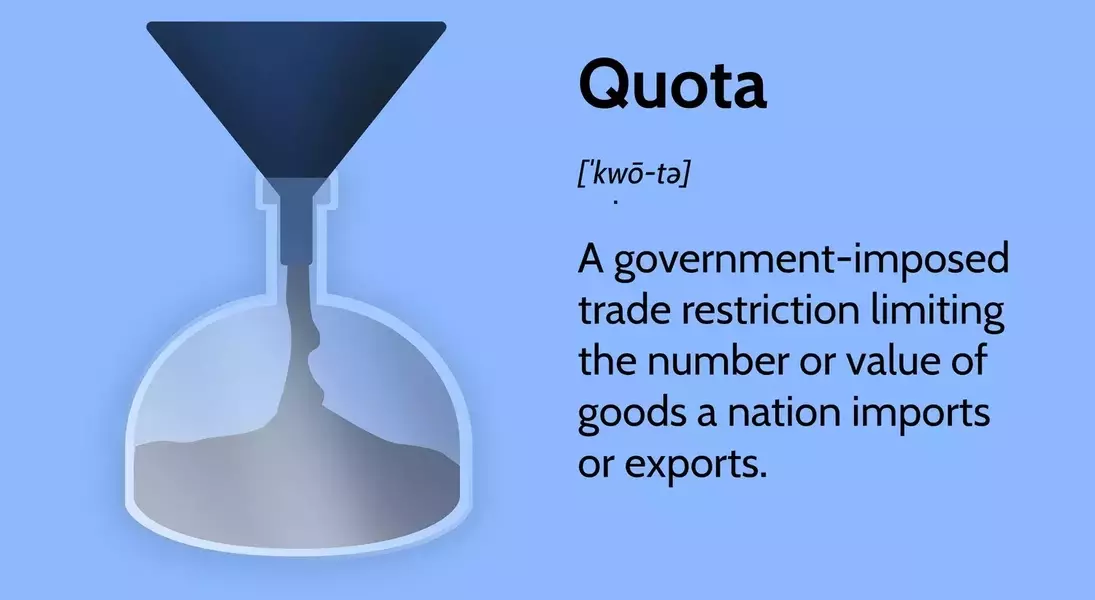
This article explores the multifaceted concept of quotas, examining their role as government-imposed trade restrictions, their application in business and politics, and their broader economic impact.
Unveiling the Power of Quotas: Shaping Markets and Societies
Defining Quotas: A Fundamental Concept
A quota is essentially a governmental directive that imposes restrictions on the volume or monetary worth of goods a country can either bring in or send out within a set timeframe. These measures serve various purposes, including balancing international trade, bolstering local industries, and managing the movement of commodities between nations. The implementation of such limits often stems from a desire to shield domestic production from foreign competition or to ensure the quality and safety of imported goods.
Exploring the Operational Dynamics of Quotas in Commerce
Quotas diverge significantly from tariffs, which involve taxes levied on imports or exports. Both instruments are employed by governments as protective measures to influence cross-border trade, yet their mechanisms are distinct. While quotas directly cap the quantity or value of goods a nation trades, tariffs augment the cost of these goods. Tariffs, also known as customs duties, are designed to increase the financial burden on producers or suppliers seeking to operate within a country's market. This generates additional revenue for the importing nation and offers protection to local producers by making foreign goods more expensive.
Regulatory Bodies Governing Import Quotas
In the United States, the Customs and Border Protection Agency plays a pivotal role in overseeing global trade, collecting duties, and enforcing trade regulations. Quotas in the U.S. manifest in three primary forms: absolute, tariff-rate, and tariff-preference level.
Types of Quotas and Their Economic Implications
An absolute quota establishes a definitive maximum on the quantity of a specific commodity that can be imported into the U.S. Once this limit is reached, any additional goods must be stored in a bonded warehouse or moved to a foreign trade zone until a new quota period begins. Tariff-rate quotas permit the import of a certain volume of goods at a reduced duty rate, with subsequent imports incurring a higher rate. Tariff-preference levels, conversely, are established through separate negotiations, often as part of Free Trade Agreements (FTAs).
Evaluating the Merits and Drawbacks of Quota Systems
Despite their contentious nature, quotas offer several potential advantages. They can shield domestic industries from foreign competition by limiting the influx of imported goods, thereby safeguarding local jobs. Quotas can also help rectify trade imbalances by curbing imports from countries with significant trade deficits, reducing reliance on foreign products. Furthermore, quotas can stabilize domestic prices by controlling supply fluctuations and can be used to enforce environmental, health, or safety standards on imported goods.
Real-World Examples of Quota Implementation
Historical instances illustrate the tangible impact of quotas. For example, in 2018, the Trump administration imposed substantial tariffs on imported solar panels from China, a move that reflected a more assertive stance on trade policy and significantly affected the U.S. solar industry. More recently, in December 2023, President Joe Biden issued a directive concerning the import volumes of steel and aluminum from the European Union, demonstrating ongoing governmental intervention in trade through quota adjustments.
Beyond Trade: Diverse Applications of Quotas
The concept of a 'quota' extends far beyond trade, finding application in various business and non-trade contexts. In business, a sales quota represents a target for sales personnel or teams to achieve within a given period, often with associated rewards or penalties. Employment quotas, or hiring quotas, are targets set by organizations to promote diversity and representation within their workforce, aiming to mirror community demographics or customer bases. Supplier quotas, meanwhile, involve a predetermined quantity of goods or services that a supplier is contracted to provide, crucial for ensuring consistent material availability for manufacturing and retail operations.
