
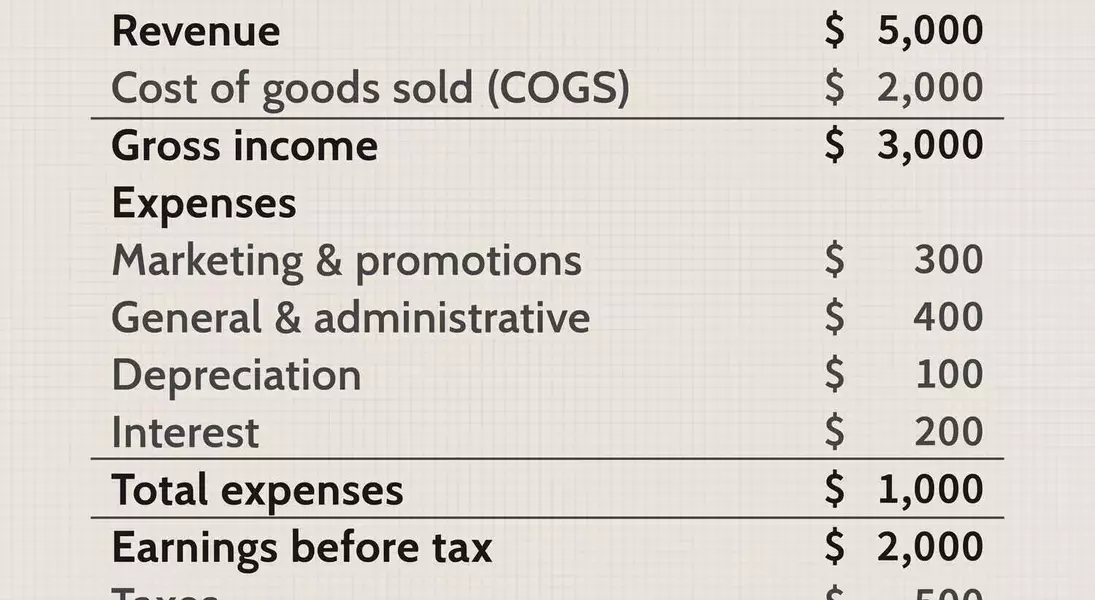

When analyzing a company's financial health, it is essential to distinguish between various profit metrics, such as gross profit, operating profit, and net income. These figures, all presented on a company's income statement, offer distinct perspectives on financial performance throughout the production and earnings cycle. While any positive cash flow might be broadly considered income, a comprehensive understanding of net income involves a more intricate calculation. Each of these profit indicators plays a unique role, making it crucial to grasp their specific definitions to make sound financial judgments.
Delving deeper into these metrics, gross profit represents the revenue remaining after deducting the direct costs associated with producing goods or services, commonly known as the cost of goods sold (COGS). This figure specifically highlights a product's individual performance. Operating profit, also referred to as operating income or earnings before interest and taxes (EBIT), is derived by subtracting both COGS and operating expenses from revenue. This metric provides insight into a company's core operational efficiency, excluding financial and tax considerations. Finally, net income, often called the 'bottom line,' is the most comprehensive profit measure, calculated by subtracting all expenses, including interest and taxes, from total revenue and adding any non-operating income. It signifies the ultimate profitability available to business owners and shareholders.
Understanding the interplay of gross profit, operating profit, and net income empowers both internal management and external investors to assess a company's financial landscape more effectively. Each metric serves a distinct purpose, from evaluating product-level efficiency to overall corporate profitability. Businesses can use these insights to fine-tune operations, control costs, and drive strategic growth, ultimately leading to sustained success and increased value for all stakeholders. For investors, these figures are indispensable tools for gauging a company’s earning potential and making informed investment decisions, thereby contributing to a robust and transparent financial market.
