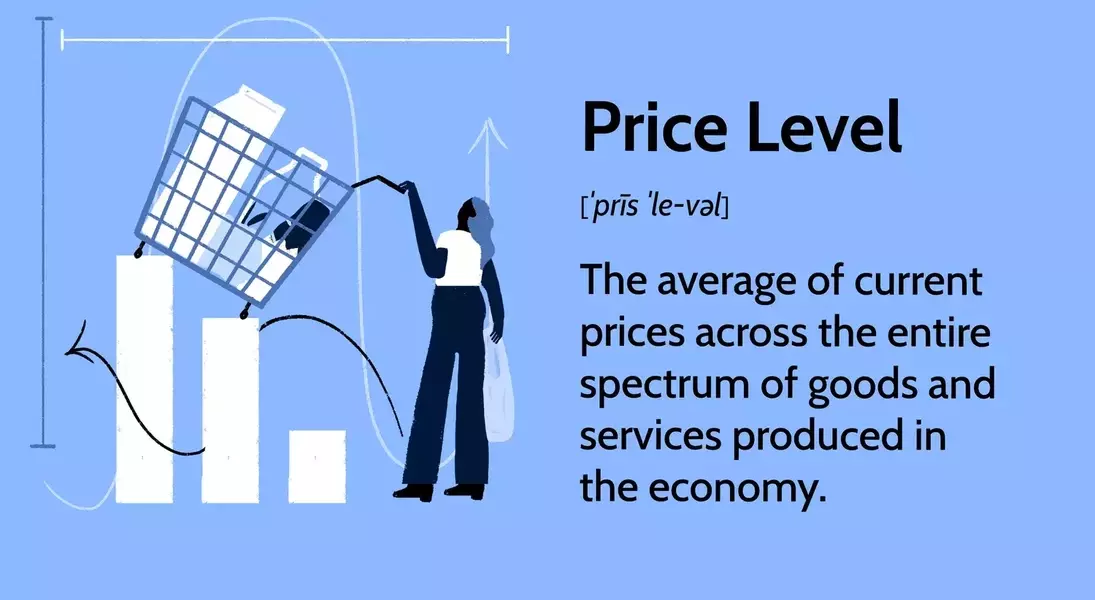
Price levels are a fundamental concept in economics and finance, influencing everything from daily consumer purchases to complex investment strategies. This comprehensive guide explores the definition of price levels, their impact on economic indicators, and their practical application in investment decisions.
Navigating the Economic Landscape: The Power of Price Levels
Defining Price Levels in the Economy
A price level essentially signifies the prevailing average costs of goods, services, and securities throughout an economy. More broadly, it can refer to the specific cost associated with any individual item, service, or financial asset. These values can be granular, like the minute fluctuations in stock prices, or broader, such as a general dollar amount for a good.
The Economic Significance of Price Levels
Price levels are vital economic metrics that economists meticulously observe. They directly affect consumers' purchasing power and the dynamics of buying and selling. Furthermore, they are integral to the interplay of supply and demand within the market. When demand rises, prices typically increase; when demand falls, prices tend to decrease.
The Dual Nature of Price Levels: Macroeconomics and Markets
The term "price level" holds two distinct meanings in the business world. The first, commonly understood, refers to the cost consumers or entities must pay for goods, services, or securities. These price shifts are critical for gauging inflation and deflation. Rapid inflation might lead central banks to tighten monetary policy and raise interest rates, curbing the money supply and aggregate demand. Conversely, sharp price drops might prompt central banks to ease policy, boosting the money supply and aggregate demand.
The second meaning pertains to the market valuation of assets like stocks or bonds, often characterized by support and resistance levels. In this context, a drop in an asset's price often fuels demand, establishing a support line. Conversely, a price surge can trigger a sell-off, creating a resistance zone.
Price Levels' Influence on Macroeconomic Indicators
In macroeconomics, price levels indicate the purchasing power of money or the rate of inflation. Economists analyze the economy's health by determining how much goods and services a fixed amount of currency can acquire. The Consumer Price Index (CPI) is a widely used tool for this purpose.
This analysis often employs a "basket of goods" approach, tracking the aggregate price changes of a selected group of consumer items and services over time. Economists typically use weighted averages rather than geometric means for these calculations. These price level snapshots enable the observation of broad price changes over time, affecting consumer demand and broader economic measures like Gross Domestic Product (GDP).
Price levels are among the most scrutinized economic indicators globally. Economists advocate for stable year-over-year prices to prevent excessive inflation. Should price levels escalate too rapidly, central banks and governments might implement measures to reduce the money supply or overall demand for goods and services. It's crucial to remember that while prices typically change gradually during inflationary periods, they can fluctuate multiple times a day during hyperinflation.
Price Levels in Investment Strategies: Support and Resistance Dynamics
For traders and investors, price levels dictate buying and selling opportunities. They use specific price thresholds, known as support and resistance, to determine optimal entry and exit points for their trades.
A support level indicates a price point where a decline is expected to halt due to high demand. As an asset's price falls, interest in buying it increases, forming this support line. Conversely, resistance zones emerge when price increases lead to widespread selling, thereby suppressing further demand.
Identifying these support and resistance areas provides invaluable insights for potential trade entries or exits. When a price reaches either a support or resistance level, it typically reacts in one of two ways: it either reverses direction away from that level or breaks through it, continuing its trajectory until it encounters the next significant support or resistance level.
The Concluding Perspective
Price levels serve as critical barometers of economic health, signaling potential inflationary or deflationary trends. They are instrumental in evaluating purchasing power through indices like the CPI, often prompting central banks to adjust their policies to maintain economic equilibrium.
Beyond macroeconomic implications, price levels are integral to investment strategies, providing crucial support and resistance points that guide trading decisions.
