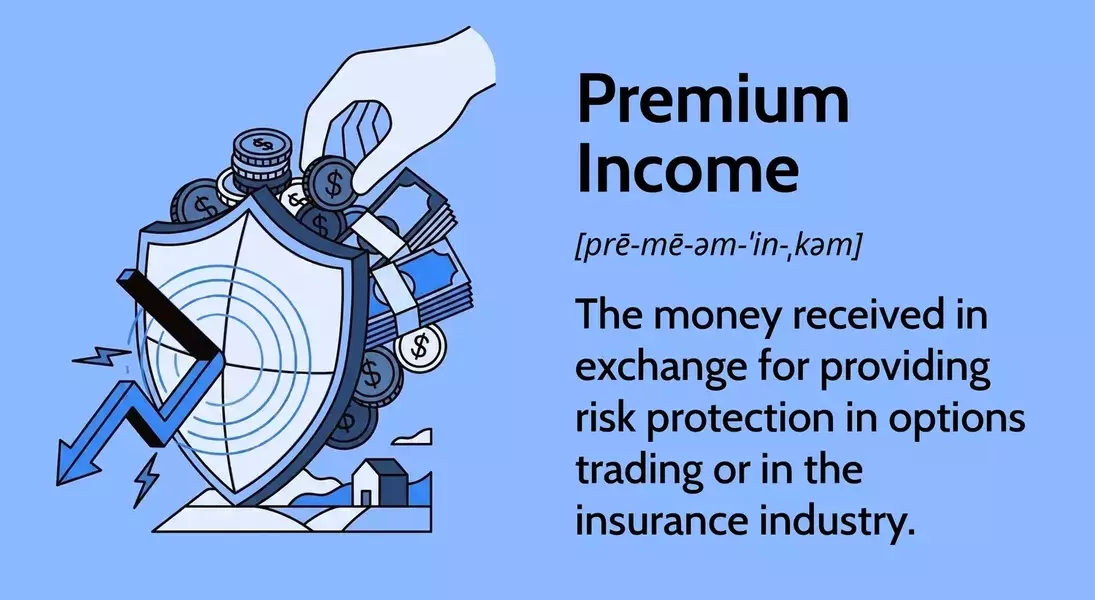
This article explores the concept of premium income, a term that appears in both financial markets and the insurance sector. It represents the funds received by an individual or entity for offering risk protection. In the context of options trading, investors earn premium income by selling options contracts, thereby taking on the obligation to potentially deliver an underlying asset. Similarly, insurance companies generate premium income from policyholders in exchange for covering potential losses or damages. Understanding this dual application of premium income is crucial for comprehending how risk is managed and monetized in different financial landscapes.
The Dual Nature of Premium Income: Options and Insurance
Premium income is a financial term referring to money obtained from selling risk protection. It applies primarily in two fields: options trading and insurance. In both scenarios, the recipient is compensated for assuming a potential financial obligation.
In the domain of financial trading, specifically options contracts, an options writer (seller) earns premium income by selling a contract to a buyer. This payment grants the buyer the right, but not the obligation, to exercise the contract at a predetermined strike price. If the option is exercised, the writer is then obligated to deliver the underlying asset or cash. The value of an options premium is theoretically composed of two elements: the difference between the strike price and the current market price of the underlying asset, and a monetary representation of the time remaining until the contract's expiration. This time value diminishes as the expiration date approaches, a phenomenon known as time decay.
For example, an options trader quoting a premium of $3.25 per share for a call option on a standard contract covering 100 shares would expect to receive $325 in premium income. This sum is paid upfront by the buyer to the seller for undertaking the risk.
In the insurance industry, premium income is the revenue an insurance carrier receives from policyholders for providing coverage against various risks. These risks can range from auto accidents and loss of life to property damage. Insurance companies meticulously calculate premiums based on the perceived level of risk associated with potential claims. The collected premium income is then strategically utilized either to cover claims from other policyholders or invested in liquid assets to ensure funds are available for future payouts. A portion of this premium income is considered a liability, as the insurance carrier will eventually need to disburse it to policyholders who file valid claims.
Thus, whether in derivatives markets or risk management services, premium income serves as a fundamental mechanism for transferring and compensating risk.
The concept of premium income highlights a crucial aspect of financial and insurance markets: the pricing of risk. From a broader perspective, it underscores how entities can generate revenue by effectively assessing and managing potential future uncertainties. This practice encourages sophisticated risk analysis and diversification strategies, ensuring stability and profitability within these sectors. For individuals and businesses, understanding premium income helps in making informed decisions about investments and insurance coverage, balancing potential returns or protection with the associated costs.
