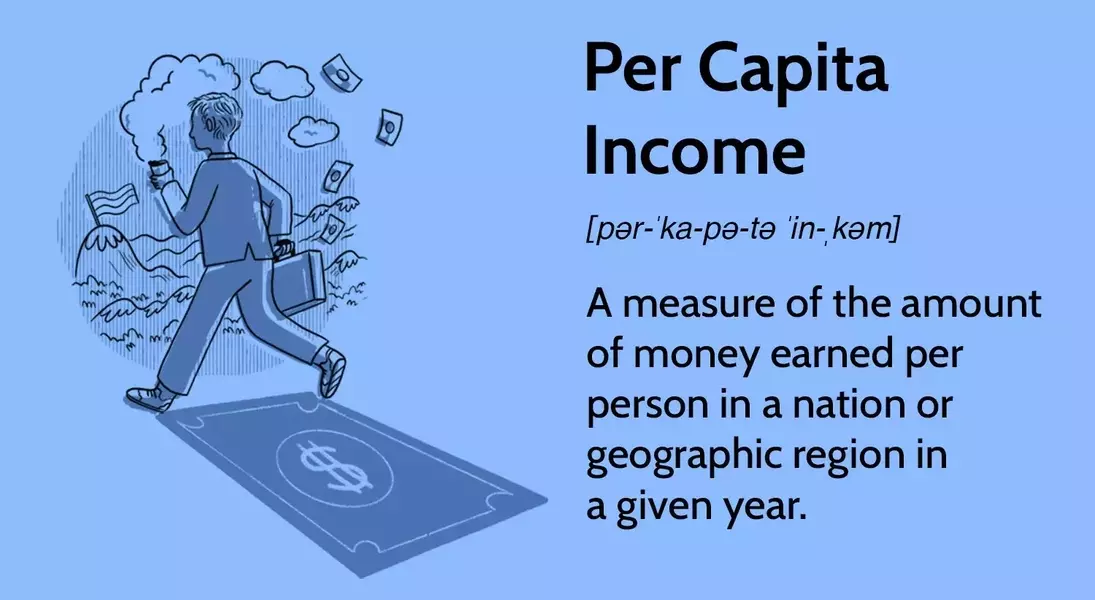
Per capita income serves as a fundamental economic metric, providing an average measure of income for each person within a defined geographical area. This indicator is derived by dividing the total income generated in a region by its entire population. It is widely utilized to gauge the general economic health and the prevailing standard of living within a community or nation. Despite its utility in offering a broad snapshot of prosperity, this measure is subject to certain limitations, as it doesn't fully capture nuances such as income disparities, the impact of inflation, or variations in living costs.
Per capita income is often employed by governments and businesses to understand economic trends and inform strategic decisions. For instance, government bodies may use this data to assess the need for social programs or to compare economic progress across different regions. Similarly, businesses might leverage per capita income figures to identify potential markets for their products and services, assuming that higher average incomes suggest greater purchasing power. However, it is essential to consider this statistic in conjunction with other economic indicators to form a comprehensive understanding.
One notable aspect of per capita income is its inclusive nature, as it considers every individual in the population, regardless of age or employment status. This contrasts with other income measures like household income, which focuses on collective earnings within a single living unit, or family income, which applies to related individuals under one roof. While broad inclusion allows for a general population-wide assessment, it can also dilute the accuracy of the average, particularly in areas with a significant proportion of non-working individuals, such as children.
For instance, the United States Census Bureau meticulously collects and analyzes per capita income data annually. Their methodology involves aggregating all forms of income for individuals aged 15 and older, including wages, self-employment earnings, interest, dividends, and government benefits like Social Security. Excluded from these calculations are non-monetary benefits such as employer-paid health insurance, food stamps, and capital gains. In 2022, the U.S. per capita income stood at $41,804, a figure lower than the median household income of $74,580, underscoring the distinction between these two important economic measurements.
The practical applications of per capita income are diverse. Economic analysts frequently use it to rank the affluence of different areas. For example, the U.S. Bureau of Economic Analysis (BEA) uses per capita income, alongside median household income, to determine the wealthiest counties. This data can also help evaluate the affordability of an area, by comparing average incomes with housing costs. Businesses planning new locations often examine per capita income to gauge market potential, anticipating higher sales in areas with greater average disposable income.
However, the limitations of per capita income are significant. It does not provide a clear picture of income inequality; a high average can conceal vast disparities between the rich and the poor. For instance, a town with a few very high earners and many low earners might show a deceptively high per capita income, masking significant economic hardship for the majority. Furthermore, per capita income often fails to account for inflation, meaning an increase in nominal income might not translate to an improvement in real purchasing power. It also overlooks non-monetary aspects of welfare, such as the quality of public services, work conditions, education, and health benefits, which are crucial components of overall living standards. When comparing internationally, currency exchange rates and varying costs of living can distort the picture, making direct comparisons challenging without adjustments like purchasing power parity (PPP). Moreover, the inclusion of non-earning individuals, like children, can artificially lower the average income in countries with younger populations.
In conclusion, per capita income is a valuable tool for understanding the economic landscape and is instrumental in broad economic comparisons and policymaking. However, its inherent limitations necessitate its use in conjunction with other economic metrics. Indicators such as median household income, poverty rates, and measures of income disparity offer a more nuanced and accurate depiction of economic reality, helping to paint a complete picture of societal well-being and financial health.
