Operating costs represent the routine financial outlays a business makes to sustain its core activities and administrative functions. These expenses, crucial for a company's operational continuity and efficiency, directly impact its profitability. This comprehensive guide delves into the nature of operating costs, their calculation, various classifications, and their strategic importance in financial management. Understanding and managing these costs is paramount for any business aiming to optimize its financial health and long-term success.
Businesses classify their expenditures into two main categories: operating costs and non-operating costs. Operating costs encompass the day-to-day expenses directly tied to generating revenue and running the business, such as manufacturing goods or providing services. Non-operating costs, conversely, are not directly related to the core business activities and include items like interest payments on loans. This distinction in accounting allows companies to accurately assess the efficiency of their primary operations and identify areas for cost reduction.
A primary objective for any business is to maximize its earnings, which are derived from subtracting all expenditures from its total revenue. While an increase in revenue naturally boosts profits, an uncontrolled rise in expenses can significantly diminish them. Therefore, businesses often prioritize reducing operational expenses as a more direct and often quicker route to enhance profitability compared to solely focusing on increasing sales. However, it's crucial to strike a delicate balance. Excessive reductions in operational outlays can inadvertently harm long-term profitability by hindering productivity and impacting sales. For instance, drastically cutting customer service staff might lead to immediate payroll savings, but it could also result in dissatisfied customers and a subsequent decline in revenue and sustained earnings.
The calculation of a company's operational expenditures involves summing the cost of goods sold (COGS) and other operational expenses. These figures are typically found in a company's income statement, where COGS might also be referred to as the cost of sales. The formula for determining total operating costs is straightforward: Operating Cost = Cost of Goods Sold + Operating Expenses. Given that both expenses and overall business operations evolve, these costs are typically computed for specific financial periods, such as a month, quarter, or year, aligning with the reporting cycles of income statements.
Operational expenses are broadly categorized into three types based on their behavior in relation to production or sales volumes: fixed, variable, and semi-variable costs. This classification helps businesses understand how different expenditures respond to changes in operational activity. Fixed costs are those that remain constant regardless of the level of production or sales. Even if a company ceases all production, these costs still need to be paid. Examples include rent for a factory, insurance premiums, and the depreciation of equipment. Fixed costs are advantageous for achieving economies of scale, as increasing production spreads these static costs over a larger output, thereby reducing the per-unit cost. However, this principle has its limits; beyond a certain production threshold, businesses may need to expand facilities, which would then increase their fixed costs.
In contrast to fixed costs, variable costs fluctuate directly with the level of production or sales. When production increases, variable costs rise, and when production decreases, they fall, becoming zero if production ceases entirely. Raw materials and electricity consumption for production are classic examples of variable costs. For instance, a manufacturing firm will purchase more raw materials when it scales up production and none if it halts production. While variable costs increase with production, businesses can sometimes secure volume discounts, leading to a lower per-unit cost even as total variable costs rise.
Semi-variable or semi-fixed costs exhibit characteristics of both fixed and variable expenses. These costs change in response to production variations but do not disappear entirely when production drops to zero. Overtime wages are a common example. Regular wages for a core workforce are typically fixed, as a company cannot eliminate them completely and remain operational. However, overtime pay directly correlates with increased production demands. Thus, if a company needs to boost output, overtime wages will increase, demonstrating a variable component, while a baseline level of labor cost remains fixed regardless of overtime usage. Such costs require careful management to balance operational flexibility with cost efficiency.
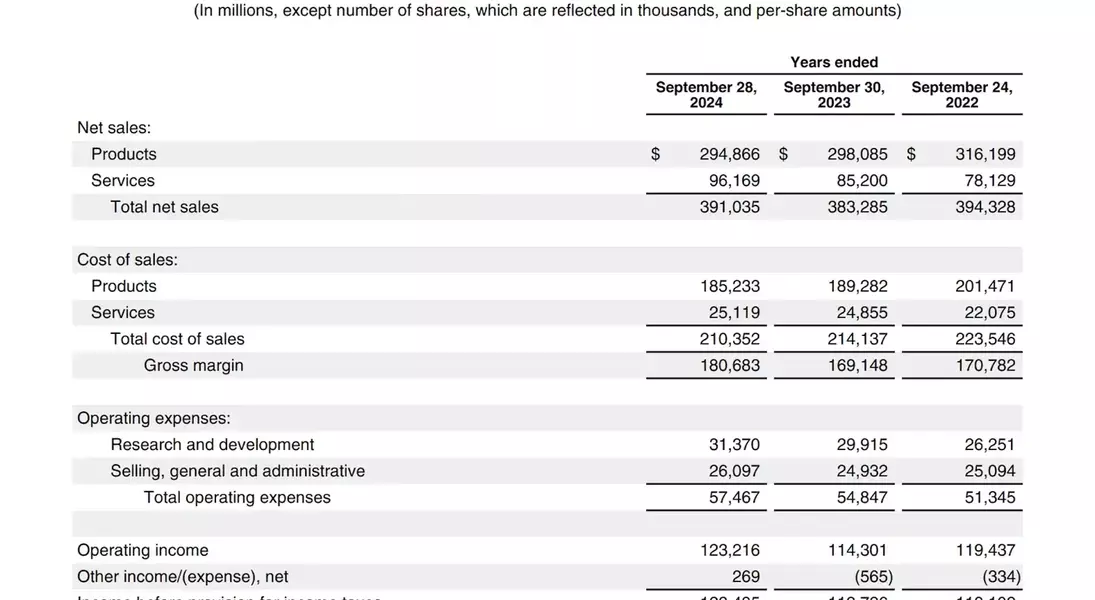
Another important distinction within operational expenditures is between operating costs and Selling, General, and Administrative (SG&A) expenses. SG&A costs are a subset of operating costs, specifically encompassing expenditures related to managing the company, advertising and selling its products or services, and delivering them to customers. Unlike the direct costs of manufacturing (COGS), SG&A expenses are indirect. Collectively, SG&A expenses combined with COGS form a company's total operating costs. For example, in Apple's income statement for the year ending September 2024, the cost of goods sold was $210.4 billion and operating expenses (including SG&A) were $57.5 billion, resulting in total operating costs of $267.9 billion.
In financial analysis, operating costs are a key metric for assessing a company's operational efficiency. By subtracting these costs from total revenue, businesses can determine their operating income, providing a clear picture of profitability from core operations. For investors, analyzing operating costs over multiple periods, such as several quarters or years, offers insights into a company's ability to manage its expenditures effectively. This longitudinal analysis, when coupled with an evaluation of overall financial performance and revenue trends, helps stakeholders understand how well a business is controlling costs and enhancing its bottom line over time, making it a critical component of a comprehensive financial review.
