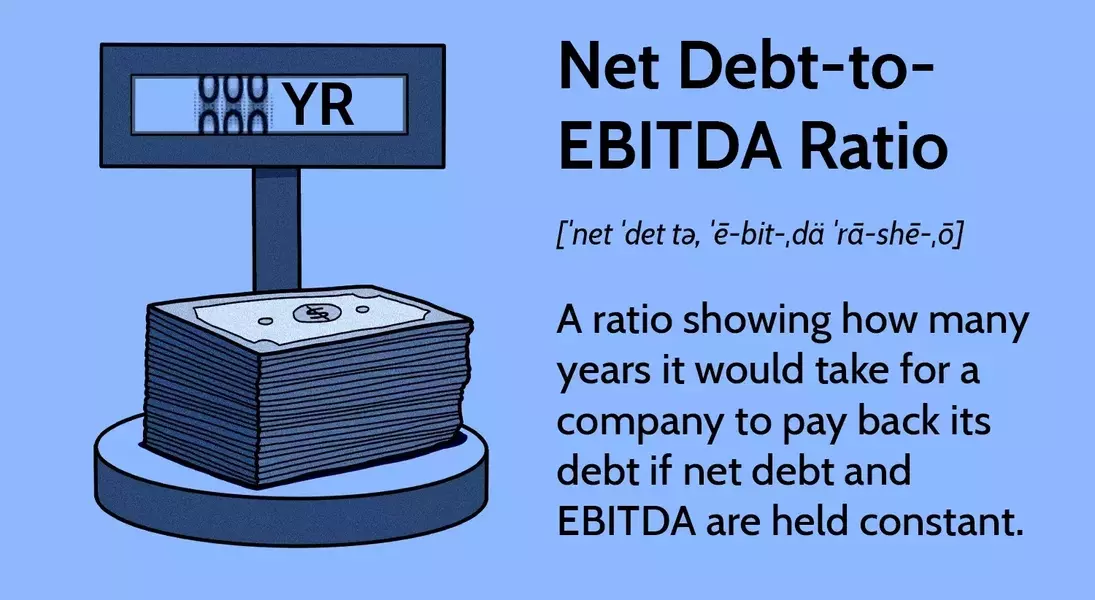
The net debt-to-EBITDA ratio is a significant indicator of a company's financial leverage and its capacity to manage its debt obligations. This metric assesses how many years of earnings, specifically Earnings Before Interest, Taxes, Depreciation, and Amortization (EBITDA), would be required to fully cover its net debt. A favorable ratio, particularly one that is negative (indicating more cash than debt), suggests robust financial standing. Ratios between 1 and 3 are typically seen as manageable, while anything above 3 may signal potential financial strain.
This ratio is derived by subtracting cash and cash equivalents from a company's total interest-bearing liabilities and then dividing the result by its EBITDA. Unlike the standard debt-to-EBITDA ratio, the net debt-to-EBITDA ratio provides a more refined view of a company's debt burden by accounting for readily available cash that can be used for debt reduction. This makes it a preferred tool for analysts seeking a comprehensive understanding of a company's financial risk profile.
Evaluating the net debt-to-EBITDA ratio involves more than just a single calculation; it necessitates a comparative analysis against industry benchmarks and historical trends. Industries with high capital intensity, such as telecommunications or utilities, might naturally exhibit elevated ratios. However, due to their stable income streams, these companies often remain creditworthy. A horizontal analysis, which tracks the ratio's evolution over time, can reveal whether a company's debt burden is increasing or decreasing, thereby offering deeper insights into its financial trajectory.
While the net debt-to-EBITDA ratio offers a convenient and straightforward method for assessing a company's debt repayment capabilities, it is not without its limitations. Its ease of calculation, drawing data from balance sheets and income statements, is a definite advantage. However, relying solely on EBITDA, which excludes interest expenses, might not always present the clearest picture of cash available for debt service. For some companies, interest payments can be substantial, influencing actual cash flow significantly. Therefore, a more precise evaluation of cash available for debt repayment might involve considering net income adjusted for capital expenditures, depreciation, and amortization.
For instance, consider Company ABC. In a prior fiscal year, its short-term debt totaled $6.31 billion, long-term debt was $28.99 billion, and cash holdings amounted to $13.84 billion. This translates to a net debt of $21.46 billion ($6.31 billion + $28.99 billion - $13.84 billion). With an EBITDA of $60.60 billion for the same period, Company ABC's net debt-to-EBITDA ratio was 0.35 ($21.46 billion ÷ $60.60 billion), indicating a strong financial position.
Fast forward to the most recent fiscal year, Company ABC's short-term debt rose to $8.50 billion, long-term debt to $53.46 billion, and cash reserves to $21.12 billion. Its net debt consequently increased to $40.84 billion year-over-year. Despite a significant 90.31% increase in net debt, its EBITDA also grew by 28.53% to $77.89 billion. This resulted in a net debt-to-EBITDA ratio of 0.52 ($40.84 billion ÷ $77.89 billion), marking a 49.81% increase from the previous year. Although the ratio grew, remaining below 1 still reflects the company's ability to fulfill its debt obligations, even with debt expanding faster than its earnings.
This financial tool is instrumental in evaluating a company's capacity to manage its outstanding liabilities. By comparing net debt against earnings, it offers a quick snapshot of financial resilience. While a negative ratio is a clear sign of strength, a range of 1 to 3 typically suggests a healthy level of debt management. Conversely, a ratio exceeding 3 warrants caution, indicating potential difficulties in meeting financial commitments.
