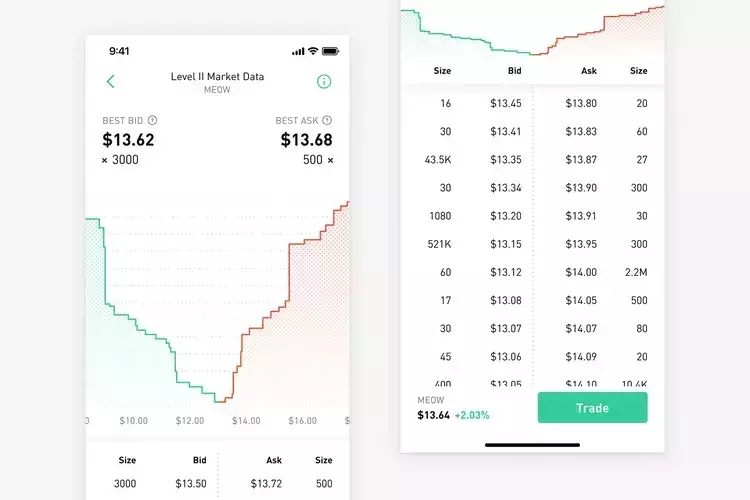

Market depth is a crucial metric for understanding how resilient a financial market is to large trades. It reveals the extent to which a security can absorb significant buy or sell orders without undergoing substantial price changes, acting as a barometer for market liquidity. This article delves into the concept of market depth, its implications for trading, and how traders leverage this data for informed decision-making.
Navigating Market Dynamics: The Power of Depth
What Constitutes Market Depth in Financial Markets?
Market depth provides a snapshot of available buy and sell orders for a specific asset across various price levels. This indicator is vital for investors seeking to understand the ease with which a security can be traded without provoking major price shifts. A robust market depth signifies ample liquidity, where large trades can be executed with minimal disruption to prices. Conversely, shallow market depth suggests that even moderately sized orders can trigger considerable price swings.
The Impact of Market Depth on Trading Strategies
While often associated with trading volume and liquidity, market depth, also known as Depth of Market (DOM), offers a distinct perspective. It's not merely about high trading volumes but rather the distribution of orders within a security's order book. This book, a compilation of pending buy and sell orders at different price points, allows traders to gauge the market's immediate capacity to absorb trades. Even high-volume stocks can experience significant volatility if their market depth is uneven, reflecting order imbalances that can lead to abrupt price movements.
Harnessing Market Depth Data for Trading Success
Market depth data serves as a predictive tool for traders, offering clues about potential price trajectories. By analyzing the bid-ask spread and the concentration of orders at various price levels, traders can anticipate market reactions. Securities characterized by deep markets and high liquidity enable traders to execute large orders without unduly influencing the market price. In contrast, thinly traded securities with poor market depth are susceptible to substantial price movements from even modest buy or sell orders.
Market Depth in Practice: A Visual Illustration
Consider a hypothetical order book for "MEOW" shares. If the current price range is $13.62 (bid) to $13.68 (ask), with 3,000 shares at the bid and 500 at the ask, the depth of bids on the right panel provides further insight. If a large sell order of 10,000 shares is placed, it would consume all available bids down to $13.35, where a significant buy order for 43,500 shares resides. This scenario would cause the market price to drop by nearly 30 cents, or approximately 2%, demonstrating a low level of market depth. Such real-time data, often provided by trading platforms, empowers traders to capitalize on short-term price fluctuations, particularly when a company experiences significant events like an initial public offering, by identifying strong buying demand that could propel prices upward.
