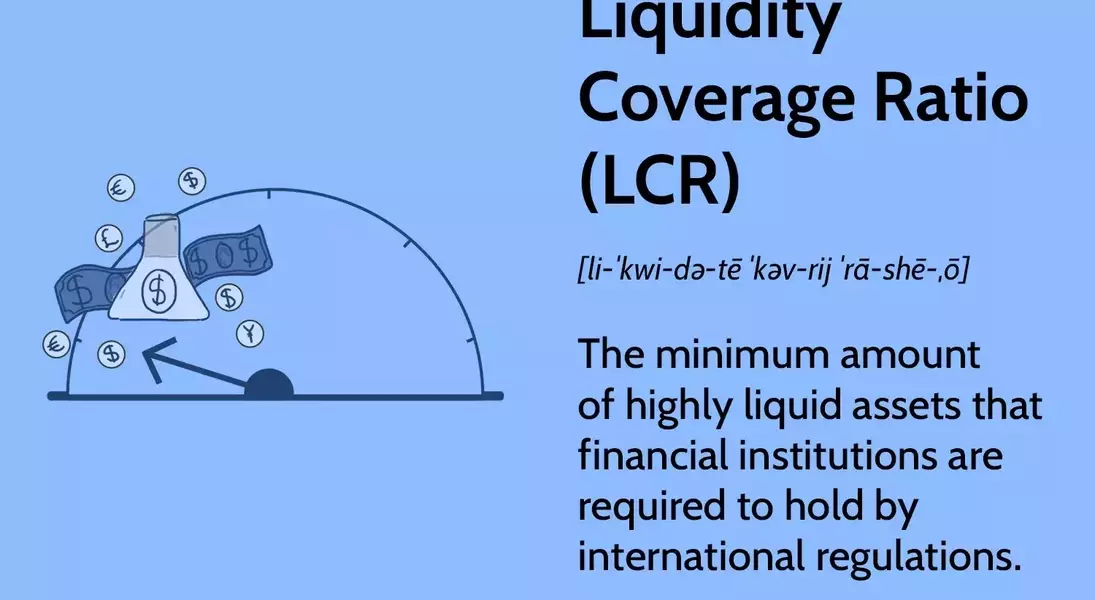
This article explores the Liquidity Coverage Ratio (LCR), a vital regulatory tool implemented after the 2008 financial crisis to enhance the resilience of banks. It delves into the purpose, calculation, and evolution of the LCR, highlighting its significance in ensuring banks can meet their short-term financial obligations even during periods of market stress.
Safeguarding Financial Systems: The Imperative of Bank Liquidity
The Liquidity Coverage Ratio: A Fundamental Pillar of Bank Resilience
The Liquidity Coverage Ratio (LCR) is a critical regulatory measure stemming from the Basel Accords, a framework established by the Basel Committee on Banking Supervision. This regulation serves as a daily stress test for banks, compelling them to maintain a robust buffer of readily available assets. Its primary aim is to protect not only individual financial institutions but also the wider ecosystem of financial and economic actors dependent on their stability.
The Genesis of LCR: Lessons from the 2008 Financial Meltdown
Following the tumultuous 2008 financial crisis, regulators recognized the urgent need for enhanced liquidity safeguards. The collapse of key institutions during that period underscored the vulnerability of banks to rapid cash outflows. In response, the LCR was conceived to ensure that banks possess an adequate supply of highly liquid assets, capable of being swiftly converted into cash, to weather intense periods of financial market dislocation. The standard, adopted in the U.S. in 2014, mandates that banks hold enough cash-like assets to survive 30 days of market turbulence.
Defining the Liquidity Coverage Ratio: More Than Just a Safety Net
The LCR necessitates that financial institutions maintain a specific portfolio of assets that can be rapidly converted into cash—such as Treasury bonds, rather than illiquid long-term loans or real estate—to sustain operations for a 30-day period. These assets are categorized into three tiers, reflecting their ease of liquidation during a crisis. Tier 1 assets, including cash, central bank reserves, and highly desirable government securities, are fully counted. Tier 2A assets are high-quality but less liquid, subjected to a 15% discount. Tier 2B assets, comprising corporate stocks and bonds, are counted at 50% to 75% of their value. The 30-day survival period is not arbitrary; it aligns with historical patterns of crisis duration, where government intervention often stabilized markets within approximately one month.
Critiques and Controversies: The LCR's Efficacy Under Scrutiny
Despite its implementation, the LCR has faced criticism from some experts who argue its current requirements are insufficient. These critics suggest that the ratio may underestimate the actual cash outflows that would occur during a severe crisis, particularly concerning customer withdrawals, the disappearance of short-term interbank funding, and the cash needed for collateral. Such concerns imply that even compliant major U.S. banks could remain vulnerable to liquidity crises, posing systemic risks.
Regulatory Shifts: Alterations to LCR Requirements in 2019
The LCR has been a point of contention between regulators and the banking sector due to the opportunity cost associated with holding highly liquid, lower-yielding assets. In 2019, under the Trump administration, the Office of the Comptroller of the Currency introduced a "tailoring rule" that significantly scaled back LCR requirements for mid-sized banks. This adjustment exempted banks with assets between $100 billion and $250 billion from full LCR compliance, reserving the strictest rules for the largest U.S. financial institutions. Under the revised framework, only banks with over $700 billion in assets or more than $75 billion in cross-border activities faced full LCR requirements, while those with assets between $250 billion and $700 billion faced reduced obligations, and banks under $250 billion were entirely exempt.
The SVB Collapse: A Harsh Re-evaluation of LCR Reforms
The failure of Silicon Valley Bank (SVB) in 2023 prompted a critical re-evaluation of the 2019 LCR changes. Many experts contend that SVB, had it been subject to the pre-2019 LCR rules, would have been required to maintain substantially more liquid assets, potentially averting its collapse. This event highlighted that even moderately sized banks can pose systemic risks, challenging the rationale behind relaxing regulatory requirements for them.
Calculating Liquidity Coverage: A Detailed Methodology
The calculation of the LCR involves a precise formula to ensure a bank’s liquid assets can cover its expected cash outflows over a 30-day crisis period. The ratio must be at least 100%. The formula is: LCR = (High Quality Liquid Asset Amount (HQLA)) / (Total Net Cash Flow Amount). For instance, if a bank holds $85 billion in HQLA and anticipates $68 billion in cash outflows during a crisis, its LCR would be 125%, exceeding the minimum requirement. However, accurately determining HQLA and net cash flows involves meticulous assessment of asset quality, projected outflows based on historical and stress scenarios, potential collateral value changes, timing of payments, and customer behavior during crises.
LCR Versus Capital Requirements: Distinct Yet Complementary Safeguards
While both LCR and capital requirements bolster bank stability, they address different aspects of risk. The LCR specifically targets a bank’s ability to manage short-term liquidity needs, preventing forced asset sales at distressed prices. In contrast, capital requirements focus on a bank's capacity to absorb long-term losses and remain solvent. The 2008 crisis underscored that a bank could be well-capitalized but still face liquidity failure, leading to the parallel strengthening of both types of regulations. The largest and most interconnected global systemically important banks (G-SIBs) face additional capital surcharges, reflecting their heightened systemic risk.
The Enduring Importance of the LCR: A Continuous Evolution
The LCR, a cornerstone of post-2008 financial reform, is designed to prevent bank runs by mandating that large financial institutions hold adequate emergency reserves. However, recent bank failures have demonstrated that its effectiveness is contingent on the scope and enforcement of these rules. Experts continue to debate whether the LCR’s assumptions are sufficiently conservative, especially in light of rapid withdrawals of uninsured deposits. Nevertheless, the LCR remains an indispensable tool for monitoring and maintaining the stability of the global financial system.
