This article delves into the characteristics of leptokurtic distributions, highlighting their heightened peaks and substantial tails. It explains how these features suggest a greater likelihood of encountering extreme values compared to standard distributions. The discussion also covers their role in assessing Value at Risk (VaR) and distinguishes them from mesokurtic and platykurtic distributions, offering practical insights for investors.
Navigating Volatility: The Investor's Guide to Leptokurtic Distributions
Exploring the Nature of Leptokurtic Distributions
A leptokurtic distribution, a key concept in statistical analysis, is identifiable by its pronounced peak and heavy tails. This statistical shape signifies a kurtosis value exceeding three, indicating a heightened potential for extreme occurrences compared to a typical normal distribution, which possesses a kurtosis of precisely three (often referred to as a platykurtic distribution, characterized by a flatter peak and lighter tails). For market participants, grasping the implications of leptokurtic distributions is crucial, as it sheds light on the possibility of exceptional market movements or investment outcomes.
The Inner Workings of Leptokurtic Forms
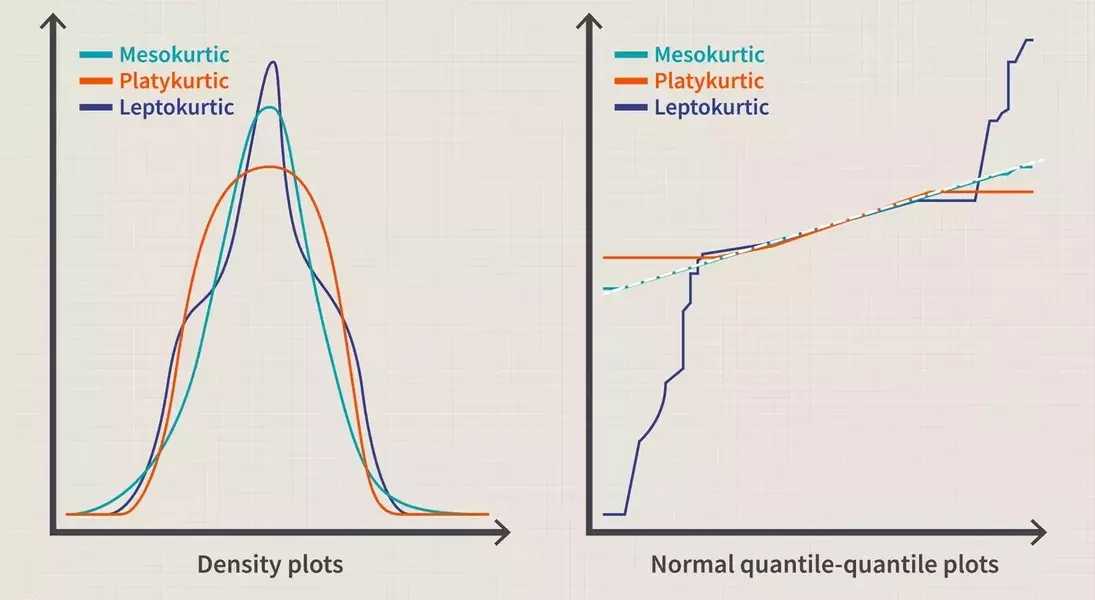
These distributions are defined by their positive kurtosis, which surpasses that of a normal distribution. Given that a normal distribution has a kurtosis of exactly three, any distribution registering a kurtosis value greater than three falls under the leptokurtic classification. Fundamentally, leptokurtic distributions are marked by more substantial tails or an elevated probability of observing extreme outlier values when contrasted with mesokurtic or platykurtic counterparts. When assessing historical investment returns, kurtosis offers investors a metric to gauge an asset's inherent risk. A leptokurtic pattern implies that an investor might experience more significant fluctuations—potentially three or more standard deviations away from the average—thereby increasing the chance of both exceptionally high and remarkably low returns.
Quantifying Potential Loss: Utilizing Leptokurtic Distributions in Value at Risk
Leptokurtic distributions play a pivotal role in the evaluation of Value at Risk (VaR) probabilities. While a normal distribution of VaR generally provides more stable outcome predictions due to its inclusion of up to three kurtoses, leptokurtic distributions present a more complex scenario. Typically, fewer kurtoses and higher confidence levels within each kurtosis render a VaR distribution more dependable and secure. However, leptokurtic distributions are recognized for extending beyond three kurtoses, which often diminishes the confidence levels associated with the excessive kurtosis, thereby reducing overall reliability. Furthermore, leptokurtic distributions can indicate a greater VaR in the left tail, attributed to the larger area under the curve in extreme negative scenarios. In essence, an increased probability of negative returns far from the mean on the distribution's left side translates to a higher Value at Risk.
Comparing Leptokurtosis with Mesokurtosis and Platykurtosis
While leptokurtosis signals a greater potential for outliers, mesokurtosis and platykurtosis suggest a lesser likelihood of such extreme events. Mesokurtic distributions exhibit a kurtosis close to 3.0, signifying an outlier profile similar to that of a normal distribution. In contrast, platykurtic distributions display a kurtosis below 3.0, indicating fewer outliers than a normal distribution. Investors strategically consider the statistical distributions linked with various investment types when making allocation decisions. Those with a lower tolerance for risk may gravitate towards assets and markets characterized by platykurtic distributions, given their reduced propensity for extreme outcomes, whereas risk-takers might be drawn to leptokurtic profiles in pursuit of potentially higher returns.
A Practical Illustration of Leptokurtic Distributions
Consider a hypothetical scenario involving an excess of positive kurtosis. If one were to meticulously record the daily closing price of stock XYZ over the course of a year, this data would reveal the frequency with which the stock achieved specific closing values. Plotting these closing values on the X-axis and their frequency on the Y-axis would produce a bell-shaped curve representing the stock's closing price distribution. Should a narrow range of closing prices occur frequently, the resulting curve would be notably slender and steep. Conversely, if closing values fluctuate widely, the bell curve would appear broader with gentler slopes. The tails of this curve would illustrate the frequency of significantly deviated closing prices, with graphs featuring numerous outliers exhibiting thicker tails extending from both sides of the bell.
The Core Message
Leptokurtic distributions serve as crucial analytical tools in finance, marked by their elevated peaks and extended tails. This configuration implies a higher likelihood of extreme outcomes compared to normal (mesokurtic) or flatter (platykurtic) distributions. Such distributions are particularly significant for investors as they illuminate the potential for substantial gains or losses. By understanding leptokurtic distributions, investors can more effectively evaluate risk and align their investment decisions with their individual risk tolerance, whether they prefer more conservative strategies or are inclined to pursue higher returns through greater risk exposure.
