Joint probability is a fundamental concept in statistics that helps quantify the likelihood of two or more independent events happening at the same time. This measure is crucial for statisticians, data analysts, and financial professionals who build models, evaluate risks, and make informed investment decisions by understanding the simultaneous occurrence of different phenomena. While it quantifies concurrent events, it's important to note that joint probability does not explain how these events might influence each other.
A joint probability quantifies the chance that two or more events will occur in unison. For this statistical measure to be applicable, each event must be independent of the others. For example, consider the probability of simultaneously flipping a coin and getting heads, and rolling a die to get a six. Another illustration could be rolling two dice and both landing on a three. These concepts can be visually represented and understood using Venn diagrams. Joint probabilities are essential tools for statisticians, data analysts, and financial experts who develop predictive models, conduct risk assessments, and guide investment choices.
The notation for joint probability can vary, but it generally represents the intersection of events. For instance, the probability of events X and Y occurring together is denoted as P(X ∩ Y), where X and Y are distinct, intersecting events. The notation P(X and Y) or P(XY) also signifies the joint probability of X and Y. While joint probability helps determine the concurrent likelihood of events, it does not provide insights into how these events might affect one another.
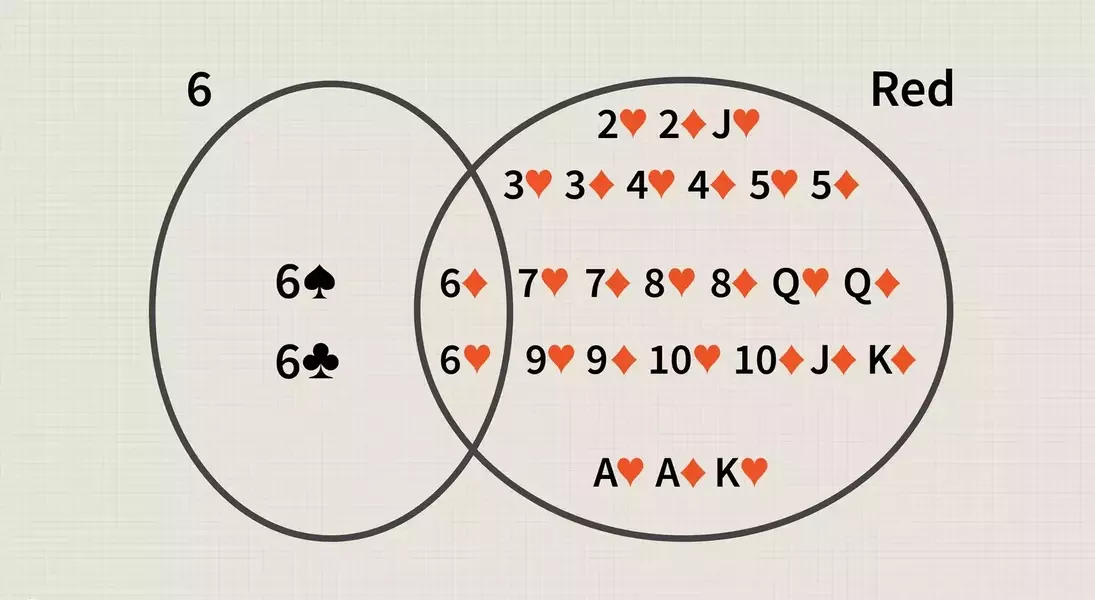
Probability, as a field, is closely linked to statistics and focuses on the likelihood of an event or phenomenon materializing. This likelihood is expressed as a numerical value ranging from 0 to 1, with 0 indicating impossibility and 1 signifying certainty. For instance, the probability of drawing a red card from a standard deck is 1/2, or 0.5, because half the deck consists of red cards. Joint probability, however, deals with two events occurring simultaneously. It can only be applied when multiple observations can happen at the same time. If we consider drawing a card that is both red and a six, the joint probability P(6 ∩ red) is 2/52, or 1/26, since there are two red sixes (the six of hearts and the six of diamonds) in a deck. Because the events 'red' and 'six' are independent, the joint probability can also be calculated as P(6) × P(red) = 4/52 × 26/52 = 1/26. The symbol '∩' signifies the intersection of events, visually explained through Venn diagrams, where the overlapping region represents the joint probability.
It is important to distinguish joint probability from conditional probability. Conditional probability refers to the likelihood of one event occurring given that another event has already happened. The formula for conditional probability is P(X, given Y) or P(X | Y), meaning the chance of event X occurring is contingent upon event Y occurring. For example, the probability of drawing a six, given that a red card was drawn, is P(6 | red) = 2/26 = 1/13, as there are two sixes among 26 red cards. Joint probability, conversely, focuses solely on the likelihood of both events happening simultaneously. Interestingly, conditional probability can be used to derive joint probability through the formula P(X ∩ Y) = P(X|Y) × P(Y). This means the probability of X and Y both occurring is the probability of X occurring given Y, multiplied by the probability of Y occurring. Statisticians and analysts utilize joint probability when two or more observable events can happen concurrently. For example, it can be employed to estimate the likelihood of a decline in the Dow Jones Industrial Average coinciding with a drop in Microsoft's share price, or the chance of oil prices rising while the U.S. dollar weakens. A critical aspect of joint probability is the independence of the events involved. If the outcome of one event influences the other, they are dependent, leading to conditional probability rather than joint probability.
To illustrate joint probability further, consider rolling two dice and calculating the probability of rolling a four on each die. Since each die has six sides, the probability of rolling a three on the first die is 1/6, and the probability of rolling a three on the second die is also 1/6. Using the joint probability formula, multiplying these individual probabilities gives us 1/6 × 1/6 = 1/36. This indicates that there is a 1/36 chance of rolling two fours with a pair of dice. Joint probability is a statistical tool used to determine the simultaneous occurrence of two independent events. It is a vital measure for identifying relationships between different sets of variables, such as the returns of various companies or the combination of high winds and rainfall in weather forecasts. However, it does not reveal the causal relationship or influence between these events.
