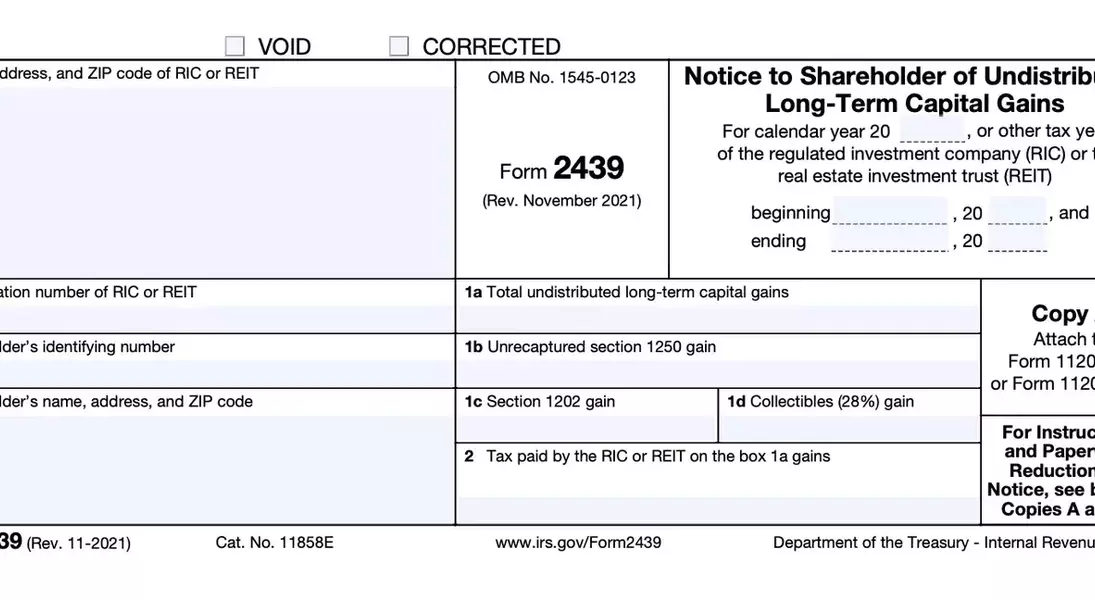
This article provides an in-depth look into IRS Form 2439, a crucial document for shareholders of Regulated Investment Companies (RICs) and Real Estate Investment Trusts (REITs). It clarifies how these entities report undistributed long-term capital gains and the implications for individual taxpayers.
Navigating Your Tax Obligations: Form 2439 Explained
The Essence of Form 2439: Reporting Undistributed Capital Gains
Form 2439 serves as an essential Internal Revenue Service (IRS) document designed for reporting long-term capital gains that have not been distributed. This form is mandatory for mutual funds, exchange-traded funds, and real estate investment trusts to provide to their shareholders, detailing how the fund company manages capital gains.
Deconstructing Form 2439: A Shareholder's Guide to Undistributed Long-Term Capital Gains
Issued by the IRS, Form 2439 is specifically utilized by Regulated Investment Companies (RICs), which encompass mutual funds and exchange-traded funds, alongside Real Estate Investment Trusts (REITs). Its primary function is to inform shareholders about long-term capital gains that the fund has chosen to retain rather than distribute. While funds typically distribute most capital gains to shareholders, reported on Form 1099-DIV, instances where funds retain these gains necessitate the fund to pay taxes on behalf of shareholders and report these transactions through Form 2439.
Interpreting Form 2439: Key Information for Investors
Form 2439 is a mechanism from the U.S. Internal Revenue Service, enabling RICs and REITs to notify investors about long-term capital gains that were not disbursed. This practice of retaining capital gains is somewhat infrequent, as regulations generally mandate fund companies to distribute nearly all gains to investors through capital gains distributions. These distributions typically occur in November and December, often preceded by an estimated warning to investors. This is particularly relevant for actively managed funds, which engage in more frequent trading. In contrast, index funds, with their more stable portfolios, usually generate fewer and more predictable capital gains.
Adjusting Share Basis: Shareholder Responsibilities with Form 2439
Shareholders subject to federal taxation are required to increase the basis of their shares. This is achieved by first deducting the taxes reported by the fund company on Form 2439 from the capital gains also reported on the same form. Subsequently, this calculated difference is added to the original cost basis of their shares.
The Implications of Form 2439: Advantages and Disadvantages
From a shareholder's perspective, the financial outcome of a capital gains allocation through Form 2439 is largely similar to that of a direct capital gains distribution. In a distribution, an investor receiving cash dividends from capital gains pays taxes on those gains and then reinvests the remaining amount into new shares. This process mirrors the situation where gains are distributed, and the after-tax proceeds are reinvested.
Tax Rate Disparities and Credit Recovery: The Nuance of Retained Gains
A notable distinction arises when a fund opts to retain gains: it pays tax at the corporate capital gains rate, and the shareholder's portion of this tax is documented on Form 2439. The shareholder then reports the total gain and claims a credit for the tax already paid by the fund. If the shareholder's personal capital gains tax rate is lower than the corporate rate paid by the fund, this credit mechanism allows them to effectively recoup a portion of the tax difference.
