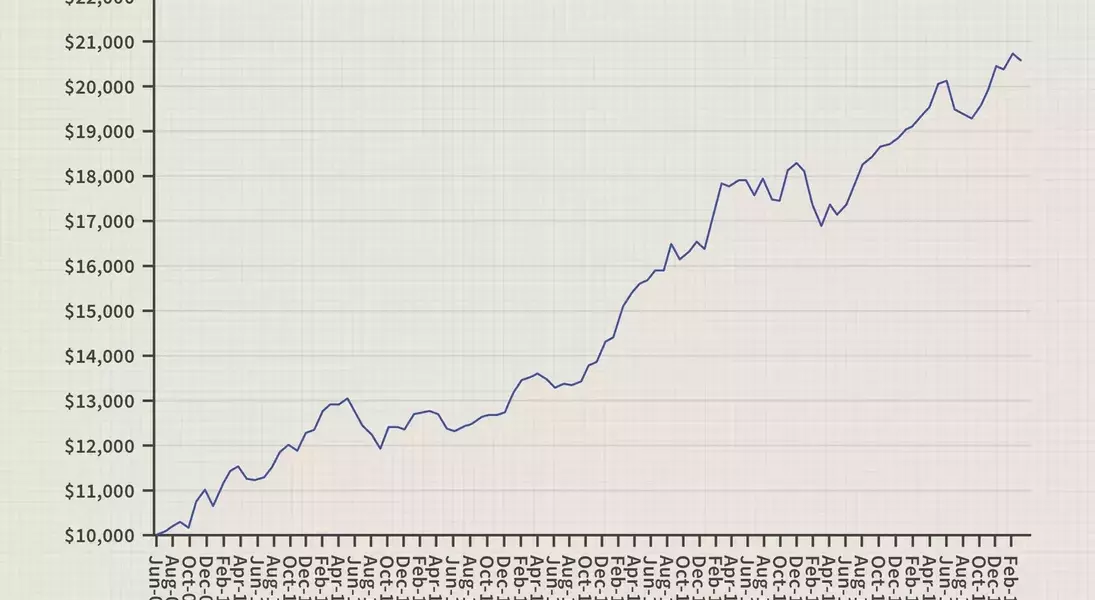
This article delves into the concept of "Growth of $10K," a crucial metric for evaluating investment performance. It explains how this chart visualizes the hypothetical growth of an initial $10,000 investment over time, its widespread use in mutual fund reporting, and its significance for comparative analysis. Furthermore, it addresses the inherent limitations of this metric, particularly regarding the omission of fees and volatility, which are essential considerations for investors.
Unlocking Investment Potential: A Visual Guide to Portfolio Appreciation
Decoding the "Growth of $10K" Metric
The "Growth of $10K," often referred to as "Growth of 10,000," serves as a fundamental financial chart illustrating the value trajectory of an initial $10,000 investment in a particular financial asset over a defined period. This period typically spans the asset's entire existence or the most recent decade, concluding with its latest fiscal year-end.
Visualizing Investment Performance and Comparative Analysis
This graphical representation is frequently employed to benchmark the performance of various investments, either against each other or relative to a designated market index. The returns displayed in these charts typically incorporate the reinvestment of dividends and capital gains, offering a holistic view of an investment's compounding growth. However, it is noteworthy that these charts generally do not account for various fees and sales charges that investors might incur, which can influence the actual realized returns. Mutual fund companies widely utilize "Growth of $10K" charts, prominently featuring them in their marketing and reporting materials to aid investors in assessing market performance.
The Role of "Growth of $10K" in Investment Decision-Making
"Growth of $10K" charts are an indispensable component of mutual fund annual reports, with most fund providers offering interactive versions on their digital platforms. These interactive tools empower investors to visually assess and contrast the performance of hypothetical $10,000 investments across multiple funds and their respective benchmarks over diverse timeframes. For a comprehensive comparison of funds launched at different times, the starting point of analysis should align with the inception date of the oldest fund.
Acknowledging the Limitations of the Metric
While the "Growth of $10K" chart is a highly valued and popular instrument for evaluating investment performance, it is not without its caveats. A primary limitation is its typical exclusion of fund management fees, sales charges, and redemption costs. This omission can lead to an overstatement of the depicted growth, implying that the actual returns an investor would have achieved might be lower than those illustrated. Investors must consider these hidden costs for a realistic assessment of their potential gains.
The Impact of Volatility: A Deeper Look
Another crucial aspect that the chart provides limited insight into is investment volatility. For example, while Fund A might have grown a $10,000 investment to $15,000 over five years, and Fund B to $16,000 within the same period, Fund B could have experienced significantly higher fluctuations. For risk-averse investors, Fund A, despite offering a slightly lower return, might be a more suitable choice due to its greater stability. Therefore, a comprehensive investment decision requires considering both growth and risk profiles.
Regulatory Mandate and Performance Transparency
The U.S. Securities and Exchange Commission (SEC) mandates the inclusion of "Growth of $10K" charts in mutual fund annual reports. This regulation stipulates that each report must present a line graph comparing the performance of a hypothetical $10,000 initial investment against an appropriate index for either the past decade or the fund's entire existence, whichever is shorter. Although not legally required, many semiannual shareholder reports also feature this chart. A quick review of the chart can reveal whether a fund's performance has been consistently stable or marked by significant ups and downs. A jagged line with numerous peaks and troughs suggests considerable performance variability, while a smoother, gradual incline indicates more consistent returns over the period.
