Understanding a company's financial health hinges on two critical metrics: operating cash flow and free cash flow. Operating cash flow reveals a company's capacity to generate cash from its core business activities, ensuring it can meet day-to-day expenses and potentially profit. Free cash flow, on the other hand, represents the remaining cash after accounting for capital investments, indicating a company's financial flexibility for debt repayment, dividend distribution, or further expansion. Both measures are indispensable for investors and analysts seeking to evaluate a company's performance and investment potential.
Operating cash flow is derived directly from a company's core business operations. It reflects the cash generated from selling goods or services, minus the cash outflows associated with running those operations, such as paying suppliers, employees, and taxes. This metric is a strong indicator of a company's fundamental financial viability. A consistently positive operating cash flow demonstrates that a business is effectively managing its revenue and expenses, creating a stable foundation for growth. Conversely, a negative operating cash flow suggests potential issues in the company's core business model, possibly necessitating external financing to sustain operations.
Free cash flow takes the analysis a step further by subtracting capital expenditures from operating cash flow. Capital expenditures are investments a company makes in its long-term assets, such as property, plant, and equipment, which are essential for maintaining and expanding its operational capacity. The resulting free cash flow is the cash truly available for discretionary uses, like paying down debt, issuing dividends to shareholders, or repurchasing shares. It's a powerful metric for assessing a company's value and its ability to generate wealth for its owners without relying on external funding.
The significance of free cash flow extends to various stakeholders. For investors, it indicates the sustainability of dividend payments and the potential for future dividend growth. A robust free cash flow, exceeding current dividend obligations, often signals a financially healthy company capable of rewarding its shareholders. Creditors also closely monitor free cash flow, as it assures them of a company's ability to service its debts. Lenders use this metric to assess a company's repayment capacity, influencing their decisions on granting additional loans. However, it's crucial to compare free cash flow among companies within the same industry, as capital-intensive sectors, like oil and gas, naturally exhibit more volatile free cash flows due to substantial and often lumpy capital expenditures.
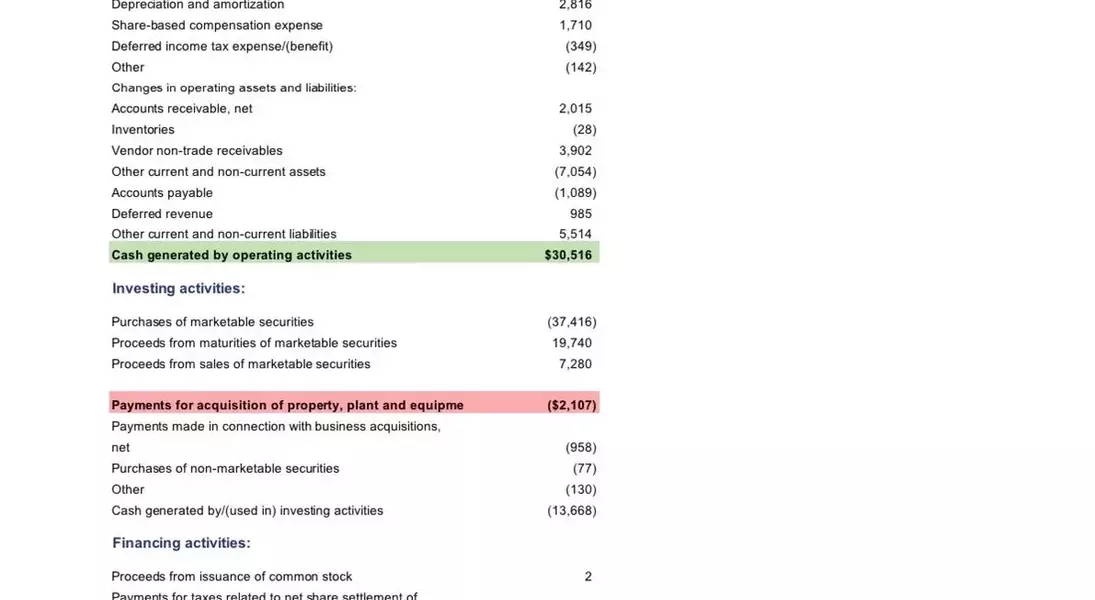
As an illustration, consider Apple Inc.'s financial statements for the period ending December 28, 2019. The company's operating cash flow was reported at $30.516 billion, demonstrating its strong cash generation from core operations. During the same period, Apple invested $2.107 billion in new plant and equipment, representing its capital expenditures. By subtracting these capital investments from the operating cash flow, Apple's free cash flow amounted to $28.409 billion. This substantial free cash flow underscores Apple's capacity not only to cover its operational costs and invest in future growth but also to return value to its shareholders and manage its debt obligations effectively.
In essence, operating cash flow provides insights into a company's core profitability, while free cash flow offers a broader perspective on its financial flexibility and capacity for long-term value creation. Both are indispensable tools for financial analysis, offering a comprehensive view of a company's cash generation and utilization, which is vital for informed investment decisions.
