
Monthly U.S. employment reports, particularly those from the Bureau of Labor Statistics (BLS) and ADP, often present seemingly conflicting figures, leading to market confusion and varied interpretations of economic health. However, a deeper analysis reveals that while short-term discrepancies exist, these vital datasets consistently align over extended periods, offering invaluable insights into consumer behavior and the broader economic landscape.
The Intricate Dance of U.S. Employment Metrics
In the United States, the analysis of labor market dynamics relies heavily on two primary sources: the Bureau of Labor Statistics (BLS) and ADP's National Employment Report (NER). These reports, though distinct in their methodologies, collectively paint a comprehensive picture of job expansion and contraction, influencing critical economic decisions and market movements.
The BLS, a government entity, conducts extensive surveys across approximately 121,000 private firms and government agencies. Its comprehensive approach includes a significant representation of small businesses, capturing a wide spectrum of hiring activities that might otherwise be overlooked. Conversely, ADP, a private human capital management firm, compiles real-time payroll data from over 500,000 businesses, representing more than 26 million employees. This offers a high-frequency, granular view of private sector employment trends, often released ahead of the official BLS figures.
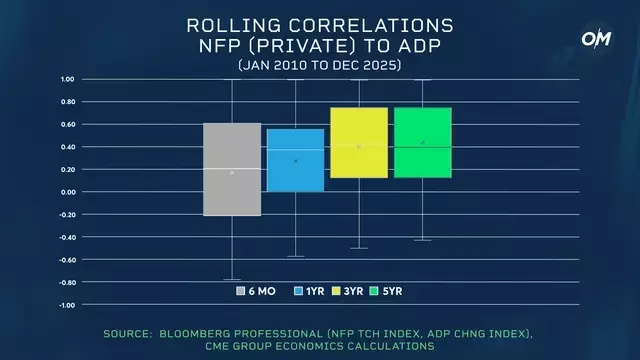
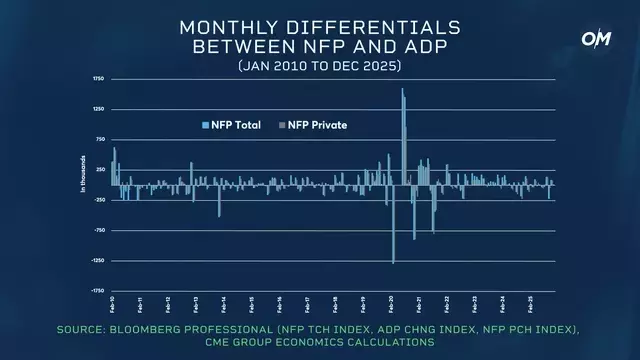
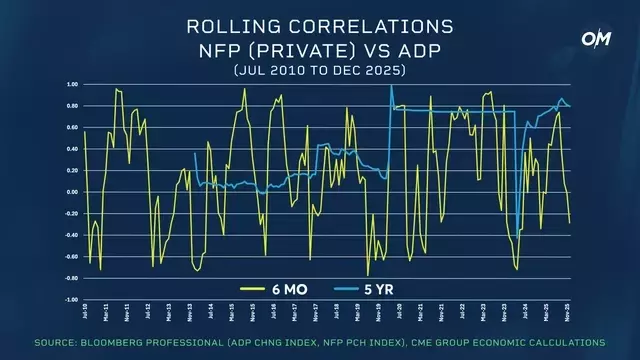
While the monthly figures from these two reports frequently diverge, generating fluctuating headlines and market reactions, a crucial insight emerges when examining their long-term trajectories. Over extended periods, such as a five-year rolling correlation, the datasets demonstrate a remarkably consistent positive correlation. This indicates that despite short-term noise and methodological differences, both BLS and ADP ultimately reflect the same fundamental shifts in the U.S. labor market.
This understanding is particularly significant for investors and policymakers. By focusing on the broader, long-term trends rather than reacting solely to monthly fluctuations, a more stable and accurate assessment of the economy can be achieved. Integrating these employment metrics with other key indicators, such as the U3 unemployment rate (standard unemployment) and the broader U6 underemployment rate, provides a robust framework for anticipating interest rate changes, shaping Federal Reserve policy, and projecting market directions across equities, commodities, and foreign exchange.
The interplay between these varied employment data sources underscores the complexity and interconnectedness of economic indicators. Recognizing their complementary nature and distinguishing between short-term volatility and long-term consistency is essential for navigating the intricate landscape of economic analysis and making informed decisions.
