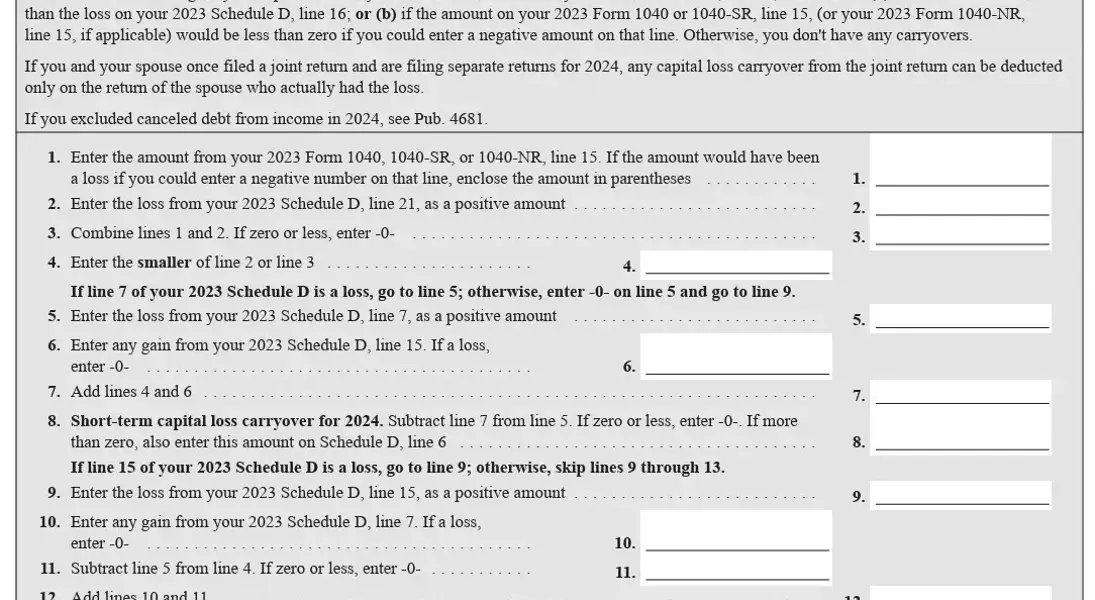

A capital loss carryover enables taxpayers to apply any remaining investment losses to future tax years, beyond the current year's deduction limits. When investment losses surpass capital gains in a given year, taxpayers can deduct up to $3,000 from their ordinary income annually ($1,500 for those married filing separately). Any outstanding losses can then be carried forward indefinitely until fully utilized, helping investors manage the impact of significant losses over an extended period rather than losing the unused portion of the deduction.
The mechanics of capital loss carryovers are rooted in tax regulations for capital gains. Capital gains are categorized as either short-term or long-term, with different tax implications. Short-term gains, from assets held for one year or less, are taxed at the same rates as ordinary income. Long-term gains, from assets held for over a year, generally benefit from lower tax rates (0%, 15%, or 20%), depending on income levels. The amount of a capital gain or loss is determined by subtracting the adjusted cost basis of an asset from its sale price. The adjusted basis typically includes the purchase price plus any ownership-related expenses. Should a loss remain after offsetting all capital gains, it can be applied to ordinary income in subsequent years, with no time limit on how long it can be carried forward. However, it's important to note that losses from personal property, such as a primary residence, are not deductible, nor are losses from sales to certain family members or closely held corporations.
The Internal Revenue Service (IRS) implements the wash sale rule to prevent taxpayers from artificially generating tax benefits through investment losses. A wash sale occurs when an investor sells a security and then repurchases a substantially identical security within 30 days before or after the sale. This rule aims to curb tax-loss harvesting, a strategy where investors deliberately incur losses to offset other gains. If a wash sale occurs, the loss is disallowed for tax purposes, but it is added to the cost basis of the newly acquired stock. This rule also extends to transactions between spouses, preventing one spouse from purchasing a substantially identical investment that the other spouse recently sold within the 61-day window. Taxpayers can determine their eligible capital loss carryover using IRS Worksheet 4-1 in Publication 550. This amount is reported on IRS Form 8949 when filing tax returns. Married taxpayers filing separately have a lower annual deduction limit of $1,500.
Capital loss carryovers offer a valuable mechanism for investors to soften the financial blow of investment losses over time. By enabling the deduction of up to $3,000 against ordinary income annually, after first offsetting capital gains, and allowing remaining losses to be carried forward indefinitely, these provisions help maintain financial stability. Adhering to precise record-keeping practices and understanding complex regulations like the wash sale rule, often with the guidance of a tax professional, is vital to accurately claiming these losses and ensuring compliance with tax laws. This approach not only provides tax relief but also encourages responsible financial planning and long-term investment strategies.
