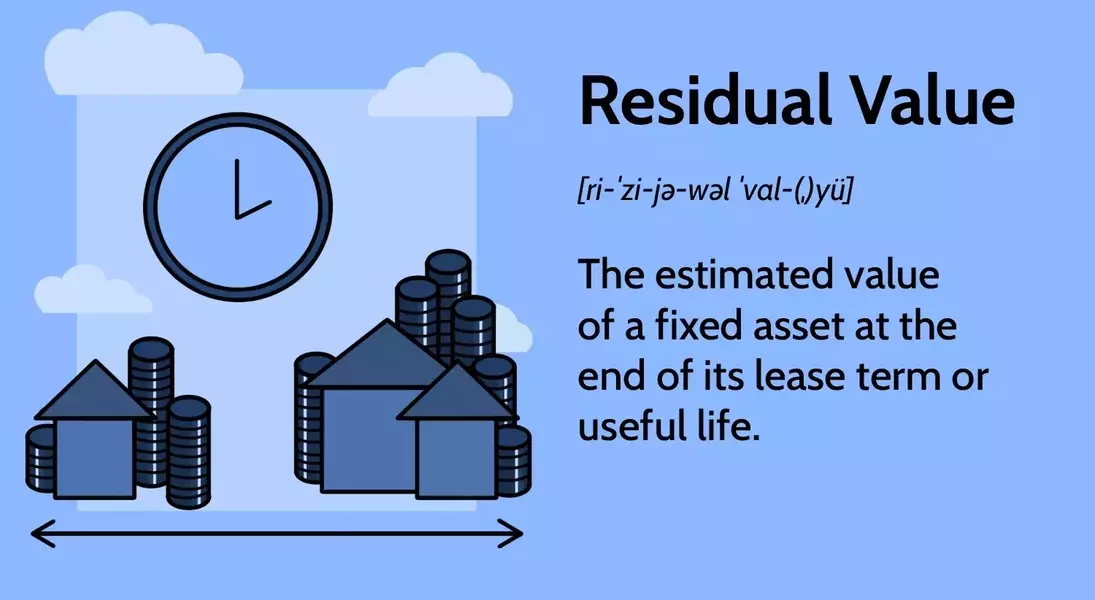
Residual value, also known as salvage value or scrap value, represents an asset's estimated worth at the end of its useful life. This concept is fundamental in finance and accounting, influencing depreciation schedules, lease agreements, and overall investment strategies. Understanding residual value allows businesses and investors to accurately gauge an asset's long-term cost and make informed decisions regarding acquisition, leasing, and disposal.
Detailed Insight into Residual Value
Residual value is the projected market price an asset commands when it is no longer actively used or at the end of a lease term. Assets naturally depreciate over time due to various factors including physical wear and tear, technological obsolescence, and shifts in market demand. For accounting purposes, residual value directly impacts depreciation and amortization calculations, thereby affecting a company's financial statements. In capital budgeting, it helps determine the total cost of ownership and guides decisions on whether to purchase or lease assets. For leased items, a higher residual value typically translates into lower monthly lease payments, as the lessee essentially covers the difference between the initial cost and the projected resale value.
The most basic calculation for residual value, particularly under straight-line depreciation, is:
Residual Value = Initial Cost – (Annual Depreciation Expense × Useful Life) – Disposal Costs
However, real-world residual value assessments are more intricate, incorporating:
- Prevailing market conditions and demand for used assets.
- The rate at which technology renders existing assets obsolete.
- Historical pricing data for comparable assets.
- Maintenance expenses and the asset's overall condition.
- Specific industry factors (e.g., brand loyalty in the automotive sector or usage patterns in heavy equipment).
Calculating residual value involves several steps:
1. Determine the Asset's Initial Cost:
This includes the purchase price and any additional costs to make the asset operational, such as installation fees. For instance, a machine costing $50,000 with a $1,000 installation fee has an initial cost of $51,000.
2. Establish the Asset's Useful Life:
This is the period during which the asset is expected to be productive for the business, usually measured in years. Manufacturer guidelines, industry standards, and historical data are key resources for this estimation. For example, the machine might have an expected useful life of 10 years.
3. Forecast the Salvage Value:
Estimate the asset's worth at the end of its useful life, taking into account market trends, technological changes, and anticipated wear. This can be done through a percentage of the original cost (e.g., 20% of $50,000, which is $10,000) or by researching market prices of similar used assets (e.g., $8,500 based on market research). Often, a combination of these methods provides a more robust estimate.
4. Account for Disposal Costs:
Subtract any expenses associated with selling or disposing of the asset. If the machine incurs a $250 removal fee, the final residual value would be the forecasted salvage value minus this cost.
5. Calculate the Net Cost to the Business:
Subtract the adjusted residual value from the initial acquisition cost to determine the asset's total cost to the business over its useful life.
Practical Applications:
For example, if a company's machine costs $51,000 initially and has an adjusted residual value of $9,000 after 10 years, its annual straight-line depreciation would be ($51,000 - $9,000) / 10 = $4,200.
In vehicle leasing, the residual value is paramount. If a car with an original cost of $30,000 is leased for three years with a residual value set at 50% ($15,000), this figure is used in the lease calculation. However, the actual market value at lease-end might differ (e.g., $13,000 due to market fluctuations or excessive wear), highlighting the challenges in precise long-term forecasting.
Ultimately, whether you are acquiring new equipment, structuring a lease, or managing depreciation, the effort invested in calculating and regularly adjusting residual value estimates is invaluable. It helps maintain the accuracy of financial records and empowers better strategic financial decisions.
