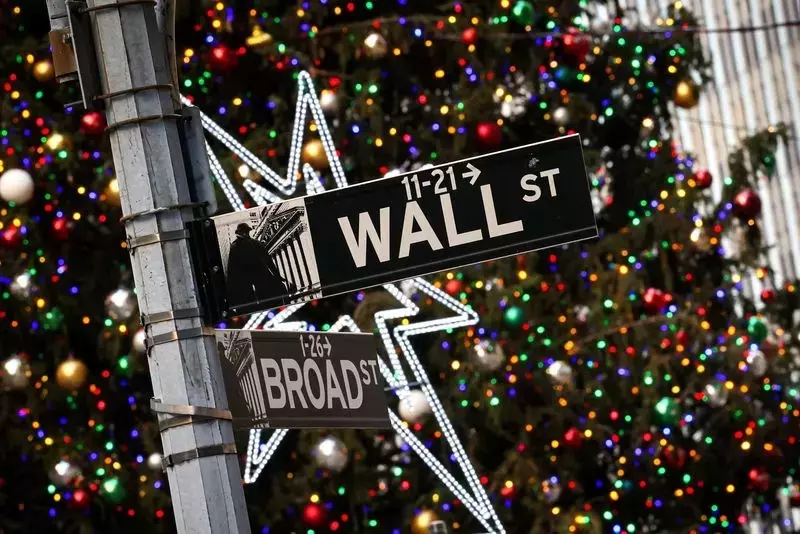
In the final days of the year, U.S. stock markets are entering a traditionally robust period known as the "Santa Claus rally," yet traders remain cautious amid light trading volumes and uncertainty about future market conditions. Despite expectations for historically strong performance in late December and early January, concerns about interest rates and market valuations have tempered enthusiasm. With Wall Street set to close early on Tuesday and remain closed for Christmas on Wednesday, investors are bracing for potentially volatile trading sessions.
Details of the Market Outlook
In the waning days of 2023, financial markets are preparing for a brief but eventful trading session. On Tuesday, the stock exchanges will close at 1:00 p.m. ET, earlier than usual, and will remain shut on Wednesday for the Christmas holiday. Early morning indicators showed modest gains, with Dow E-minis rising slightly, S&P 500 E-minis up by a small margin, and Nasdaq 100 E-minis showing a more notable increase. However, these movements were not indicative of significant momentum, as trading volumes are expected to be low during this period.
The Federal Reserve's recent decision to adjust interest rates has added another layer of complexity to the market outlook. While the Fed signaled only two rate cuts in 2025, down from four previously projected, traders now anticipate rates to stabilize between 4% and 4.25% by the end of that year. This shift in expectations has raised questions about the sustainability of the market's upward trajectory, especially given the high valuations of certain stocks.
Moreover, the so-called "Santa Claus rally" typically brings positive returns for the S&P 500 in the last five days of December and the first two days of January. Historically, this period has seen an average gain of 1.3%, according to data dating back to 1969. However, some analysts warn that expensive growth stocks and lower-quality cyclicals may struggle under the weight of higher interest rates and reduced liquidity.
Notably, individual stocks like U.S. Steel faced challenges in premarket trading, dropping due to concerns over a $15 billion bid from Nippon Steel that has been referred to President Joe Biden for review. The company's long-standing opposition to the merger adds another element of uncertainty to the market.
Despite these challenges, the S&P 500 and Nasdaq managed to post consecutive gains on Monday, driven by a few large-cap and growth companies. Yet, the broader market sentiment remains cautious, as investors weigh the potential risks against the historical strength of year-end rallies.
From a journalistic perspective, the current market environment underscores the delicate balance between optimism and caution. While historical patterns suggest a positive close to the year, the underlying challenges—such as interest rate hikes and valuation concerns—remind us that markets can be unpredictable. Investors would do well to stay informed and prepared for any volatility in the coming days.
