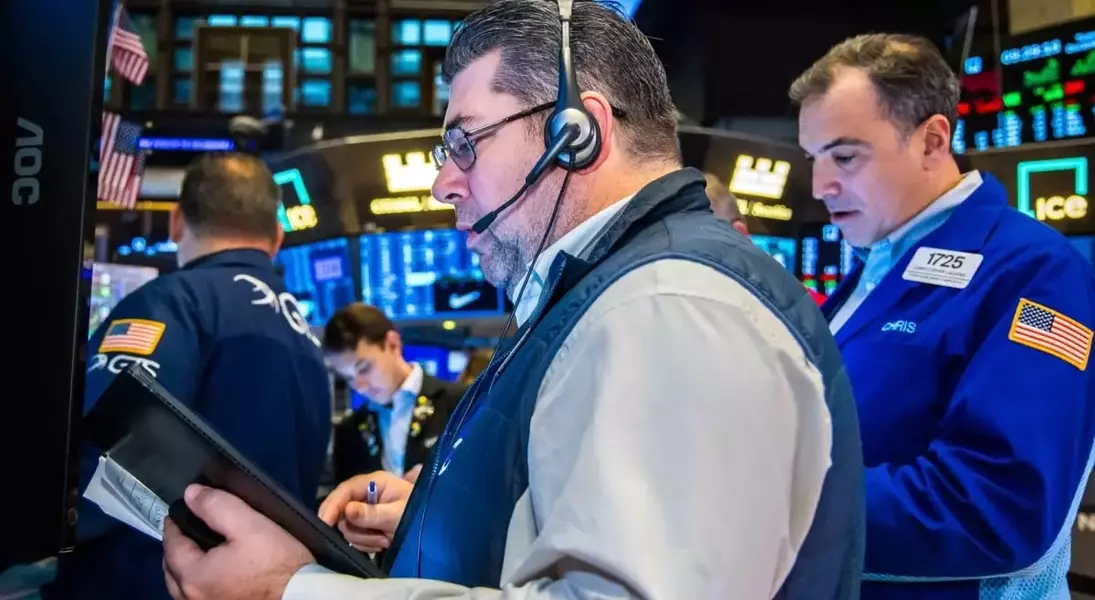
U.S. stock futures experienced a slight fall on Thursday evening as traders awaited the latest reading of the Federal Reserve's preferred inflation gauge. This anticipation had a significant impact on various market indices and individual stocks. Futures tied to the Dow Jones Industrial Average dropped 100 points, or 0.2%, while S&P 500 futures and Nasdaq 100 futures also saw declines of around 0.2% and 0.4% respectively. Extended trading witnessed interesting movements as FedEx and Nike both showed positive results. The delivery giant rose approximately 8%, and the sports apparel retailer jumped more than 7%. During Thursday's trading session, the Dow was the only major average to close in positive territory, eking out a 15-point gain and ending a 10-day losing streak, which was its longest since 1974. This marked its first session in the green since December 5 when the index fell more than 200 points. The slim gain for the Dow and narrow losses for the S&P 500 and Nasdaq Composite came as the 10-year Treasury yield increased for a second day, keeping stocks under pressure.Anticipation of Federal Reserve's Inflation Gauge
Investors are now eagerly looking ahead to November's reading of the personal consumption expenditures price index, which is the Federal Reserve's preferred inflation metric. The report, set to be released on Friday, could hold significant importance as Fed Chair Jerome Powell indicated this week that PCE is likely to show a 12-month inflation rate above the central bank's 2% goal. Analysts polled by Dow Jones expect the index to rise 0.2% on a monthly basis and show an annual reading of 2.5%. Core inflation, excluding food and energy, is also expected to rise 0.2% monthly and 2.9% annually. Mike Dickson, head of research and quantitative strategies at Horizon Investments, told CNBC that whatever the reaction to the inflation report, it is likely to be more severe than before seeing the Fed increase its expectations. This follows the Fed's decision earlier this week to cut interest rates by a quarter point and indicate that it would likely only lower rates twice in 2025, fewer times than previously anticipated. This led to a market sell-off on Wednesday, with all three indexes sinking.Impact on Major Averages and Short Selling
The latest bout of market turbulence has put the major averages on track for sharp weekly losses. The S&P 500 and the Dow are down more than 3% week to date, while the Nasdaq is off more than 2% in the same period. Short sellers are also targeting automakers as analysts issue more sell ratings. S3 Partners, which specializes in monitoring short selling activity, has noted that major global auto stocks have experienced significant declines in 2024, with many facing growing short positions and increased analyst sell recommendations. Notable patterns emerge across regions, with larger companies like Toyota, Volvo, and Porsche showing a rise in short interest and sell ratings, while smaller firms exhibit persistent short positions with minimal shifts in analyst sentiment. U.S. automakers or stocks traded here with large short positions include Lucid Group ($8 billion market cap), Rivian Automotive ($15 billion), Winnebago Industries ($1.5 billion), and American depositary receipts of NIO ($9 billion). For the major stocks in each region, the short position has grown as the stock has fallen. For the smaller stocks, many had large short positions to begin with.Government Shutdown and Investment Strategy
Lawmakers in Washington are racing against time to avoid a last-minute government shutdown. However, investors should remain calm and maintain their portfolio positions, according to Wells Fargo Investment Institute. President-elect Donald Trump backed a plan put forward by House Republicans. The measure could be voted on as early as Thursday evening, and if approved, it could prevent a shutdown that would start on Friday night. Paul Christopher, head of global investment strategy at Wells Fargo Investment Institute, said that his team believes there will be little economic or financial-market impact in the event of a shutdown, and discretionary spending will be the most affected, not Social Security or Medicare payments. He recommended looking through any potential shutdown and maintaining the current portfolio positions. The institute continues to foresee a strong economy heading into 2025 and maintains its outlook for earnings growth and an S&P 500 Index target range of 6500-6700.Stocks Making Moves After Hours
After hours trading saw some significant movements in stocks. FedEx shares rose 8% after the delivery giant reported better-than-expected earnings. For its fiscal second quarter, FedEx reported adjusted earnings of $4.05 per share, surpassing the $3.90 per share expected by analysts. However, revenue came in weaker than expected. The company also announced its plan to spin off its freight business. Nike's stock also popped around 6% after its fiscal second quarter results exceeded Wall Street estimates. Nike earned 78 cents per share on $12.35 billion in revenue, with analysts expecting 63 cents per share on revenue of $12.13 billion. Mission Produce shares gained 9% as its fiscal fourth quarter results beat analysts' expectations. The company posted adjusted earnings of 28 cents per share on revenue of $354.4 million, an improvement from the 11 cents per share in adjusted earnings in the previous year. Revenue also rose 37% from a year earlier.Stock Futures Open Higher
U.S. stock futures inched higher on Thursday night. Futures tied to the Dow Jones Industrial Average gained 36 points, or 0.08%, while S&P 500 futures and Nasdaq 100 futures rose 0.1% and 0.2% respectively. This indicates a potential shift in market sentiment as the trading day begins.