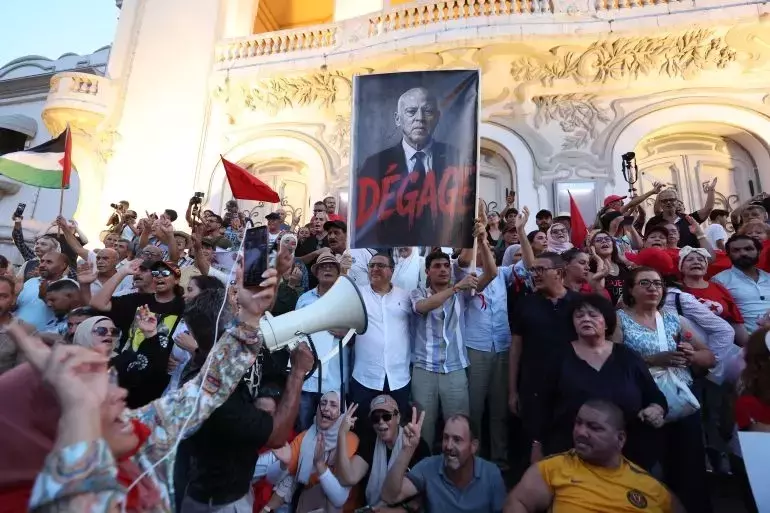
Tunisia's highest judicial body has recently affirmed the convictions of several prominent opposition figures and activists, imposing substantial prison terms. This final ruling by the Court of Cassation concludes a protracted legal battle, with many individuals facing sentences stretching up to 45 years on charges related to allegedly conspiring to unseat the current president.
The judicial process, spanning three years, has implicated around 40 individuals. This group includes leaders of opposition parties, legal professionals, business figures, and human rights advocates. Notably, half of those targeted in this widespread legal action had sought refuge outside the country and received their sentences in absentia. Among the prominent figures affected are Najib Chebbi, a leader of the National Salvation Front, who received a 12-year sentence, and other notable opposition members like Ghazi Chaouachi, Issam Chebbi, Jawhar Ben Mbarek, and Ridha Belhaj, each handed 20-year terms. Additionally, politician Noureddine Bhiri was sentenced to 10 years.
Critics, including Haifa Chebbi, a lawyer and daughter of Najib Chebbi, argue that the verdict underscores a lack of judicial independence within Tunisia. She contends that her father and fellow defendants were unjustly silenced through a politically motivated case designed to incarcerate dissenting voices. Her view suggests that these detentions stem from political directives and that their release is contingent upon a change in leadership.
Further concerns have been raised regarding the fairness of the legal proceedings. Lawyers representing the defendants reported receiving notification of the final hearing just days before it was scheduled, leaving insufficient time to adequately prepare their defense. Dalila Msaddek, whose brother Jawhar Ben Mbarek was among those convicted, conveyed through social media that the legal avenues have been exhausted, marking the commencement of a purely political struggle.
This case is widely perceived as a reflection of Tunisia's deteriorating democratic landscape since President Kais Saied's election in 2019. His administration has increasingly centralized power, operating largely through decrees, dismantling the independent Supreme Judicial Council, and removing numerous judges from their positions. Despite these criticisms, Saied's government has consistently denied allegations of political persecution. Tunisia's justice minister has asserted that the defendants aimed to destabilize the nation, while President Saied himself labeled the accused as "traitors and terrorists" following their arrests in 2023, even cautioning that judges who acquitted them would be considered accomplices.
The recent judicial pronouncement in Tunisia marks a significant moment in the country's political narrative, solidifying the legal repercussions for those deemed to have opposed the current leadership. The lengthy sentences and the manner of the proceedings have ignited considerable debate concerning judicial autonomy and the trajectory of democratic principles within the nation.
