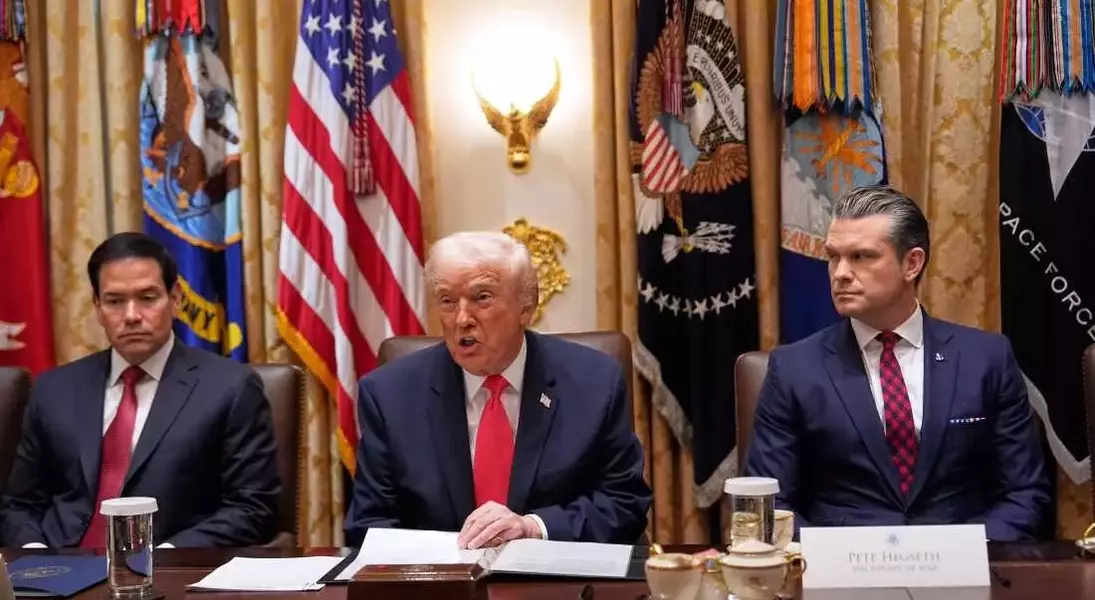
The Trump administration's recently released national security strategy marks a significant reorientation of American foreign policy, rooted deeply in its 'America First' philosophy. This comprehensive document provocatively redefines international relationships, challenging long-held alliances and asserting a more unilateral global stance. It critiques the trajectory of European nations, suggesting their current policies risk societal decline, while simultaneously outlining an aggressive strategy to enhance U.S. influence across the Americas. Furthermore, the strategy indicates a deliberate shift in focus from the complexities of the Middle East, opting instead for economic engagement and a strategic 'rebalance' with China, demanding increased contributions from regional allies.
Trump Administration Unveils Sweeping New National Security Doctrine, Redefining Global Engagement and Alliances
WASHINGTON D.C. — On a pivotal Friday, the Trump administration officially unveiled its latest national security strategy, a document that signals a dramatic departure from established international norms. The strategy, steeped in the 'America First' ideology, explicitly criticizes long-standing European partners, expressing concerns over their immigration policies and free speech debates, and alarmingly predicting a potential 'civilizational erasure' if current trends persist. This assertive posture has inevitably created fissures within traditional alliances, prompting widespread debate and concern across the globe.
Simultaneously, the administration's policy document underscores an intensified commitment to reasserting American preeminence within the Western Hemisphere. This includes a more robust approach to regional challenges, exemplified by recent military interventions targeting drug trafficking routes in the Caribbean and Pacific, and contemplations of assertive actions concerning Venezuela's political landscape. This aggressive stance is framed as a modern interpretation of the historic Monroe Doctrine, aiming to cement U.S. dominance in its immediate geographical sphere.
In a notable pivot, the strategy advocates for a reduced U.S. engagement in the Middle East, moving away from past attempts to influence or critique governmental structures in the region. Instead, it champions economic partnerships and investment opportunities, particularly with Gulf monarchies, viewing the Middle East as a burgeoning area for collaboration rather than intervention. This strategic recalibration reflects a diminishing reliance on the region's oil resources and a desire to encourage organic reform movements without external imposition.
Concurrently, the Trump administration is undertaking a significant 'rebalance' in its relationship with China. While committed to preventing potential conflicts over Taiwan by maintaining military superiority, the strategy places a renewed emphasis on regional allies to take on greater responsibility in countering Chinese influence and bolstering collective defense capabilities. This shift underscores a demand for increased burden-sharing among allies, signaling a more transactional approach to international security cooperation.
The announcement has drawn immediate reactions from international figures. German Foreign Minister Johann Wadephul reiterated the importance of the U.S. within NATO but firmly stated that internal European affairs, such as freedom of expression or societal organization, are not subjects for external counsel. Meanwhile, Markus Frohnmaier of Germany's far-right Alternative for Germany party welcomed the U.S. strategy as a 'reality check' for Europe, particularly Germany, highlighting the divergent perspectives on this new foreign policy framework.
The newly articulated national security strategy represents a bold and contentious vision for America's role in the world. It challenges conventional diplomatic frameworks, prioritizes national interests above traditional alliances, and signals a more assertive, yet selective, engagement on the global stage. This strategic shift promises to reshape international relations and provoke ongoing discussions about the future of global cooperation and security.
The unveiling of President Trump's latest national security doctrine offers a stark reminder of the dynamic and often unpredictable nature of international relations. From a strategic perspective, this document serves as a powerful declaration of intent, prioritizing national interests and sovereignty in a manner that fundamentally re-evaluates traditional alliances and global responsibilities. One key takeaway is the evident willingness to challenge diplomatic norms, particularly in its candid critiques of European allies. This approach could be interpreted as a pragmatic push for greater self-reliance and burden-sharing among nations, or as a potentially destabilizing factor that strains long-cultivated partnerships. The focus on strengthening influence in the Western Hemisphere, coupled with a reduced interventionist stance in the Middle East, suggests a more concentrated application of American power. While this might lead to more effective regional policies, it also raises questions about potential power vacuums and unforeseen consequences in areas where U.S. engagement lessens. Ultimately, this strategy prompts contemplation on the evolving definitions of global leadership and the intricate balance between national ambition and international cooperation in a multipolar world.
