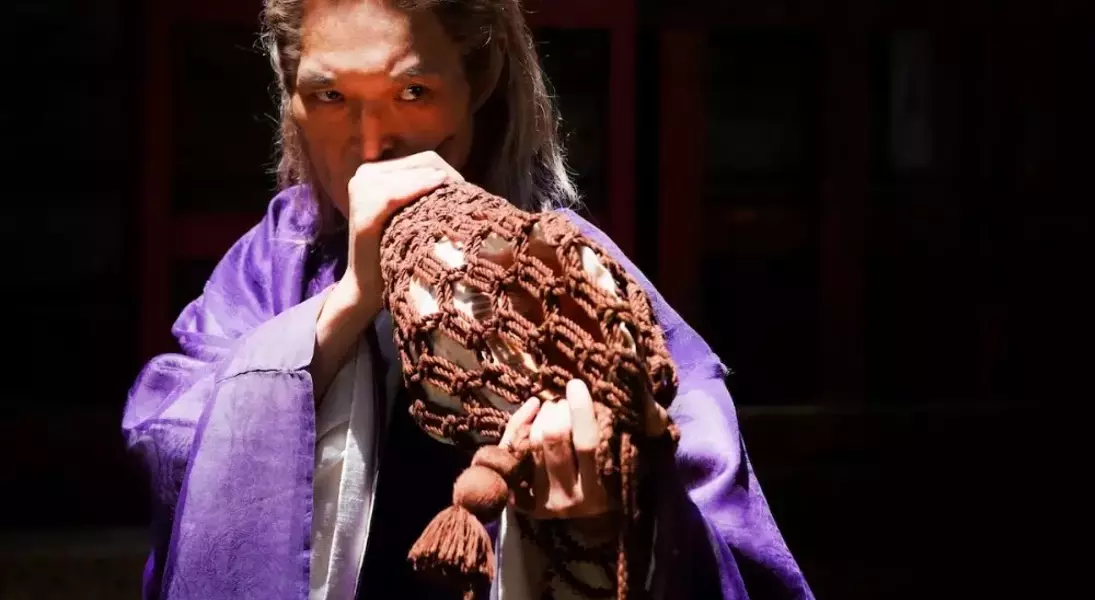
Toshiaki Toyoda's latest cinematic creation, 'Transcending Dimensions,' offers viewers an unparalleled journey into the realms of the metaphysical and the absurd. This film, potentially the director's swansong, skillfully weaves together a tapestry of philosophical inquiry, comedic elements, and a touch of the inexplicable. It stands as a profound summary of his artistic vision, presenting both a challenge and a reward to those familiar with his previous works. While it may occasionally disorient its audience with its intricate layers, its imaginative flair and unpredictable narrative remain its most compelling attributes. Rather than a conventional science fiction piece, it's a cosmic expedition that questions the very nature of truth and existence, proving to be a singularly unique and mind-bending experience.
A Cosmic Odyssey Unfolds: Details of 'Transcending Dimensions'
The film commences with a deceptively serene scene: a contemplative monk discovering a peculiar conch shell by a tranquil waterfall. Silence reigns for the initial ten minutes, broken only by the appearance of Master Hanzo, portrayed by Chihara Jr., who conducts a ritual invoking the 'power of the wolf' before a gathered crowd. This enigmatic guru, with his dyed-blond hair and a penchant for demanding extreme sacrifices for his counsel, soon reveals a darker side, utilizing psychic abilities against a disbelieving attendee.
Adding another layer to the intricate plot is Shinno, a hitman played by Ryuhei Matsuda, who arrives at the remote sanctuary on behalf of his client, Nonoka (Haruka Imou). Nonoka seeks answers regarding her vanished boyfriend, Rosuke (Yosuke Kubozuka), who disappeared during his 'training' with the manipulative Hanzo. Accusing Hanzo of driving her to madness, she implores Shinno to eliminate him before taking a desperate turn herself.
Around the forty-minute mark, the narrative explodes into a psychedelic spectacle, reminiscent of classic mind-bending cinema. The journey transcends conventional reality, propelling characters into space, through a labyrinth of reflective surfaces, and into clandestine research facilities where human experimentation blurs ethical boundaries. The mysterious conch shell, repeatedly sounded, becomes a beacon for a 'light of truth,' though truth itself proves fluid and ever-changing within this universe. Concepts such as 'soul,' 'intuition,' and 'transcendence' are earnestly pursued by the characters, yet the film, with its deadpan humor, transforms this quest into a playfully deceptive intellectual exercise rather than a straightforward spiritual pilgrimage.
Though less grand in its visual effects, 'Transcending Dimensions' could be seen as a fusion of philosophical depth and existential absurdity. Despite occasional moments of confusion, the film largely delivers an original and captivating experience. Viewers familiar with Toyoda's filmography will discern echoes of his past themes, particularly from his 'Mt. Resurrection Wolf' series, which began with 'Wolf's Calling' in 2019. Elements of religious cultism and criminal undertones, long-standing motifs in his work, from 'I'm Flash!' to 'Nine Souls' and 'Monsters Club,' are skillfully re-explored. Toyoda's intention is not to provide answers but to provoke thought, making the film a demanding yet rewarding experience for those open to intellectual challenge.
The ensemble cast, including Yosuke Kubosuka, Ryuhei Matsuda, and Haruka Imou, masterfully navigate the film's nuanced tone. Behind the scenes, the artistic and technical teams, including cinematographer Kenji Maki, art director Takashi Sasaki, costume designer Kazuhiro Sawataishi, and visual effects chief Nobutaka Douki, contribute significantly to the film's rich texture. The sonic landscape is equally impressive, with a powerful soundtrack featuring the resonant drumming of Kodo and the innovative jazz of Sons of Kemet.
The Unfolding Enigma: A Reflection on 'Transcending Dimensions'
As a viewer, 'Transcending Dimensions' leaves an indelible mark, serving as a powerful reminder that cinema can be much more than mere entertainment; it can be an intellectual and emotional journey. Toyoda challenges our perceptions, encouraging us to question the boundaries of reality and the nature of spiritual seeking. The film’s deliberate ambiguity isn’t a flaw but a strength, mirroring life's own perplexing journey where definitive answers are often elusive. It inspires a deeper appreciation for artistic freedom and the courage to explore unconventional narratives, proving that cinema, at its best, is a profound and transformative art form.
