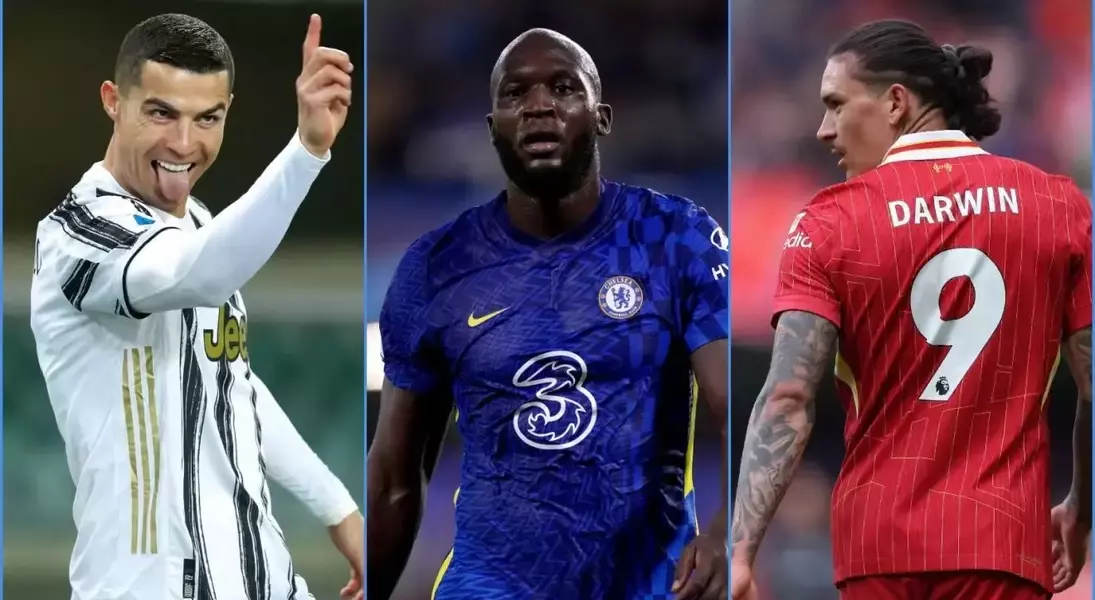
Football clubs frequently invest substantial sums in acquiring top-tier attacking talent, a trend reflected in the history of record-breaking striker transfers. Examining the most costly forwards reveals recurring names, with some players commanding astronomical fees on multiple occasions. These transfers are often pivotal moments in a player's career and can significantly influence a club's fortunes, shaping their competitive landscape for years to come.
Kylian Mbappé's move to Paris Saint-Germain in July 2018 for a reported €180 million stands as a monumental deal. Initially a loan, it underscored PSG's ambition to dominate European football. Mbappé's tenure at the club saw him become their all-time leading scorer, a dominant force whose influence even seemed to eclipse that of national political figures. His eventual departure for Real Madrid, after a prolonged period of speculation, marked the end of an era, coinciding with PSG's long-sought Champions League triumph.
Harry Kane's transfer to Bayern Munich in August 2023 for a fee potentially rising to £120 million also highlights the lengths clubs will go to secure a prolific goalscorer. Despite Tottenham's chairman Daniel Levy's difficult negotiating stance, Bayern's determination prevailed. Kane's move to the Bundesliga was driven by a quest for trophies, and his immediate impact suggests the investment will pay dividends, likely breaking his personal trophy drought.
Cristiano Ronaldo features twice on this list, first with his €112 million transfer from Real Madrid to Juventus in July 2018. Juventus, having been frequently eliminated from the Champions League by Ronaldo's Real Madrid, adopted a 'if you can't beat them, sign them' philosophy. While he contributed to domestic league titles, European success remained elusive. His earlier move from Manchester United to Real Madrid in June 2009 for €94 million is widely regarded as one of football's most astute signings. Over nine years, Ronaldo became Real Madrid's all-time leading scorer, winning 15 trophies, and remarkably, the club even turned a profit on his eventual sale.
Romelu Lukaku's presence is particularly notable, appearing three times among the top transfers. His €115 million return to Chelsea in August 2021 from Inter Milan was a significant outlay. Despite his increased experience and refinement, his second spell at Stamford Bridge proved just as incompatible as his first. Prior to this, his €84.7 million move from Everton to Manchester United in July 2017 yielded a decent return of 42 goals in 96 games, though neither party ultimately viewed the two-year period with great satisfaction. His subsequent €80 million transfer from Manchester United to Inter Milan in August 2019 was a more successful venture, leading to 64 goals in 95 appearances and a Serie A title, solidifying his reputation in Italian football.
Other significant transfers include Randal Kolo Muani's €90 million switch to PSG in September 2023, Gonzalo Higuaín's €90 million move to Juventus in July 2016, and Victor Osimhen's €80 million transfer to Napoli in July 2020. These moves demonstrate the competitive nature of the transfer market and the premium placed on goal-scoring ability. Luis Suárez's €82.3 million transfer to Barcelona in July 2014, and Darwin Núñez's €75 million move to Liverpool in June 2022 further illustrate the high costs associated with acquiring top attacking talent, with varying degrees of success post-transfer. The recent transfers of Hugo Ekitike to Liverpool and Jhon Duran to Al-Nassr, alongside Dusan Vlahovic's move to Juventus, and Alexander Isak's acquisition by Newcastle, continue to shape the financial landscape of modern football, reflecting the continuous pursuit of dominant offensive players.
The extensive financial commitments made by football clubs to secure elite strikers underscore the critical importance of these players to team success. Each high-value transfer represents a calculated risk, aiming to secure a competitive edge through prolific goal-scoring and impactful performances. The narratives of these transfers, from resounding successes to unfulfilled expectations, highlight the complex and often unpredictable nature of player valuations and career trajectories in professional football.
