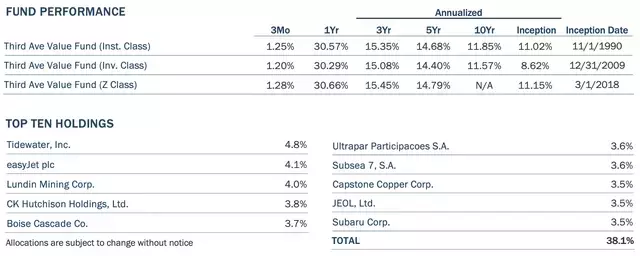

For the second quarter of 2026, the Third Avenue Value Fund achieved a return of 1.25%, falling short of the MSCI World Index's 13.76% and the MSCI World Value Index's 9.21%. Despite this, the Fund's year-to-date performance through June 30, 2026, reached a solid 8.63%, which was comparable to the broader global equity markets. The quarter's results were influenced by a surge in semiconductor and AI-related stocks, a strong U.S. dollar, and the Fund's strategic focus on non-U.S. equities and undervalued assets. The Fund's emphasis on tangible assets proved beneficial with the takeover approaches for easyJet and Paltac, underscoring the success of its asset-based investment philosophy in generating shareholder value. This approach aims to provide downside protection and enhance long-term returns by identifying companies with robust asset bases.
The Fund's portfolio management team acknowledged a mixed bag of results, with some investments performing exceptionally well and others facing challenges. Positive contributions came from holdings like easyJet and Paltac, which both became targets of takeover bids, validating the Fund's thesis on undervalued tangible assets. Additionally, Capstone Copper and Japanese semiconductor capital equipment manufacturers Horiba and JEOL showed strong performance, benefiting from growing recognition of critical supply chain links. Conversely, investments in the offshore energy sector, such as Tidewater, Valaris, and Harbour Energy, experienced headwinds due to geopolitical developments and perceptions of reduced energy supply risks. Despite short-term fluctuations, the Fund maintains a long-term conviction in the energy sector, citing ongoing needs for energy security and strategic reserve replenishment. The Fund also initiated a new position in thyssenkrupp AG, viewing it as a catalyst-rich special situation with significant restructuring potential and undervalued assets.
Navigating Market Trends: Performance and Strategy
In the second quarter of 2026, the Third Avenue Value Fund recorded a 1.25% return, which, while positive in absolute terms, significantly lagged behind major benchmarks. This discrepancy largely stemmed from the market's intense focus on semiconductor and artificial intelligence stocks, a sector in which the Fund was strategically underweight. The NASDAQ 100 Index surged by 27.73%, and the Philadelphia Semiconductor Index by a remarkable 87.98% during this period. Compounding this, the Fund's substantial allocation to non-U.S. equities and the appreciation of the U.S. dollar against foreign currencies created additional performance headwinds. Despite these challenges, the Fund's year-to-date return of 8.63% reflected a strong absolute performance over the first half of the year, aligning with the broader global equity indices.
The Fund's investment philosophy centers on identifying undervalued companies with strong tangible asset bases and robust financial positions, often in out-of-favor sectors. This approach inherently means that the Fund may not always capture the rapid gains seen in momentum-driven sectors. However, the team remains confident in its disciplined, long-term strategy, viewing short-term market dislocations as opportunities rather than deterrents. The diversification within the portfolio, even with a concentrated management style, is designed to balance successful investments with those facing temporary setbacks, ensuring a resilient investment profile. This quarter's performance reinforced the importance of adhering to a value-oriented framework, particularly when market exuberance drives valuations in specific, often speculative, areas.
Tangible Assets and Strategic Acquisitions: Unlocking Value
A key highlight for the Fund in Q2 2026 was the success derived from its investments in companies possessing valuable tangible assets, particularly easyJet and Paltac, both of which became targets of takeover approaches. easyJet, a long-held investment, saw its shares respond favorably to acquisition bids from Castlelake, an asset-based investor. The airline's ownership of a young, homogeneous fleet of A320 aircraft, a substantial order book, and highly sought-after European airport slots proved to be critical attractive features. Similarly, Paltac Ltd., Japan's leading distributor of health and beauty products, received an all-cash tender offer from its controlling shareholder, Medipal Holdings Corporation. Paltac's nationwide network of modern distribution facilities and strong net cash position underpinned its intrinsic value, validating the Fund's investment thesis that tangible assets provide both downside protection and a catalyst for value realization through M&A activity.
These instances underscore the Fund's strategic principle: investing in well-financed companies with hard-to-replicate tangible assets creates multiple avenues for shareholder wealth creation. Beyond organic growth, such assets often attract acquirers seeking to capitalize on undervalued strategic resources. The ability of these companies to operate with strong balance sheets allows them to negotiate from a position of strength, avoiding distress sales and maximizing transaction premiums. The Fund also highlighted other holdings, such as U.S. cement and aggregates production assets held through Buzzi and Taiheiyo Cement, and offshore energy service fleets owned by Tidewater, Valaris, and Subsea7, as examples of strategic assets that are difficult to replicate and possess significant long-term value. Lundin Mining's copper development project further exemplifies this strategy, positioned to benefit from anticipated global copper supply shortages. The initiation of a new position in thyssenkrupp AG, a German industrial conglomerate undergoing a complex transformation with planned business unit spin-offs, further illustrates the Fund's focus on catalyst-rich special situations that offer deep value and multiple paths to value realization.
