Tesla, long recognized for its groundbreaking electric vehicles, is increasingly being spotlighted by analysts as a significant player in the artificial intelligence domain. While many investors still primarily associate the company with EVs and energy solutions, financial experts, such as Dan Ives of Wedbush Securities, contend that Tesla is a profoundly underestimated AI enterprise. The company's strategic ventures into autonomous driving technology and advanced robotics are transforming its core identity, suggesting a future where AI forms the backbone of its growth trajectory. This evolution implies that Tesla is not merely adopting AI but is actively shaping its future through integrated hardware and software innovations.
The shift in perception for Tesla from a car manufacturer to an AI innovator is underpinned by its sophisticated Full Self-Driving (FSD) software. This system leverages extensive neural networks, trained on an enormous volume of real-world driving data, providing Tesla with a unique competitive advantage in the race for autonomous vehicle supremacy. Unlike many of its rivals, Tesla is also investing heavily in designing its own custom AI chips, such as AI5 and AI6. This move towards vertical integration, reminiscent of Apple's strategy, allows Tesla greater control over its technological ecosystem, potentially reducing costs and enhancing performance across its AI-driven platforms.
A major component of Tesla's future growth strategy is the development of its robotaxi network. This ambitious initiative aims to establish a global fleet of autonomous vehicles offering on-demand transportation services. If successful, this could revolutionize ride-sharing, delivery services, and car rentals, generating substantial recurring revenue primarily from software rather than vehicle sales. Tesla's existing capacity to produce millions of vehicles already equipped with autonomous capabilities means it could deploy a vast self-driving fleet almost instantaneously, offering a potential edge over early movers like Waymo, powered by Alphabet.
Furthermore, Tesla's foray into humanoid robotics with Optimus represents a bold, long-term vision. Elon Musk envisions Optimus performing a wide range of tasks, from industrial labor to domestic chores. Although still in nascent stages, Optimus has shown progress in coordinated movement and object manipulation, demonstrating Tesla's capability to apply its vision-based neural networks from self-driving cars to robotic interactions with the physical world. Musk has even suggested that Optimus could eventually contribute significantly to Tesla's overall valuation, potentially surpassing its automotive and energy segments. This project aims to automate physical labor on a massive scale, fundamentally altering the global economy, akin to how AI software is redefining digital tasks.
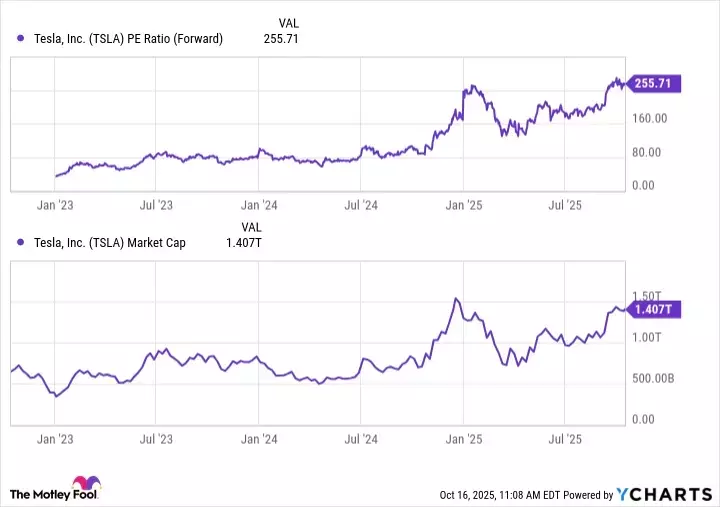
Despite the immense potential of its AI initiatives, Tesla faces considerable challenges and uncertainties. Both the robotaxi service and Optimus are still in active development, contributing little to current revenues. This ambitious roadmap, while offering unparalleled optionality, also introduces significant execution risks. With a forward price-to-earnings ratio near 256 and a market capitalization around $1.4 trillion, Tesla’s stock already incorporates a substantial degree of investor optimism regarding its AI-centric future. The central question for investors is the extent to which this optimism will be realized, given potential delays, regulatory hurdles, and increasing competition in both autonomous mobility and robotics. Nevertheless, for those aligned with Musk's transformative vision, Tesla represents a high-stakes investment at the nexus of AI, automation, and mobility.
