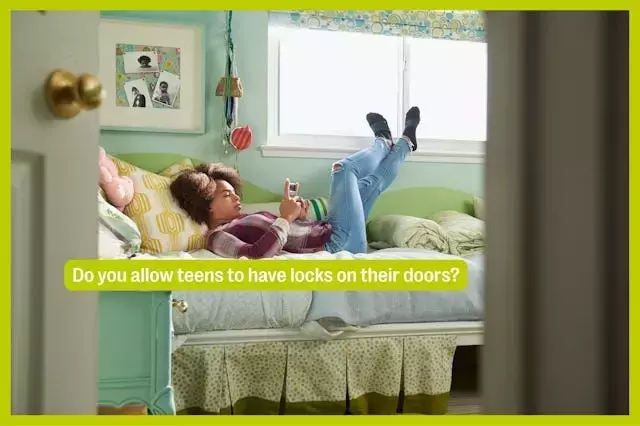
This article delves into the contemporary parenting dilemma of whether teenagers should have locks on their bedroom doors. It explores varying parental perspectives, touching upon the importance of privacy for adolescents, potential safety concerns, and the role of trust in family dynamics.
Unlocking the Debate: Privacy vs. Parental Oversight
The Question That Ignited a Community Discussion
A mother's straightforward question on a popular online forum—should adolescents be permitted to install locks on their personal spaces—ignited a wide-ranging conversation among parents. This inquiry arose from her recent experience of moving into a new residence and her decision to equip all bedroom doors, including her 14-year-old daughter's, with locking mechanisms. She shared that her own upbringing, as the eldest of five, made a lock a necessity for maintaining personal boundaries against intrusive siblings, leading her to consider this a standard practice.
The Ex-Partner's Objections and Underlying Tensions
However, this seemingly innocuous decision met with strong disapproval from her ex-partner, who contended that providing a lock created an unsafe environment for their daughter. The mother speculated that his objections might stem from underlying resentment, given his less stable living situation. She highlighted the irony that locks were commonplace in their previous rented accommodations but were now deemed problematic in her own home. She also emphasized her daughter's exemplary behavior as an honor roll student, suggesting there was no reason to distrust her, and pointed out her ability to easily access the room if necessary.
Community Weighs In: Trust, Privilege, and Consequences
The online community responded with diverse opinions, many of which supported the idea of locks as a privilege contingent on maintaining parental trust. Several individuals noted that locks offered a crucial sense of privacy, particularly for teenagers navigating their personal development. Some shared personal anecdotes, highlighting how locks became a consequence-based privilege, removed only if trust was violated. This perspective underscored the belief that granting privacy could foster responsibility, provided a foundation of trust existed.
Advocating for Personal Space: The Case for Locks
Many participants strongly advocated for locks, citing the need for personal space and protection from unwanted intrusions, especially from younger siblings or even parents who might enter without permission. They argued that a locked door provided a secure sanctuary where teenagers could have moments of solitude and engage in private activities without interruption. This viewpoint emphasized that a lock was not an indicator of clandestine activities but rather a normal component of personal autonomy and respect within a household.
Alternative Perspectives: The Power of a Closed Door
Conversely, a minority of respondents expressed skepticism about the necessity of locks, suggesting that a simple closed door, coupled with a policy of knocking before entering, could achieve similar levels of privacy. These individuals believed that in a supportive and respectful home environment, physical locks were superfluous, as mutual understanding and clear communication should suffice. They posited that the emphasis should be on teaching respect for boundaries rather than relying on mechanical barriers.
Finding a Harmonious Balance: Communication and Understanding
Ultimately, the discussion converged on the idea that the decision to have locks on a teenager's bedroom door should be a collaborative one, rooted in open communication and mutual respect. Instead of an outright refusal, parents were encouraged to engage with their teenagers, understanding their reasons for wanting a lock. Whether it's to deter younger siblings, ensure privacy during personal moments, or simply to feel a greater sense of security, understanding these motivations can lead to solutions that satisfy both the teenager's need for independence and the parent's desire for safety and trust, fostering a secure and respectful home environment for all.
