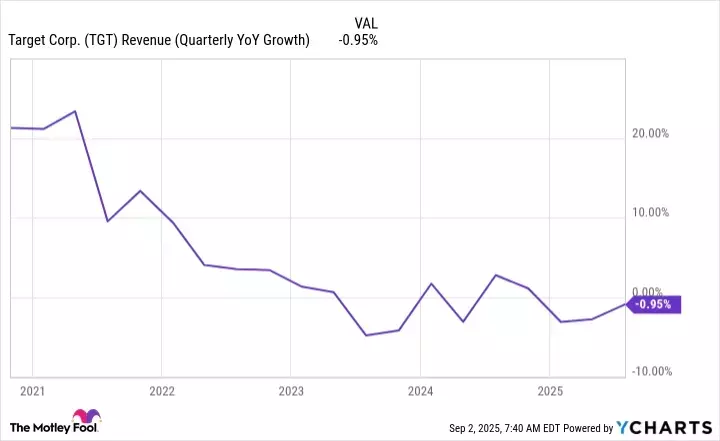

Target Corporation, a prominent retail entity, is navigating a period of significant transition and financial reevaluation. The recent announcement of Michael Fiddelke's appointment as the new Chief Executive Officer, taking over from Brian Cornell in early 2026, has stirred considerable discussion among market participants. This internal promotion, rather than an external hire, has led to investor apprehension, reflecting a desire for more radical strategic shifts in response to the company's recent performance. The retail sector, generally, has faced formidable hurdles, including global trade disputes, rising operational costs, and a discernible contraction in consumer discretionary spending. These macroeconomic pressures have noticeably impacted Target's revenue streams, leading to a substantial drop in its market valuation. The question remains whether the new leadership can effectively steer the company through these turbulent waters, potentially leading to a reversal of fortunes or further challenges for its stock.
In a move that caught some observers off guard, Target unveiled its succession plan on August 20, announcing that Michael Fiddelke would assume the CEO role on February 1, 2026. Fiddelke, currently serving as Target's Chief Operating Officer, brings two decades of experience within the company to his new position. Outgoing CEO Brian Cornell, who will transition to the board of directors, expressed confidence in Fiddelke's ability to spearhead the company's revitalization efforts. However, the market's reaction was muted, with Target's stock experiencing a dip following the announcement. Many investors and analysts had anticipated a more aggressive, outside hire, akin to Starbucks' strategic recruitment of Brian Niccol from Chipotle Mexican Grill a year prior, which, despite its initial aim, has yet to fully transform the coffee giant's trajectory.
The underlying concern among investors regarding an internal appointment centers on the potential for a continuation of existing strategies that have not yielded desired results. Target's recent financial outcomes have been less than stellar, raising questions about the need for substantial operational changes. The challenge for Target, however, extends beyond internal management decisions. The broader economic landscape, characterized by inflationary pressures and elevated interest rates, has compelled consumers to scale back on non-essential purchases. This shift in consumer behavior has had a direct and adverse impact on many retailers, including Target, contributing to stagnant sales growth over the past couple of years.
For the quarter ending August 2, Target reported net sales of $25.2 billion, marking a 0.9% decrease compared to the previous year. Concurrently, rising costs contributed to a more than 19% decline in operating income, reaching $1.3 billion. The company projects a low-single-digit drop in top-line revenue for the full fiscal year, which concludes in January. Michael Fiddelke faces a daunting task, as many of Target's current challenges are rooted in external economic factors. Implementing significant, costly changes in such an environment could prove risky, making a more conservative approach focused on cost management potentially more prudent. The company's resilience in navigating these economic headwinds will be crucial.
While Target is undeniably facing a demanding period, it is important to recognize that the core business model is not inherently flawed. The surge in sales experienced during the pandemic, fueled by increased consumer spending power, serves as a testament to its underlying strength. The current downturn reflects a natural market adjustment as economic conditions normalize. For those with a long-term investment horizon, Target's stock, currently trading at an attractive price-to-earnings multiple of 11—significantly lower than the S&P 500's average of 25—may present a compelling opportunity. Although a short-term recovery is uncertain, the company's appealing 4.7% dividend yield offers a valuable incentive for patient investors as the market awaits a potential turnaround.
